

#BR99 marked the first time Bleacher Report’s digital voice took physical form, an experimental sports culture pop up on 79 Greene Street developed in partnership with Ronnie Fieg and Kith that allowed the brand to leave the screen and meet people where culture actually happens. As design lead, I shaped the experience from first impression to final interaction, making sure every touchpoint carried B/R’s culture-first voice while staying clear, participatory, and unmistakably New York, and supported by a Social Customization Lab where visitors generated personalized sports memes in real time, effectively turning our viral Instagram language into a tactile, co created artifact fans could take home. My role spanned spatial graphics, environmental branding, wayfinding, and content systems that allowed live outputs from the lab to feed social channels, creating a feedback loop between the physical installation and our millions of digital followers. We curated artwork that celebrated the intersection of sport, music, and city identity, designed lounge zones that encouraged dwell time and community, and integrated Kith Treats’ first Manhattan outpost as both an amenity and a cultural signal, reinforcing the crossover between lifestyle retail and fandom. Over eight days the pop up welcomed more than 6,200 visitors and drove nearly 45 million social engagements, with coverage across GQ, Vogue, and Hypebeast validating the experiment as more than a retail activation but a proof of concept for Bleacher Report as an experiential brand. For me, the project was a defining moment in understanding how design can choreograph behavior, translate a media brand into material form, and create spaces where fans do not simply consume culture but actively produce and share it.

.jpg)
"This is about New York. This is about Brooklyn. Queens. The Bronx. Harlem. Staten Island." - A$AP FERG ON #BR99
Launching the Kith x B/R pop up with The Madbury Club required us to translate a digital native brand into a physical environment without losing the immediacy, wit, and cultural fluency that defined Bleacher Report online. Media companies rarely step into brick and mortar in a meaningful way, yet the opportunity was obvious. Fans no longer wanted a one way relationship with the brands they followed on their phones. They wanted proximity, participation, and proof that the culture they engaged with daily had weight in the real world. #BR99 became our answer, an eight day retail and exhibition experience on 79 Greene Street designed to collapse the distance between sport, streetwear, and media. The name itself carried layered intent. The “99” referenced iconic jersey numbers worn by legends like Wayne Gretzky and Warren Sapp, while also evoking the visual language of corner store pricing, grounding the concept in New York retail vernacular. Kith brought its design authority and capsule discipline, while B/R contributed the social voice of sports, resulting in an exclusive Fourth of July collection, a multi floor exhibition, and programming that felt equally native to SoHo, sports bars, and Instagram feeds. Every touchpoint, from signage and wayfinding to merch displays and lounge areas, was designed to feel like a living extension of the brand rather than a themed installation. As design lead, my focus centered on the Media Lab, a participatory engine that transformed our most viral social formats into personal artifacts. Fans could step into the content they had only consumed on their feeds, inserting themselves into meme templates, highlight frames, and social graphics to create bespoke keepsakes that were printed on site and instantly shareable. This was not a gimmick. It was a new model for fan engagement that turned passive viewers into co creators and gave them a physical memento tied to their digital identity. I worked closely with cross functional teams to ensure the interface, print outputs, and visual treatments matched our social design language so the experience felt seamless across physical and digital channels. The lab became a magnet within the space, generating lines, social amplification, and a steady stream of user generated content that extended the life of the activation far beyond the storefront. Beyond the lab, the pop up functioned as a cultural hub. Panels, artist features, and curated artwork reinforced B/R’s role as a convener of sports, music, and design, while Kith Treats’ first Manhattan location added a hospitality layer that encouraged lingering. The environment was designed for flow, discovery, and documentation. Fans moved from merchandise to customization to lounge to content capture, each step engineered to create moments worth sharing. Fun fact: the 79 Greene Street space that housed the BR99 pop up has since been transformed into a Loewe flagship, a reminder of how that corner of SoHo continues to evolve as a global stage for culture, fashion, and brand storytelling.


.jpg)


In the summer of 2016, when SoHo still felt like the epicenter of the collision between streetwear, art, and downtown mythology, Bleacher Report stepped off the screen and into the physical world with #BR99, an eight day pop up at 79 Greene Street created in partnership with Ronnie Fieg and Kith. This was not a merch table disguised as a retail moment. It was a full scale cultural installation that translated a digital sports media brand into a tactile, walkable experience. At a time when most media companies were doubling down on clicks and pre roll, we chose to build a space you could hear, touch, photograph, and inhabit. The concept was simple and ambitious at once. Take the energy that lived in our social feeds, the memes, the commentary, the athlete moments, the late night group chat debates, and give it a physical address in New York City, the global capital of sport, fashion, and attitude. In the years that followed, I saw echoes of BR99 everywhere: media brands launching pop ups, teams building lifestyle capsules, tech platforms experimenting with physical activations that blurred content and commerce. What felt scrappy and experimental in 2016 revealed itself as an early signal of a broader shift in how audiences relate to brands and how experiential pop up shops and events would become a marketing norm.
%20(1).jpg)
The name BR99 carried layered meaning that anchored the project in both nostalgia and street level accessibility. Ninety nine evoked the golden era of sports jerseys, the oversized silhouettes and double stitched numbers worn by icons from Wayne Gretzky to Warren Sapp, while also nodding to the democratic price language of the bodega, where .99 signaled everyday access and neighborhood ritual. Inside, the space fused Kith’s refined retail sensibility with Bleacher Report’s culture first voice. Black floors, white fixtures, and athletic green accents framed collaborative apparel, a social customization lab, curated artwork, nightly panels, and the first Manhattan outpost of Kith Treats. The result was equal parts gallery, locker room, newsroom, and clubhouse, a place where a teenager from Queens, a stylist from Tokyo, and a brand director from LA could stand shoulder to shoulder and argue about sneakers, playoff seeding, or who really runs New York.
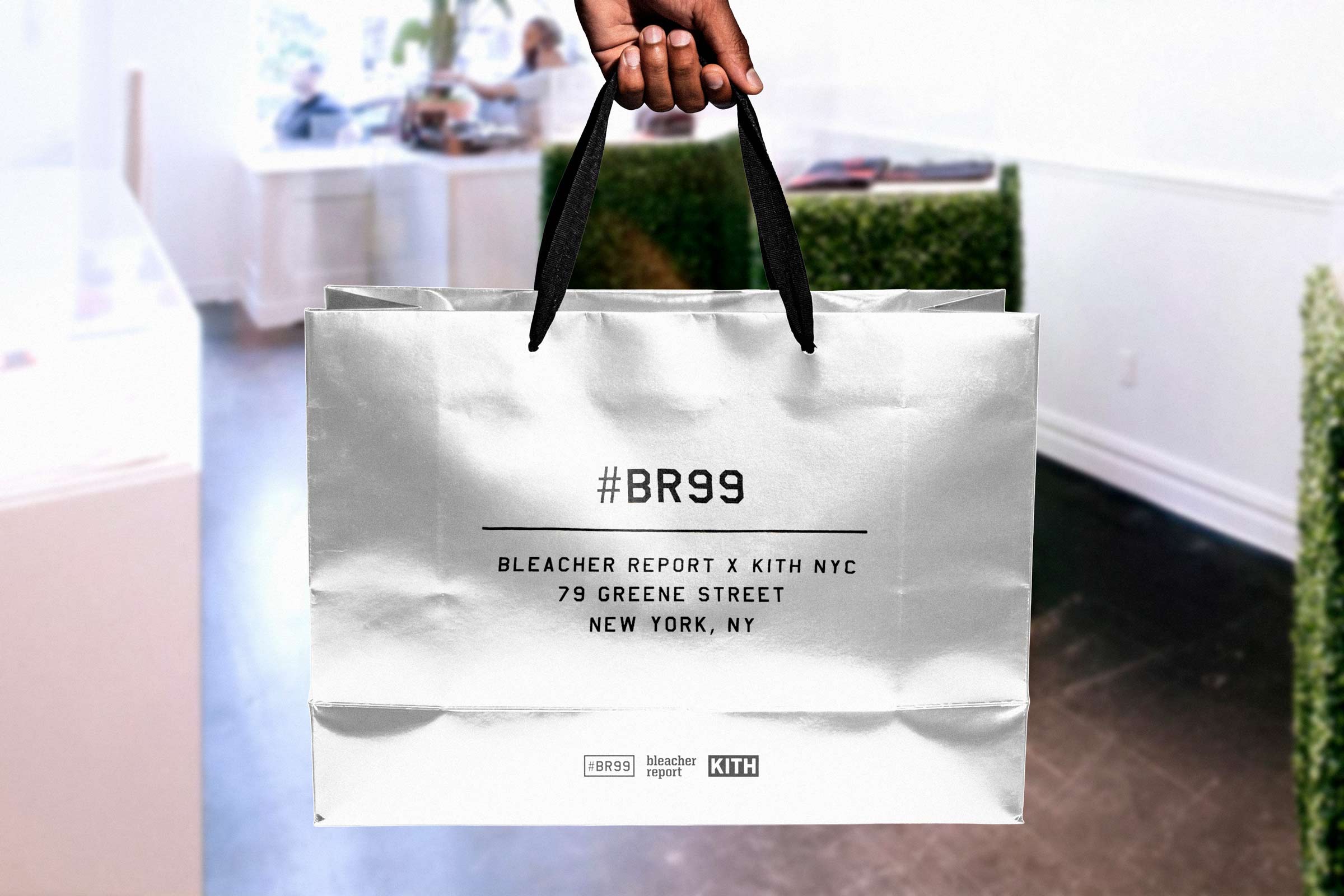
At a high level, #BR99 marked Bleacher Report’s first true foray into experiential retail and signaled a broader strategic shift from being a destination people visited on their phones to a brand they could physically enter and participate in. Over eight days, more than six thousand visitors moved through the space, generating tens of millions of social impressions and coverage from outlets like PorHomme, Time Out, and Hypebeast, but the real success was less about foot traffic and more about proof of concept. We demonstrated that a sports media brand could operate like a cultural platform, that fandom could be activated through environment and design, and that the line between content, commerce, and community was far thinner than the industry had assumed. It set the tone for everything that followed, showing that Bleacher Report was not confined to the feed. It could occupy the street, the store, and the imagination of the fans who had built it with us.

As design lead, I owned the translation layer between Bleacher Report’s digital voice and a physical environment that had to function like a real retail business, a live content studio, and a cultural venue simultaneously. That meant defining the experiential brand system, mapping the end to end guest journey, and designing the on site visual language across environmental graphics, wayfinding, merch presentation, and interactive touchpoints.

I partnered tightly with Kith’s team, The Madbury Club, and Game Seven to align on creative intent, then carried that through production with fabricators, print vendors, and our internal content team to ensure the space behaved like B/R, not like a themed pop up wearing B/R clothes. We built BR99 around a small set of experience principles that acted like a design system for behavior. Make it instantly legible from the sidewalk. Make it participatory, not observational. Make it modular so the space could shift from daytime retail to nighttime programming without losing cohesion. Make it camera ready without becoming a set. Those principles guided decisions from sightlines and signage hierarchy to where we placed “shareable” moments, how we controlled visual noise, and how we created frictionless paths between product discovery, customization, lounge dwell time, and content capture. I sat at the intersection of cross functional collaboration between our internal teams and creative partners.
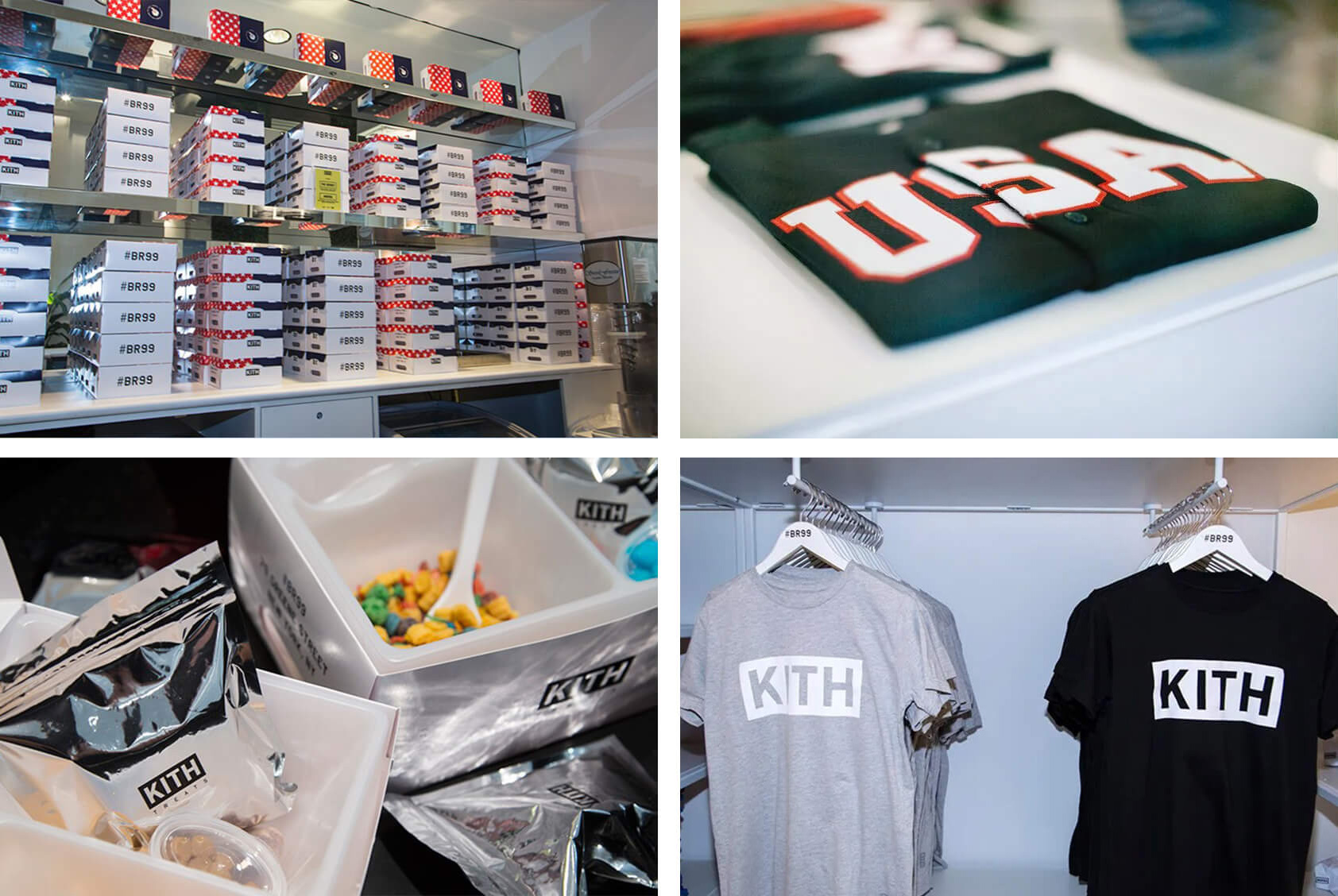
BR99 proved that the future of sports media brands is not confined to publishing. It lives at the intersection of content, commerce, and community, where the brand behaves like a platform people can enter. By materializing B/R’s voice into a physical environment and giving fans tools to co create, we shifted the relationship from audience to membership. That shift is the strategic value. When a brand becomes a place, even temporarily, it earns a different kind of loyalty, one built on memory, proximity, and participation. For me, this project sharpened a core belief that has shaped my leadership since. Design is not only aesthetics. It is choreography. It dictates how people move, what they notice, what they share, and how they feel included. BR99 was a crash course in building systems that operate across mediums, environmental design, product thinking, content pipelines, and cultural strategy, all under real world constraints. It was the moment I saw, in public, that a digital brand can become physical without losing its soul, if the design is rooted in behavior, not decoration. This was both a statement and a pilot project for our company.

79 Greene is not neutral real estate, it is a high intent stage where retail either performs or gets exposed. SoHo is a ruthless distribution channel with physical consequences, where foot traffic is discerning, cameras are always on, and adjacency communicates status. Planting BR99 there signaled ambition, because the neighborhood is dense with global fashion flagships, high velocity streetwear, and a rotating cast of limited run activations that train people to show up for moments. The block level context matters because it shapes expectation: visitors arrive primed for drop mechanics, merch discipline, and a clean visual language that does not tolerate clutter. Within a short radius you have the ecosystem that defines modern cultural retail, luxury houses with gallery level merchandising and streetwear institutions that have turned lines into theater. That adjacency raised the bar on materiality, lighting, typography, and spatial restraint, because SoHo punishes anything that feels like a mall takeover. It also amplified the narrative, because a sports media brand holding space in that corridor reads like a category expansion, not a collaboration gimmick. In practice, the location forced us to design with retail rigor and editorial clarity, ensuring every touchpoint earned its place in the visual field. It made the pop up legible as a real store, a real studio, and a real cultural node, all at once. Strategically, the address itself functioned like a brand credential, because in New York, where you show up is part of what you are.

#BR99 was positioned as Bleacher Report’s first true translation of digital cultural authority into a physical, members-club-meets-arena retail environment, designed to test whether a media brand could become a lifestyle destination. The concept fused exclusivity, sport heritage, and streetwear credibility by partnering with KITH and situating the experience in a 4,000-square-foot SoHo townhouse that blended Hamptons estate cues with minimalist basketball arena aesthetics. The strategy was not simply to sell product but to create a layered ecosystem: limited capsule collections, live screen-printing, a Social Customization Lab, invite-only lounge access, and cultural programming that brought athletes, creatives, and fans into the same orbit. By anchoring the activation in exclusivity and participation rather than passive consumption, #BR99 reframed Bleacher Report from a publisher into a curator of experiences where sport, fashion, and community converged. The “private club” visual language and country-club crest motifs reinforced a sense of membership and belonging, while the .99 naming convention nodded to both jersey numerology and bodega pricing, grounding the concept in everyday fan culture and the type of energy any sports fan would enjoy.

Strategically, the pop-up functioned as a prototype for how B/R could monetize fandom beyond advertising by turning cultural proximity into tangible experiences, limited goods, and social capital, proving that the future of sports media would belong to brands that do not merely report from the sidelines but build spaces where fans can step onto the court themselves. The design language for #BR99 was intentionally calibrated to sit at the intersection of heritage sport and downtown retail minimalism, creating an environment that felt both exclusive and familiar to fans who grew up idolizing jerseys and storefronts in equal measure. The palette leaned on a disciplined foundation of black, white, and deep neutrals, allowing product and cultural artifacts to take center stage, while strategic hits of athletic green and varsity yellow nodded to arena seating, scoreboards, and vintage gym floors. Materials played a critical role in reinforcing this tension between polish and grit: matte finishes against glossy acrylic, industrial metals paired with warm woods, and gallery-style lighting that elevated jerseys and memorabilia to the status of contemporary art. The result was a space that felt less like a store and more like a clubhouse for a new kind of fan, one who moves fluidly between sport, fashion, and culture.
.png)
Typography carried equal weight in shaping the tone of the experience. The system drew from collegiate and athletic vernacular without slipping into nostalgia, using bold, condensed sans serifs and varsity-inspired letterforms that communicated strength, immediacy, and team identity at scale. Oversized wayfinding and wall graphics echoed locker room signage and arena banners, while smaller typographic moments, such as product tags and customization interfaces, were treated with a restrained editorial sensibility that aligned with KITH’s retail precision. This balance allowed the space to feel rooted in sport while maintaining the clarity and sophistication expected of a modern New York concept store. Together, the palette and typography formed a cohesive visual language that signaled credibility to sneaker heads, hoop fans, and design-conscious visitors alike, reinforcing Bleacher Report’s evolution from digital voice to cultural tastemaker. Visually, we calibrated the brand system to sit between heritage sport and downtown retail minimalism. A controlled palette and high contrast typographic architecture kept the space clean enough for product and people to be the content. Sport codes lived in the density and confidence of the letterforms, the jersey numerology, and the banner like scale of key moments, while Kith level retail rigor showed up in alignment, negative space, and material restraint. This balance mattered because SoHo punishes anything that feels loud without taste. We made B/R feel elevated without sanding off its edge and fitting right into a tough neighborhood with some heavy hitters.

There was a subtle Hamptons inflection woven into the experience that elevated the space from streetwear pop up to something that felt seasonally aspirational and quietly luxurious. Crisp whites, sun-faded neutrals, and airy negative space evoked the breezy restraint of summer houses in Montauk and Amagansett, while premium finishes and thoughtful merchandising echoed the ease of coastal living where quality speaks louder than excess. This influence softened the harder edges of sports industrialism and downtown grit, introducing a sense of refinement that made the environment feel comfortable to linger in, like a gallery stop on a long July weekend. The effect was intentional: to position Bleacher Report and its collaborators not only within the energy of the city but within a broader lifestyle context, one that signaled to fans and consumers that sports culture could live comfortably alongside luxury, leisure, and the rituals of a well lived summer.

There was also a deliberate country club sensibility threaded through the environment, a visual language rooted in heritage sport and quiet prestige. Think manicured greens, crisp whites, navy accents, and materials that felt timeless rather than trendy. This aesthetic nodded to tennis lawns, golf courses, and locker rooms where tradition and ritual carry as much weight as performance. By referencing that world, the space subtly reframed sports culture through a lens of legacy and belonging, suggesting that fandom is not only loud arenas and highlight reels but also lineage, etiquette, and the social rituals that surround the game. This influence created a compelling tension with the streetwear and hip hop energy at the core of the project. Varsity typography met tailored presentation. Hardwood nostalgia sat alongside polished fixtures. The result felt like a recontextualization of access, where the codes of exclusivity were remixed and opened to a broader audience. In that collision, the brand articulated something powerful: that modern sports culture moves fluidly between pickup courts and private clubs, between asphalt and fairway, and that Bleacher Report sits comfortably at that intersection, translating tradition into something contemporary, democratic, and culturally alive.

The current wave of preppy streetwear sits at a fascinating intersection where heritage codes meet downtown irreverence, and few brands illustrate that synthesis better than Ralph Lauren, Aimé Leon Dore, Kith, and even JW Anderson in his more sport-inflected moments. What once signified Ivy League privilege has been recontextualized through a multicultural urban lens, transforming oxford shirts, rugby knits, loafers, and tailored outerwear into signifiers of taste rather than status. Ralph Lauren laid the foundation by mythologizing the American country club dream, while Aimé Leon Dore reframed that narrative through Queens nostalgia, café culture, and basketball courts, grounding prep in lived experience. Kith pushed the aesthetic into global retail spectacle, blending Hamptons polish with sneaker culture and luxury collaborations, proving that refinement and hype can coexist. Meanwhile, designers like JW Anderson destabilize tradition through proportion, material play, and gender fluidity, reminding us that prep is not static but a living vocabulary. Together, these forces reflect a broader cultural shift toward quiet luxury, material integrity, and storytelling through garments, where the new preppy is less about belonging to an institution and more about curating an identity that moves seamlessly between sport, fashion, and city life.
.png)
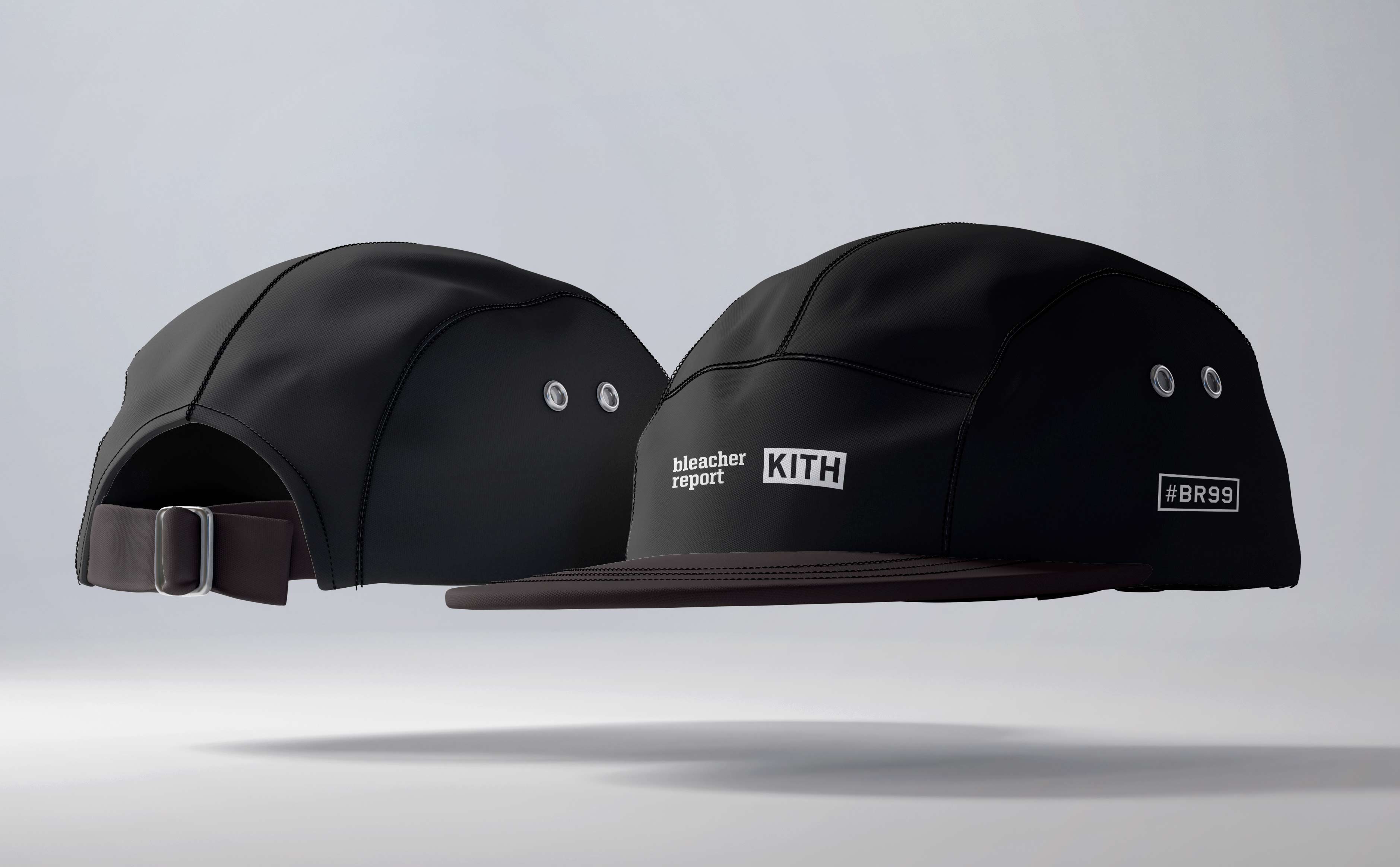
The Kith Independence Day capsule, released exclusively through the BR99 pop-up, functioned as more than a seasonal drop. It operated as a live prototype for the convergence of sports media, streetwear, and experiential retail into a single, time-bound cultural event. Rooted in the visual language of classic Americana yet rearticulated through Kith’s performance-driven materials and contemporary tailoring, the collection reframed patriotic color blocking across breathable mesh jerseys, micro-ripstop outerwear, and precision-embroidered New Era headwear. The system was intentionally modular: pieces could read as athletic kit, lifestyle uniform, or collectible artifact depending on context. This elasticity allowed the capsule to exist simultaneously on court, at backyard cookouts, and within the emerging grammar of downtown fit photography, positioning it as both apparel and visual signal. This collaboration was key in positioning Bleacher Report where we wanted to be in lifestyle and fashion.
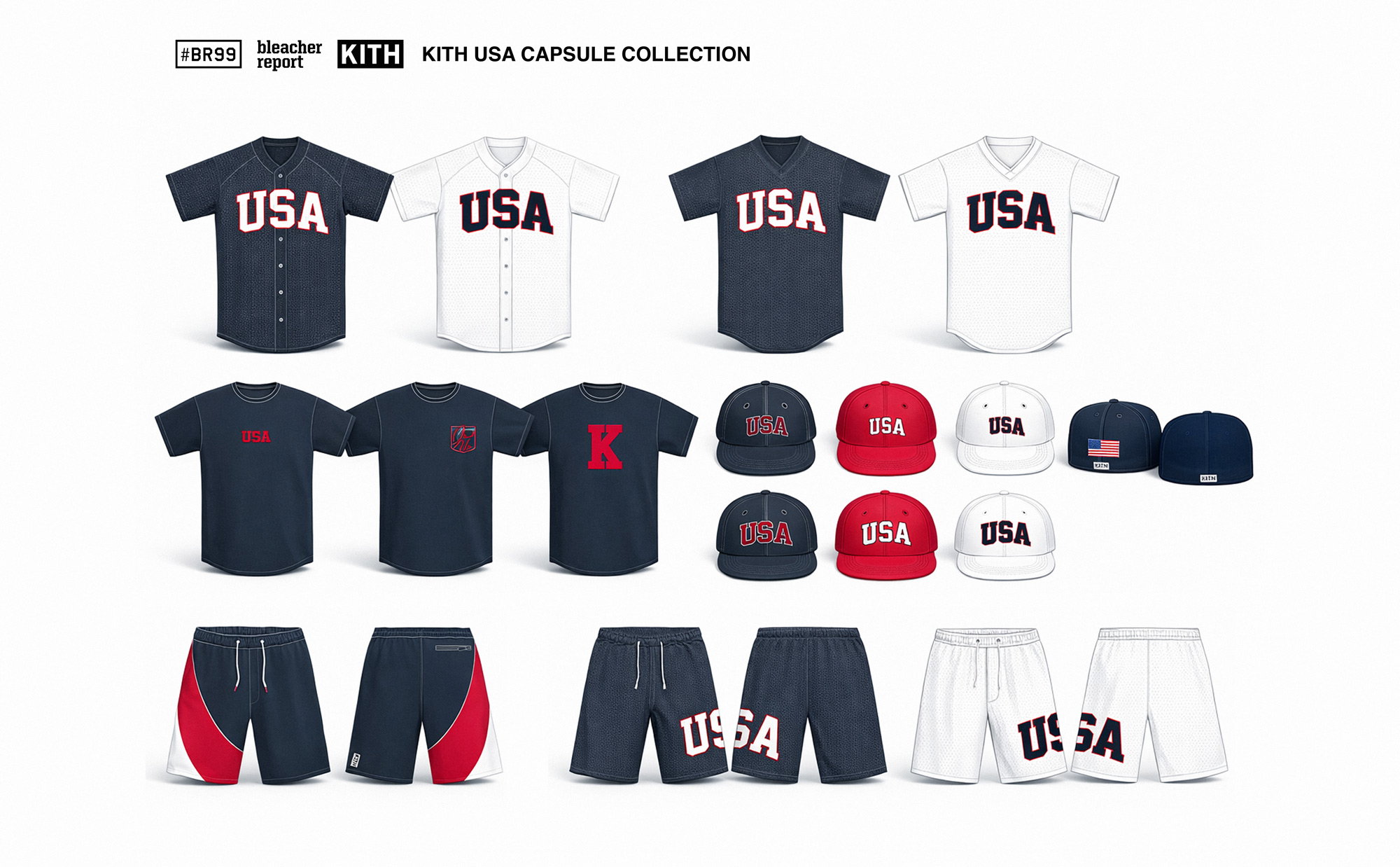
By anchoring the release to a physical environment co-conceived and activated by Bleacher Report, the capsule transcended product to become pilgrimage. The BR99 space functioned as a spatial interface where commerce, content, and community collapsed into a single feedback loop. Fans did not simply transact; they queued, documented, and broadcast their presence, transforming the drop into a participatory media event that mirrored sneaker culture’s ritualized cadence while extending it into sports media territory. In this context, the collection became proof that physical retail, when designed as a narrative platform, can convert audience into co-authors and momentary consumers into long-term cultural stakeholders who could appreciate both Kith and Bleacher Report.
.jpg)
What made the collection especially resonant was its alignment with drop culture’s core mechanics: scarcity, timing, and narrative. The limited availability, exclusive retail window, and tight integration with the BR99 environment created a sense of urgency that extended beyond commerce into identity signaling. Wearing a piece from the capsule was not only about style but about proximity to a moment, a way of saying you were there when sports fandom, streetwear, and media collapsed into one experience. In positioning BR99 as the launch platform, we effectively translated Bleacher Report’s digital authority into physical cultural capital, proving the brand could operate within the same hype economy that drives Kith, Supreme, and Aimé Leon Dore. It marked a shift from audience to community, from content consumption to cultural participation, and from media company to tastemaker with real influence on how and where fans choose to show up.
.jpg)
The capsule also tapped into a distinctly Hamptons-coded vision of Americana, where sport, leisure, art, and quiet decadence intersect along a sun-bleached coastline. Here, patriotism is less about spectacle and more about texture: weathered clapboard, sailcloth whites, navy awnings, and the ritual of seasonal sport from tennis lawns to pickup games on private courts. By translating that atmosphere into performance mesh, crisp appliqué lettering, and restrained red accents, the collection framed athletic wear as a form of coastal luxury, equally fluent in sweat and stillness. This is Americana as lived aesthetic rather than costume, where design mediates between effort and ease, and where the language of sport becomes a marker of taste, access, and cultural literacy. In this light, the garments function less as merchandise and more as artifacts of a lifestyle that treats movement, craft, and place as inseparable expressions of modern luxury.
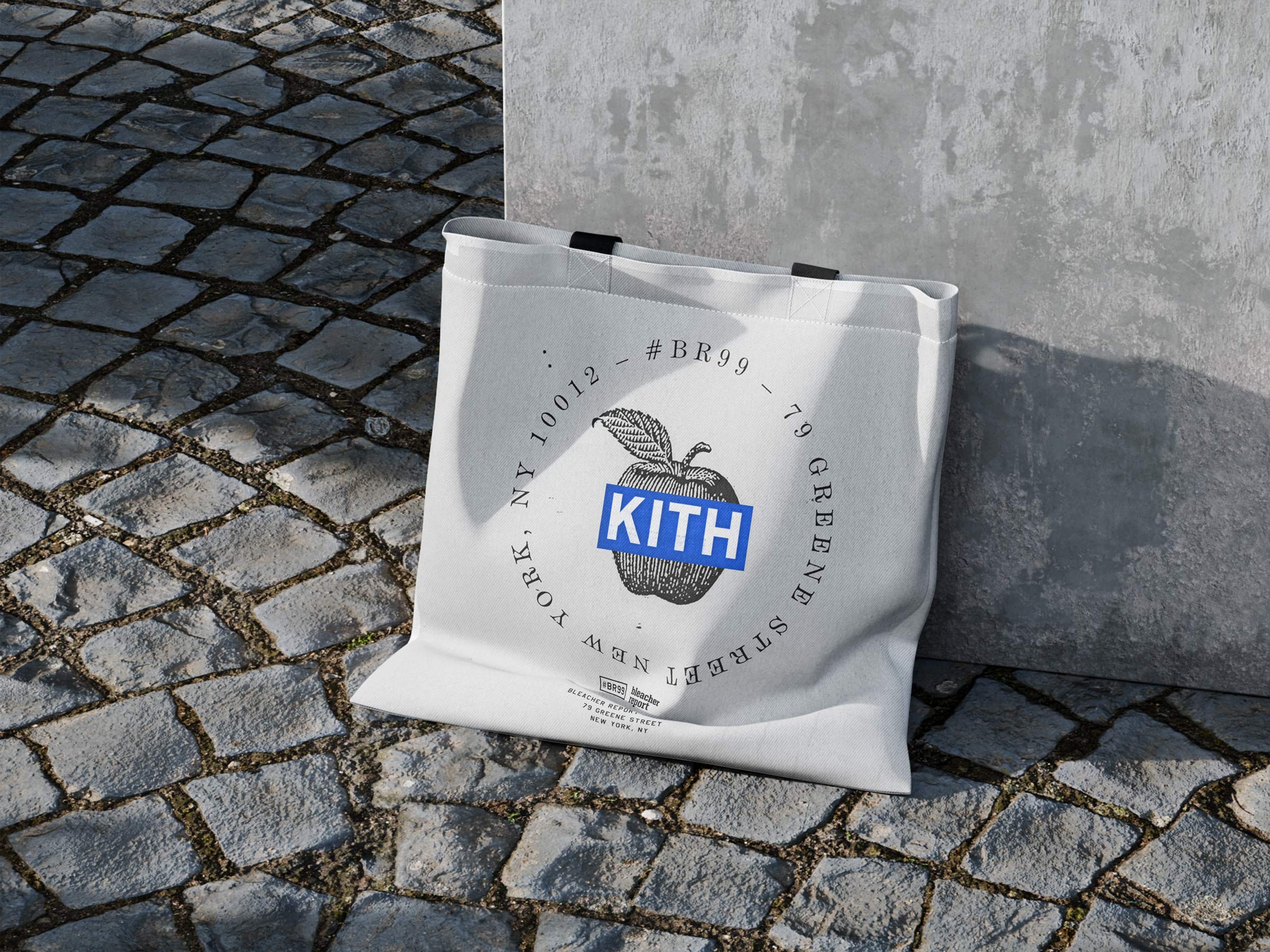
We were activating this kind of culture-first, retail-meets-media experience before events like ComplexCon mainstreamed the format, demonstrating early that sports fandom, streetwear, and experiential storytelling could coexist in a single, hype-driven physical space. The capsule itself embodied a rare blend of sport, luxury, and seasonal escapism, tapping into a Hamptons-adjacent summer fantasy where off-season athletes, creatives, and tastemakers drift between pool parties, rooftop lounges, and late-night city returns. Kith’s use of high-quality perforated mesh and lightweight performance fabrics elevated the garments beyond typical fan merch, giving them the breathability and drape of premium athletic wear while retaining the polish of lifestyle apparel. Subtle details like co-branded BR99 neck tags, refined stitching, and a restrained red-white-and-blue palette reinforced a sense of exclusivity that felt closer to a private club uniform than mass retail. The pieces moved easily between contexts, equally at home courtside, on a yacht deck, or layered over swim trunks at a sunset gathering. By positioning the collection within this aspirational summer narrative and releasing it through a tightly controlled drop, we helped frame BR99 not simply as merchandise but as a cultural artifact, a wearable signal of belonging at the intersection of sport, leisure, and luxury.

Summer 2016 was the perfect window because the city and the internet were synced in the same tempo, and sports culture was basically running the streets like a soundtrack. It was “Controlla” on repeat, it was Slide season, it was Migos ad libs leaking out of every black car, and it was that specific pre election, pre everything feeling where New York still felt like the center of the universe at night. Basketball had narrative gravity everywhere you looked: the Warriors were the spectacle machine, the Finals had everyone arguing like it was politics, and Kobe’s exit still hung in the air like the end of an era, making every jersey and highlight feel a little more mythic. Streetwear was peaking in real world ritual, lines were content, receipts were flex, and SoHo was a living feed where the sidewalk decided what mattered before any publication did. That context made BR99 feel inevitable because we weren’t trying to manufacture hype, we were building a physical interface for a moment that was already overheating. The pop up worked because it matched the season’s behavior: people wanted to be outside, be seen, argue sports, cop something limited, post proof, then move to the next spot like the night was a loop. If you wanted to translate Bleacher Report’s digital voice into a real place, summer 16 was the cheat code because the culture was already in motion.
.jpg)
BR99 was engineered as a full stack brand translation, taking Bleacher Report’s digital native cadence and instantiating it as a physical operating system for fandom, commerce, and content. We treated the pop up as a live prototype for what a media brand becomes when it behaves like a platform you can enter, not a publication you scroll. The experience architecture balanced three concurrent modes: retail throughput, social output, and community dwell time, all under one roof. Every zone was designed with an explicit job to be done, from immediate product clarity on entry to participatory capture in the lab to decompression and programming upstairs. The goal was to collapse the distance between audience and brand by making B R feel legible from the sidewalk and alive once you crossed the threshold. We intentionally built a feedback loop where the space generated artifacts, and those artifacts generated distribution, and that distribution generated foot traffic. That loop became the growth mechanic, turning square footage into amplification and visitors into media. The activation was a proof point that Bleacher Report could operate credibly in a luxury adjacent retail corridor without reading as a media tourist. In portfolio terms, it’s a case study in systems design across physical, digital, and cultural layers, where the environment itself behaves like the product. People no longer wanted to be marketed to. They wanted environments they could enter, document, and co-author. BR99 proved that a sports media company could operate as a cultural host, not just a publisher, and that insight shaped how I approached every subsequent project: design as a tool for participation, not presentation.
.jpg)
Partnering with The Madbury Club positioned the BR99 pop-up at the intersection of strategy, youth culture, and brand innovation. Madbury operated less like a traditional agency and more like a cultural intelligence collective, translating emerging behaviors across fashion, sports, tech, and media into experiences that felt native rather than manufactured. Their work centered on community insight, trend fluency, and experiential storytelling, making them an ideal collaborator for a project designed to move Bleacher Report from a digital publisher into a physical cultural presence. At a time when most media companies were still optimizing for impressions and pageviews, this collaboration reflected a deeper commitment to understanding audience identity and participation. Their influence helped ensure BR99 resonated with downtown New York streetwear culture instead of reading like a corporate activation, grounding the space in authenticity and giving B/R credibility in rooms it had not previously occupied.

We also partnered closely with Game Seven Marketing to bring the experiential dimension of BR99 to life, translating the brand’s digital energy into a physical environment that felt immersive, intentional, and unmistakably Bleacher Report. Their expertise in sports-driven brand activations helped shape the spatial storytelling, from the flow between floors to the integration of retail, customization, and community programming. Together, we built an environment that balanced gallery-like restraint with locker-room authenticity, allowing curated artwork, product displays, and interactive stations to coexist without visual noise. The collaboration ensured that every touchpoint, from signage and wayfinding to lighting and material finishes, reinforced the same culture-first ethos that defined B/R online. The result was not simply a pop-up store but a living brand experience, one that allowed fans to step inside the world we had built on their phones and feel, in real space, what it meant to be part of the culture we were shaping.

At that moment in its trajectory, Kith occupied a rare position in the culture, a brand equally fluent in luxury fabrication, streetwear credibility, and retail theater, with Ronnie Fieg operating less like a traditional designer and more like a cultural orchestrator. His ability to merge premium materials, precise color storytelling, and tightly controlled drops had already cultivated a devoted following that treated each release as an event rather than a transaction. Partnering with Bleacher Report made intuitive sense because both brands were rooted in the same intersection of sport, style, and narrative, speaking to an audience that saw jerseys as heirlooms and sneakers as identity markers. The collaboration allowed Kith to extend its language into sports media while giving B/R a tangible expression of its culture-first ethos, setting the stage for the brand’s future collaborations across performance footwear and team uniforms. In many ways, this partnership foreshadowed the path Kith would continue to chart, moving fluidly between athlete collaborations, league partnerships, and lifestyle capsules while maintaining the tight storytelling and experiential rigor that defined its rise.
Partnership was a design amplifaction as we had fertile ground and tools to play with. Kith brought retail authority and capsule discipline. Madbury brought cultural strategy and community intuition. Game Seven brought experiential execution muscle. Bleacher Report brought the audience, the social language, and the distribution engine. My job was to unify those inputs into one coherent experience so the collaboration did not feel like a logo stack. Every decision had to reinforce a single story: B/R is not only reporting on culture, it can convene it, package it, and let fans participate in it. On Greene Street, the line itself became the loudest form of media we had.
We measured success across three layers. Retail performance and operational throughput, which validated that the space could function as a legitimate store. Engagement performance, which validated that the experience could generate scalable social amplification. Brand perception, which validated that B/R could show up in fashion and culture contexts without feeling like a media tourist. The press coverage was useful as external validation, but the real KPI was behavior. Lines, raw time spent in store, repeat visits, volume of user generated content, and the density of “I was there” social proof that turned the activation into a cultural reference point rather than a one off stunt. One of the biggest unanswered questions going into BR99 was whether a brand born on screens could credibly move product in real life, not through links and limited online drops but across a physical counter in one of the most scrutinized retail corridors in the world.
Digital engagement had always been our proof of affinity, but affinity does not automatically translate into wallet behavior when the friction of travel, time, and social risk enters the equation. We needed to know if fans would show up, queue, try things on, and part with cash in a space that asked them to stand behind their taste in public. The answer arrived loudly and without ambiguity. Product moved with the kind of velocity that reframed the question from “will they buy” to “how much capacity do we need next time,” as the line outside began functioning as both demand signal and social proof. People didn’t treat the merchandise as souvenirs; they treated it as cultural artifacts tied to a moment they had physically inhabited, which elevated perceived value far beyond typical event merch. That shift in perception was the real unlock, because it proved that when you collapse distance between brand, culture, and participation, purchase becomes a natural extension of belonging. Internally, that result removed hesitation around future experiential commerce and gave stakeholders a clear, observable answer: yes, this audience will transact offline when the environment earns their trust. What began as a hypothesis about physical retail viability ended as a bombastic confirmation that culture, when properly hosted, can carry commerce with it.
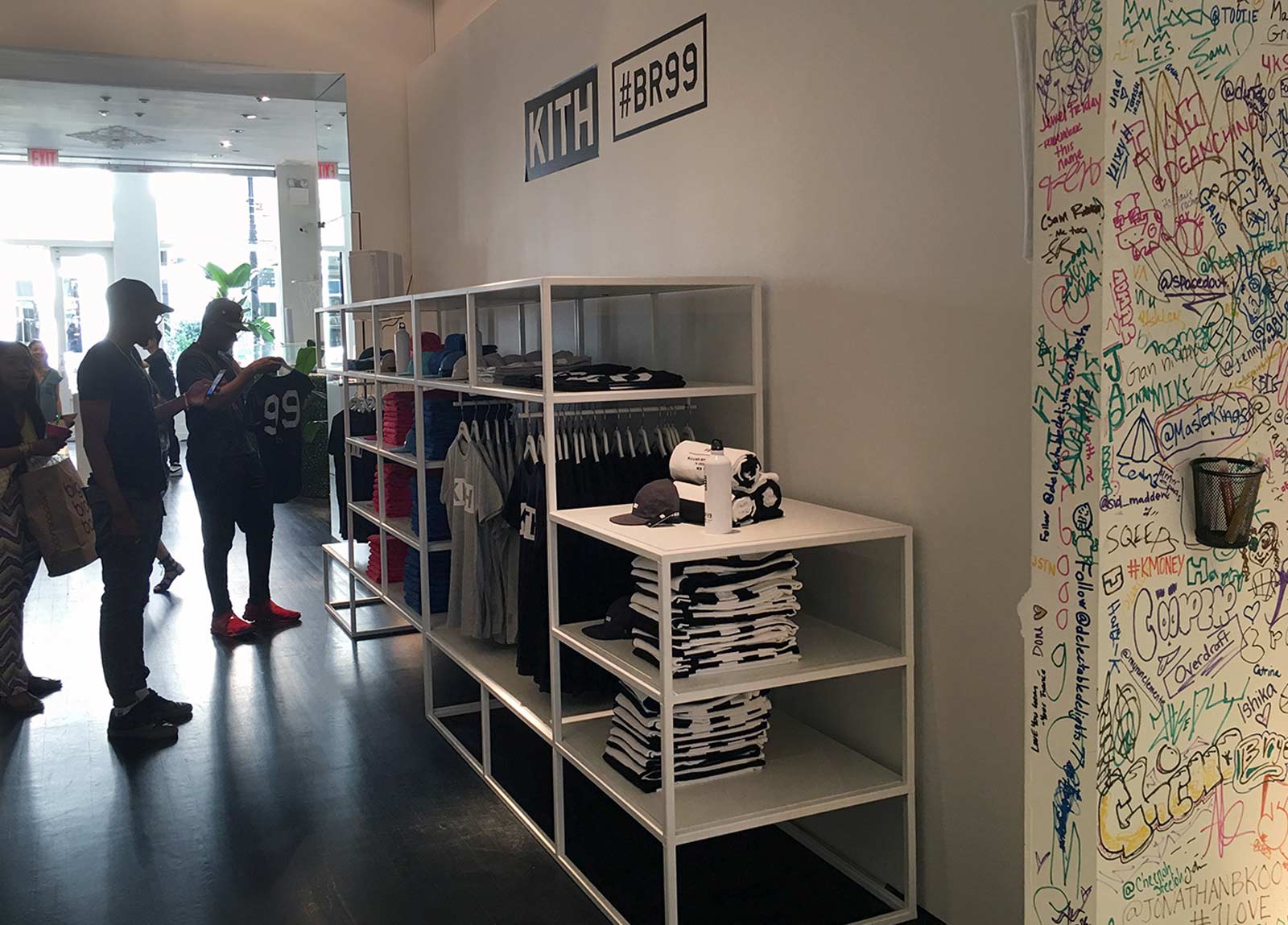
Retail was approached as cultural merchandising rather than inventory. We treated product as narrative artifacts that carried the identity of the moment, supported by a ladder of entry points from accessible objects to premium apparel. The assortment created a path for different audience types, the die hard B/R fan, the Kith loyalist, the curious tourist, the fashion and culture crowd, to all find a valid “takeaway” that extended the brand into daily life. We designed presentation and packaging cues to increase perceived value and collectability, so even small objects functioned like badges of belonging. A key unlock was treating the pop up as a live broadcast node. The physical space was not the end product. It was the source material. We designed content capture moments intentionally, then structured the system so outputs could feed directly into B/R channels and back into the space through screens and social proof. That feedback loop turned visitors into distributors and made the pop up feel bigger than its square footage. Every time someone created something in the lab, shared it, and tagged us, the brand expanded beyond Greene Street and recruited the next wave of foot traffic.
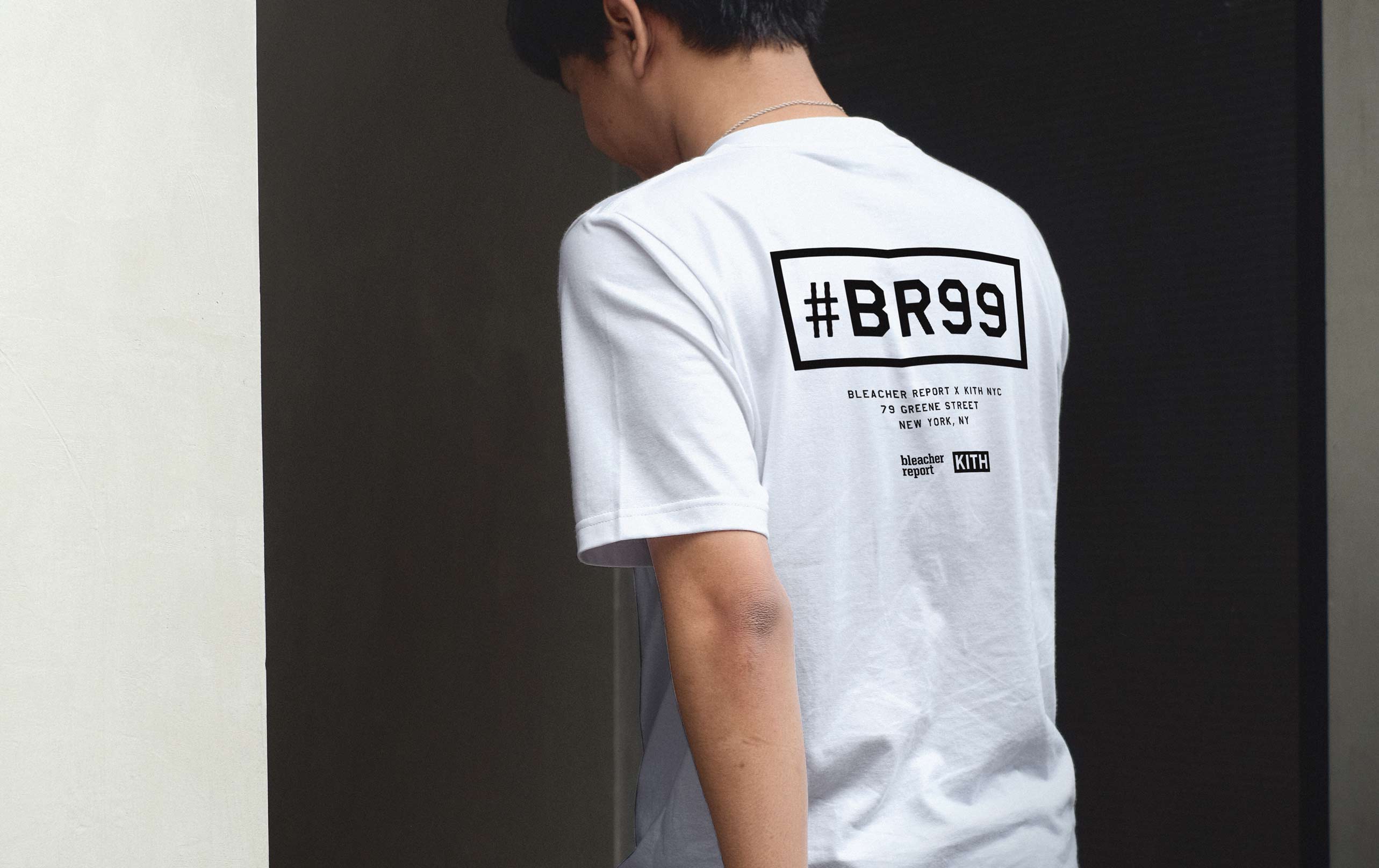
Once leadership saw that a physical activation could simultaneously drive revenue, produce content inventory, strengthen partner relationships, and grow audience, the format stopped being “an event” and became “a system” that could be repeated with different capsules, different cities, and different talent layers. That’s the strategic leap: it’s not about building a store, it’s about building a repeatable media commerce machine that converts cultural attention into tangible participation. BR99 proved that B/R could host the culture in real life and then re broadcast it through our channels with speed and authenticity. When you have that loop, you stop asking if experiential is worth it, and you start asking how often you can responsibly run it without diluting the signal. In hindsight, BR99 wasn’t the pop up, it was the operating model.

The retail space itself felt deliberately situated at the crossroads of luxury and street culture, tucked into SoHo’s cobblestone grid where BAPE camo sat a few doors down from the polished vitrines of Saint Laurent, Louis Vuitton, and Gucci, and where the quiet confidence of a Rolex window shared the same block as kids lining up for the latest drop. That placement was strategic. It positioned BR99 not as a novelty activation but as a legitimate player within one of the most competitive retail corridors in the world. Inside, the space carried the same tension as the neighborhood. Clean architectural lines and gallery-like displays gave the apparel room to breathe, while the hum of basketball highlights, social feeds, and customization stations kept the energy unmistakably rooted in sport and internet culture. Stepping off Greene Street and into the pop-up felt like crossing a membrane between two economies: the legacy luxury houses that defined aspiration for decades and a new wave of culture brands proving that fandom, storytelling, and community could command the same real estate and the same reverence. In SoHo, attention is earned at the curb, and that week, we held it.

he BR99 pop up was not simply retail, it operated like a cultural gallery where basketball was treated as subject matter worthy of fine art. Featuring the work of artists like John Margaritis of New York Sunshine, whose sculptural basketball installations elevate the sport into objects of reverence, the space invited fans to slow down and contemplate the game beyond highlights and box scores. Solomon’s pieces, with their cathedral-like presentation of hoops and backboards, reframed basketball as ritual and architecture, turning familiar forms into symbols of devotion. This curatorial layer signaled that Bleacher Report understood fandom as more than consumption. It is aesthetic, emotional, and communal. By placing art alongside apparel, memes, and media, the pop up created a continuum between street culture and gallery culture, allowing visitors to experience the sport as both lived experience and cultural artifact. It was less an event than a signal, one the culture recognized and answered in real time.
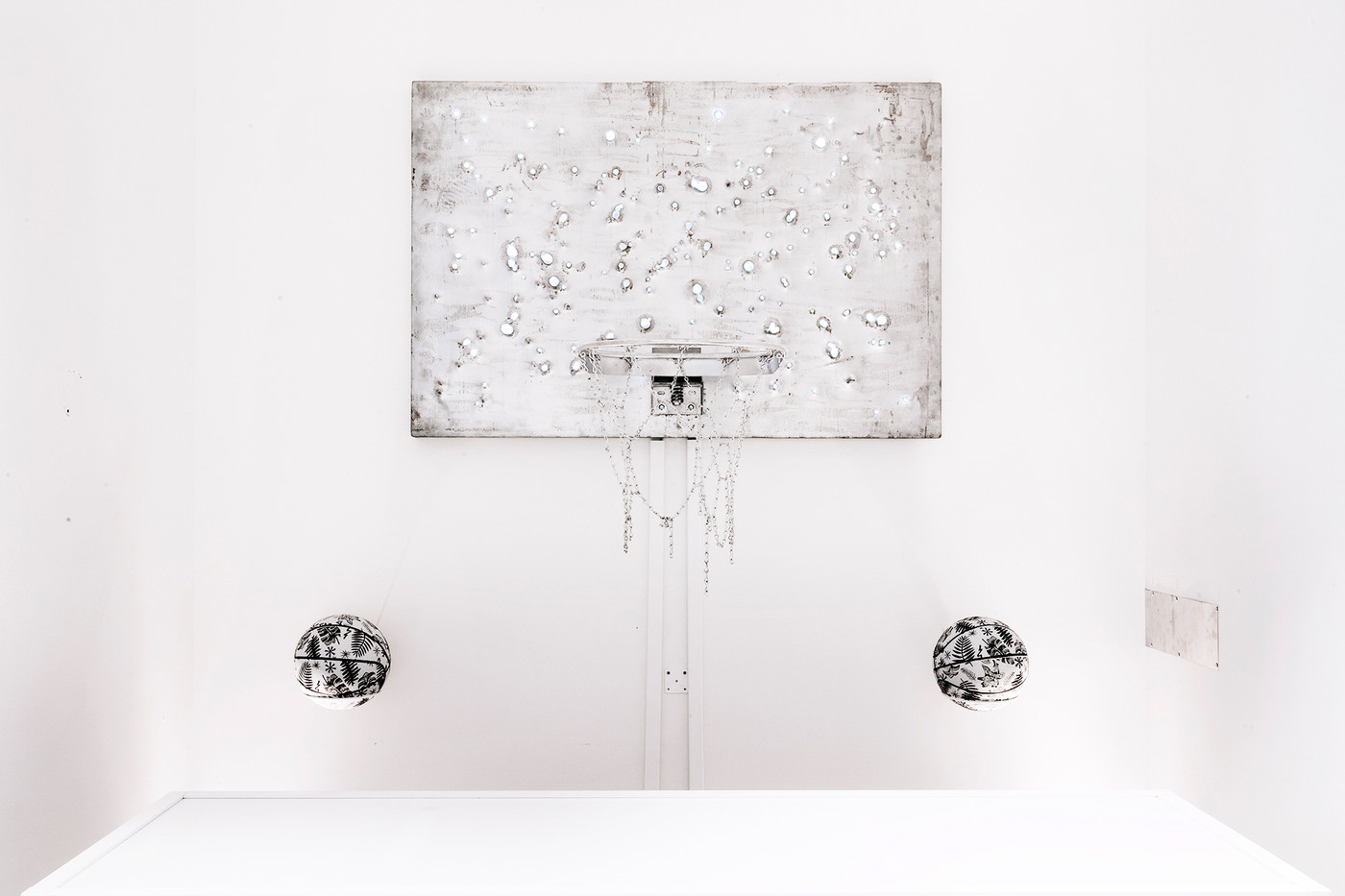
Sport and art share a common pursuit: the translation of human intention into form, rhythm, and memory. A perfectly timed swing, a clean line of typography, a jersey number arcing across mesh all operate within systems of proportion, balance, and tension that mirror the principles of composition. In this overlap, the athlete becomes a kinetic sculptor and the designer an orchestrator of movement, each shaping how bodies inhabit space and how moments are remembered. My own path from the early Posterizes art collective experiments of fandom to building visual systems at Basketball Forever and now shaping cultural touchpoints at Bleacher Report finds a clear throughline in this pop up, where years of translating sport into graphic language culminate in a physical space that lets people step inside the work. When uniforms, environments, and visual identities are treated as cultural canvases rather than mere utilities, sport transcends competition and enters the realm of aesthetic experience, where gesture, material, and symbol coalesce into a language that audiences do not just watch but feel and carry with them.

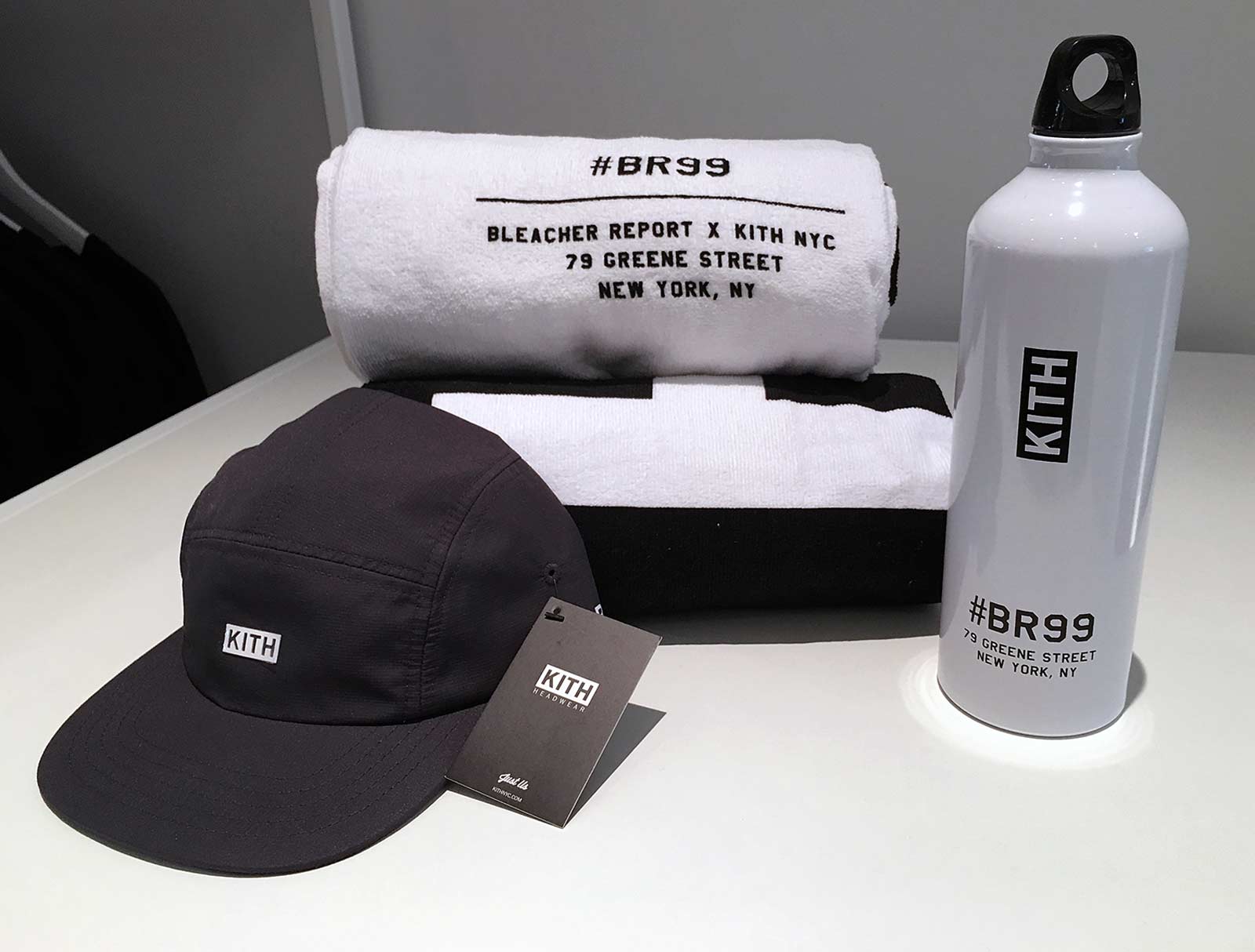
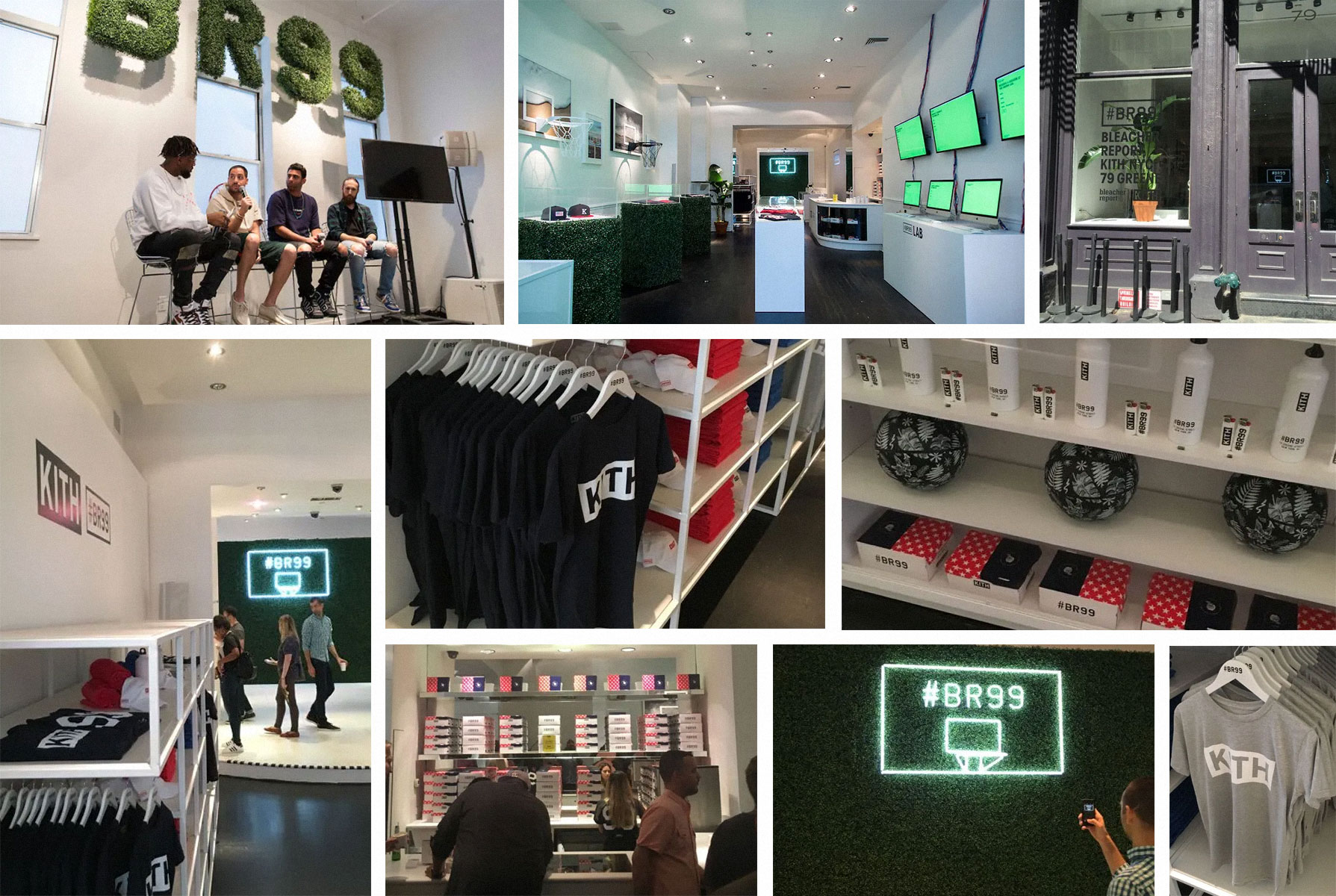
Merchandise at BR99 was treated as an extension of the story rather than an afterthought, with a tightly curated assortment that ranged from everyday objects like lighters and water bottles to premium apparel including the collaborative tees, caps, and mesh jerseys developed with Kith. The mix was intentional. Small, accessible items allowed fans to take a piece of the experience with them, while the higher-end garments carried the weight of the collaboration and the design language we had built for the space. Co-branded tags, custom packaging, and considered material choices made even the simplest objects feel collectible, reinforcing the idea that sports culture lives in the details people carry daily. Seeing someone refill a BR99 water bottle at the gym or flick open a branded lighter at a summer cookout extended the life of the pop up beyond SoHo, embedding the brand into real routines. The Kith pieces anchored the offering with their elevated fabrication and silhouette, but the full product ecosystem ensured there was an entry point for every fan, turning the retail floor into a tangible expression of Bleacher Report’s cultural reach.
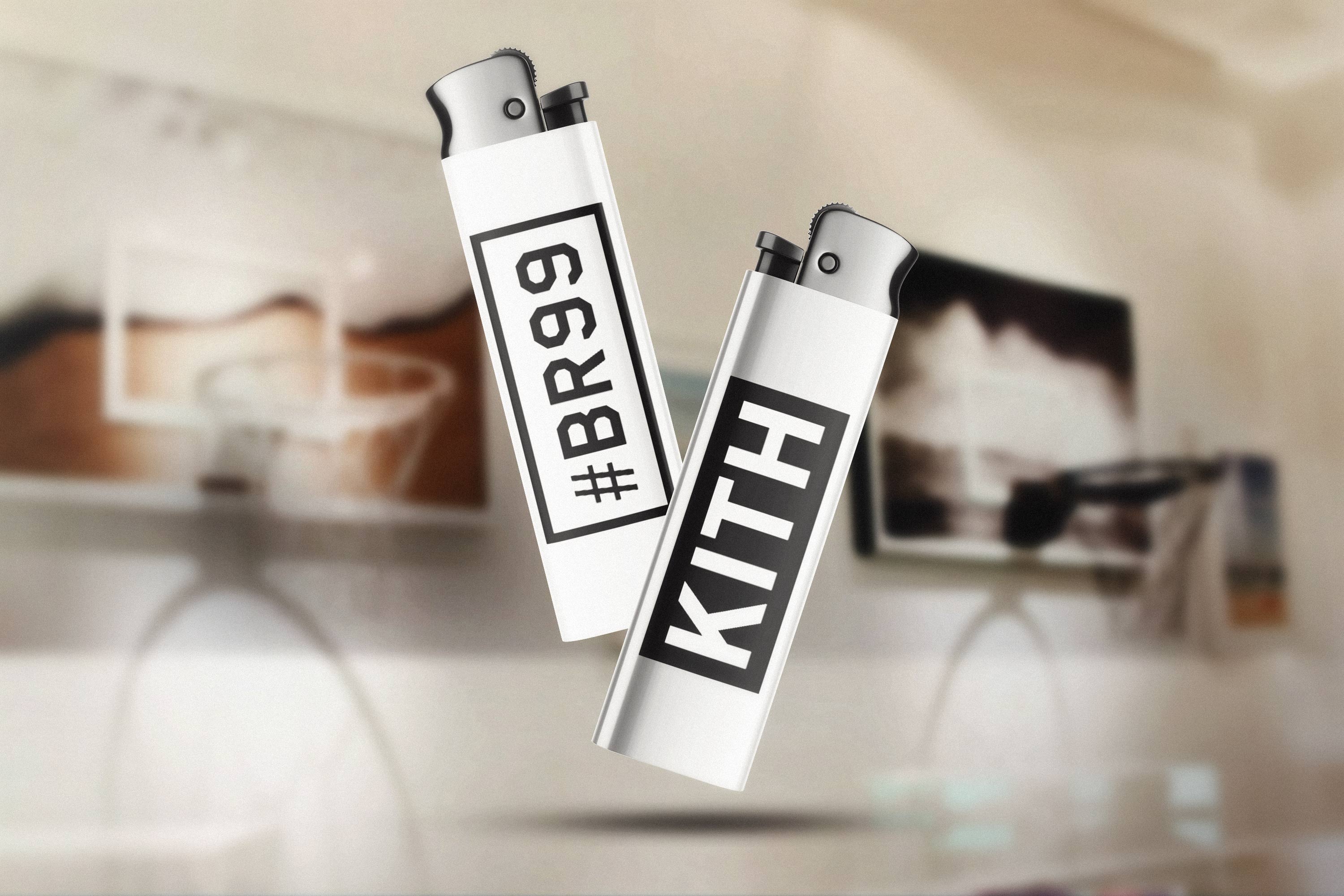
Looking back, what stays with me is not the names or the noise but the feeling that we were building something slightly ahead of its time and doing it with our friends in the middle of a city that rewards nerve. BR99 was a temporary address for an idea that media could be lived in, not only consumed, and for a few weeks that summer we watched strangers become regulars, regulars become collaborators, and a storefront become a signal people trusted. We were young enough to take the risk seriously and light enough to treat the outcome like a block party, which is a balance I hope I never lose. If my grandkids ever ask what that season meant, I’ll tell them it was proof that culture moves through people who show up, make something real, and leave the door open long enough for everyone else to walk in. A table of lighters, a crowded room, strangers becoming familiar faces by the end of the night. In that moment, the space stopped behaving like retail and started behaving like relevance. What we built didn’t interrupt culture, it gave it a place to gather. The sidewalk knew before the headlines did. It wasn’t about who walked in, but how the room rearranged itself when they did.

One of the most forward-thinking elements of BR99 was hosting the first ever Kith Treats concept, long before it became a staple of the brand’s retail footprint and a ritual stop inside Kith stores worldwide. At the time, it felt experimental and a little surreal: a sports media company and a streetwear label serving cereal, milk, and ice cream in the middle of SoHo, reframing retail as hospitality and turning a shopping trip into an experience you could taste. We were fully stocked, shelves lined with brightly colored cereal boxes that doubled as set dressing and cultural shorthand, freezers humming with ice cream, milk crates stacked like a bodega altar to nostalgia. It drew people in who might not have come for apparel alone and kept them lingering, talking, photographing, and posting. In hindsight, it previewed the future of lifestyle retail, where community, memory, and multisensory design matter as much as product. Watching fans sit on the bleachers with a bowl of cereal in hand, surrounded by jerseys and artwork, made it clear we were not building a pop up. We were prototyping a new kind of cultural space. What began as a test became a template.
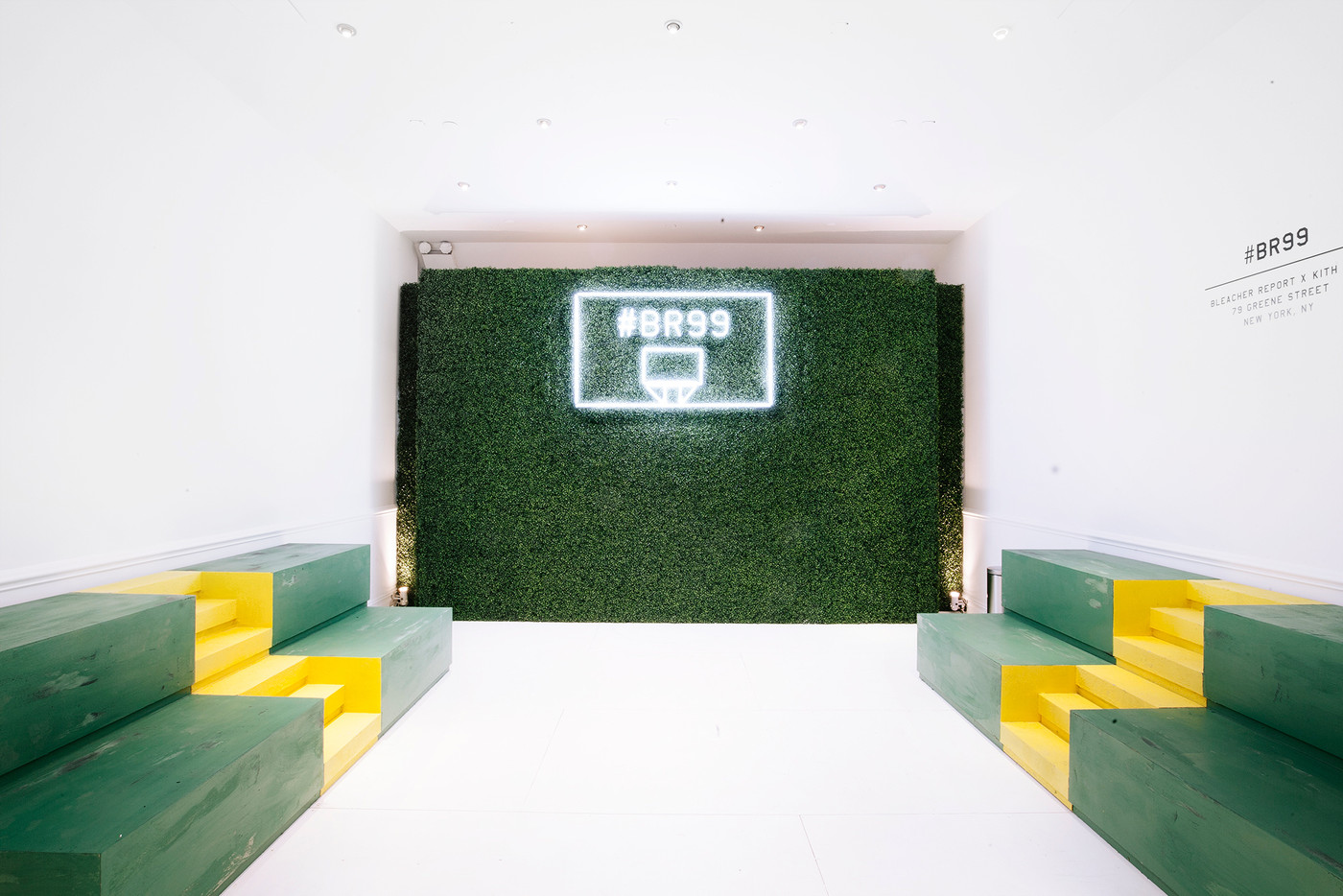
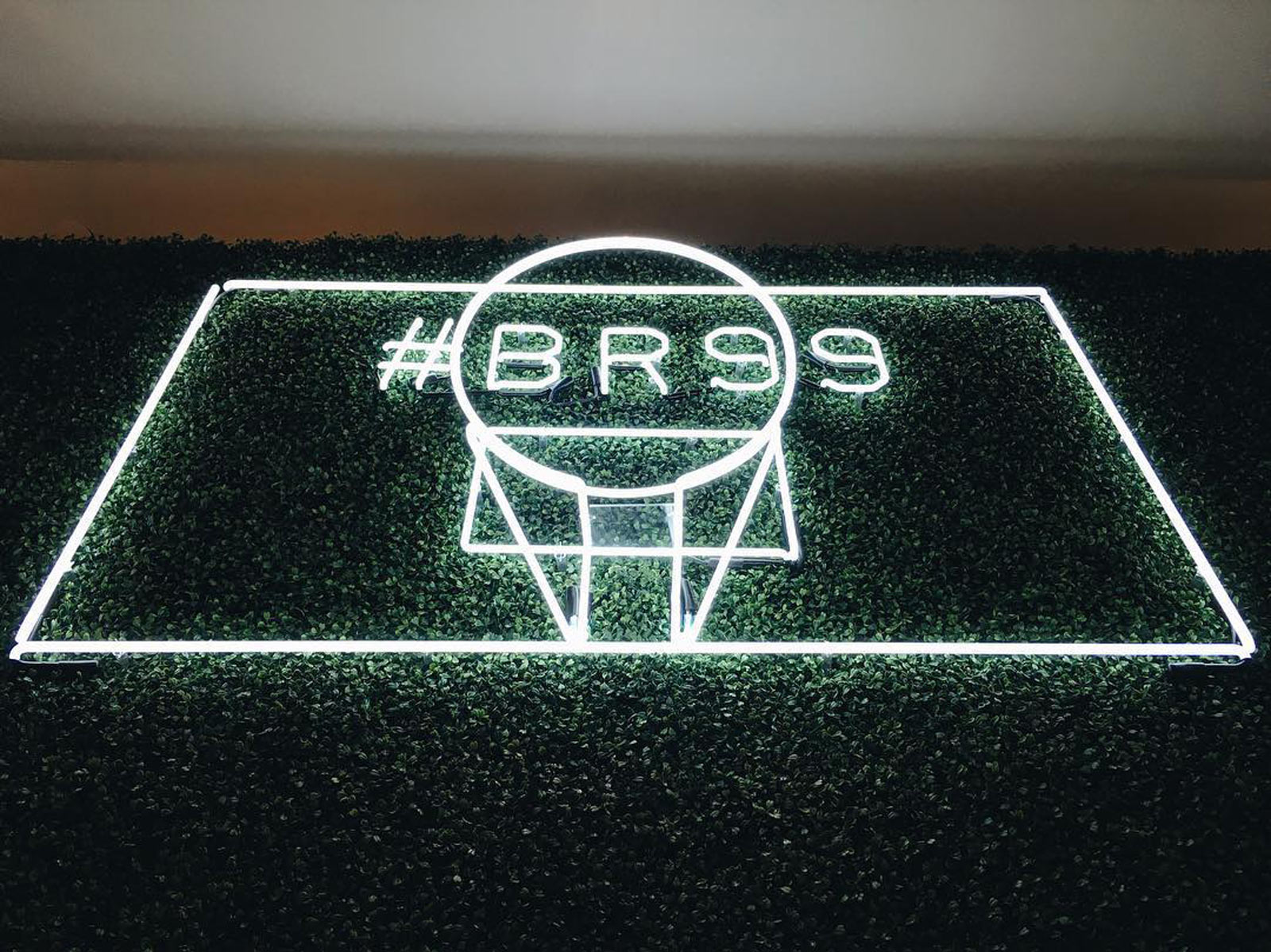
A lush, Hamptons-inspired lounge that contrasted the kinetic energy of the retail floor with a sense of coastal calm and premium leisure. The tiered mint-green benches, with their clean architectural lines and warm underlighting, evoked cabana steps at a private beach club or the sun-bleached geometry of a poolside terrace in Montauk. It was intentional. We wanted a moment where the language of sport could meet the codes of luxury summer living. Fans could sit, recharge, eat cereal, scroll through highlights, or simply observe the flow of the space like spectators in a modern amphitheater. Anchoring the room was the custom neon #BR99 backboard sign, glowing against a wall of manicured greenery. It was both playful and declarative, a direct nod to the neon installations we were developing in the Bleacher Report headquarters to give the brand a physical heartbeat beyond screens. Leading BR99 forced me to grow from a maker into a systems thinker. It wasn’t enough to design graphics or direct moments. I had to anticipate behavior, align partners with competing priorities, and make decisions that balanced brand integrity with operational reality.

There was a strange clarity to that stretch of days, the kind that only shows up when a city, a culture, and a group of people are all pointed in the same direction without needing to say it out loud. You could feel it in the way strangers held the door a second longer, in the way the line became a conversation instead of a queue, in the way every object in the room felt temporarily significant because it was part of a shared scene. Nothing about it announced itself as historic. It was simply alive, dense with intention, and moving at a speed that made you trust your instincts over your plans. In retrospect, that was the real achievement: not the activation, not the headlines, but the brief creation of a place where people arrived curious and left feeling like they had participated in something they would carry with them. Even the water bottles were considered, designed to feel less like event swag and more like something you’d absentmindedly reach for poolside in the Hamptons, a small signal that the brand understood aspiration as fluently as it understood the game, years later I still find myself reaching for it whenever I have a tennis match upcoming, match point Zendeya.
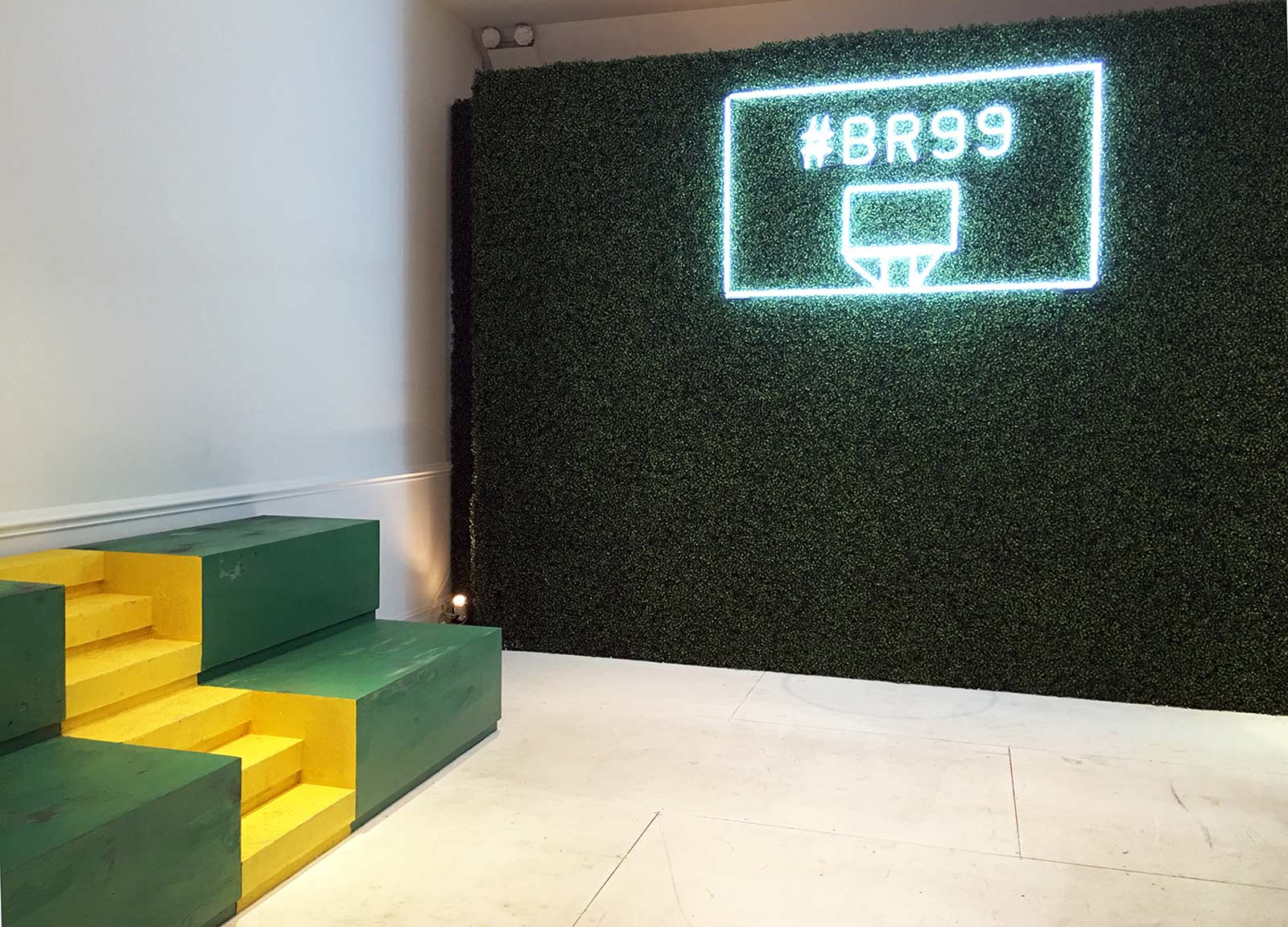
The backboard motif translated the logo into an object you could feel, photograph, and gather around. It became one of the most Instagrammed moments in the space, a beacon that merged sport iconography with lifestyle aesthetics. In that corner, the brand stopped being a media property and started behaving like a place. The environment was structured like a narrative stack. The retail floor delivered immediate product clarity and brand credibility, anchored by the Kith capsule and a disciplined merchandising grid. The Media Lab functioned as the experiential engine, converting visitors into participants and turning the space into a content generator. The lounge and programming zones created chill hangout time and social density, so the activation did not collapse into transactional behavior. Each zone had a distinct purpose, but shared one visual grammar so the experience read as one system, not a collage of activations competing for attention. We thought we were hosting a pop-up; we were actually hosting a moment.

What made the #BR99 pop up distinct was its deliberate elevation of sports culture into a luxury retail context, borrowing cues more commonly associated with Formula 1 paddocks or championship golf hospitality than traditional fan merch environments. Materials, spatial pacing, and visual restraint signaled exclusivity, positioning fandom as a premium lifestyle rather than mass consumption. The result reframed sports apparel as collectible design objects, aligning streetwear credibility with the polished, invitation-only aura found in elite sporting experiences where access, atmosphere, and storytelling carry as much value as the competition itself.
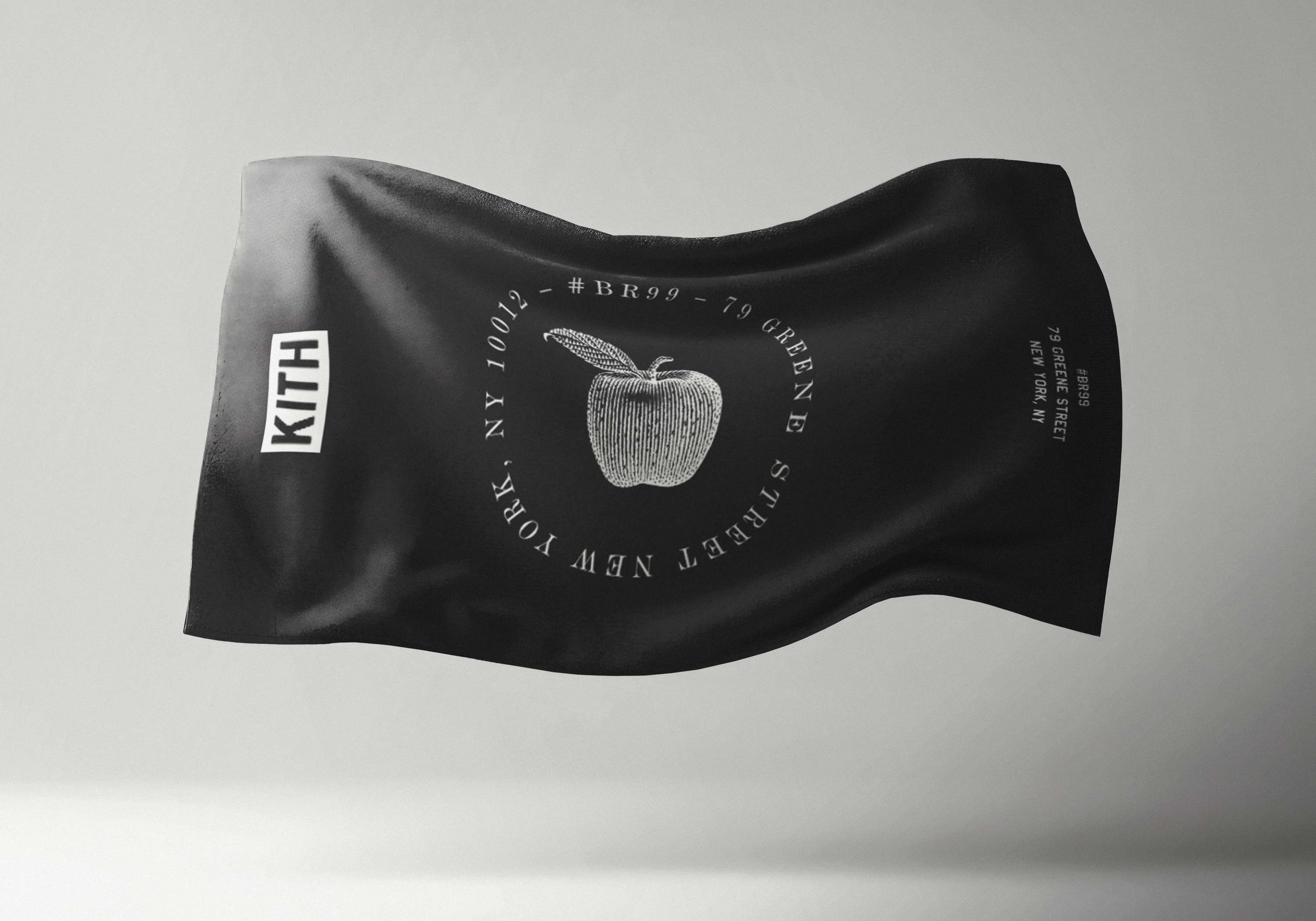
BR99 worked because we treated basketball as a cultural medium, not a content category, and designed the space accordingly. The curation was intentionally cross vertical: sport sat beside art, music, streetwear, and internet vernacular because that’s how fans actually experience identity in the wild. We built a gallery grade layer into the environment so jerseys, memorabilia, and installations read like artifacts with authorship rather than merch on fixtures. That’s also why the programming hit. Panels, DJs, surprise pull ups, and the customization lab made the whole place behave like a living editorial system where the audience was both the subject and the distribution. Even the outside coverage mattered less as press and more as signal amplification: you want the culture to repeat what you built in its own words. When people like the Fung Bros are talking about you, when creators and tastemakers treat the pop up as a reference point instead of an ad, you’ve crossed the line from activation to cultural moment. That was the real win: we proved B/R could convene a room, not only post about one.
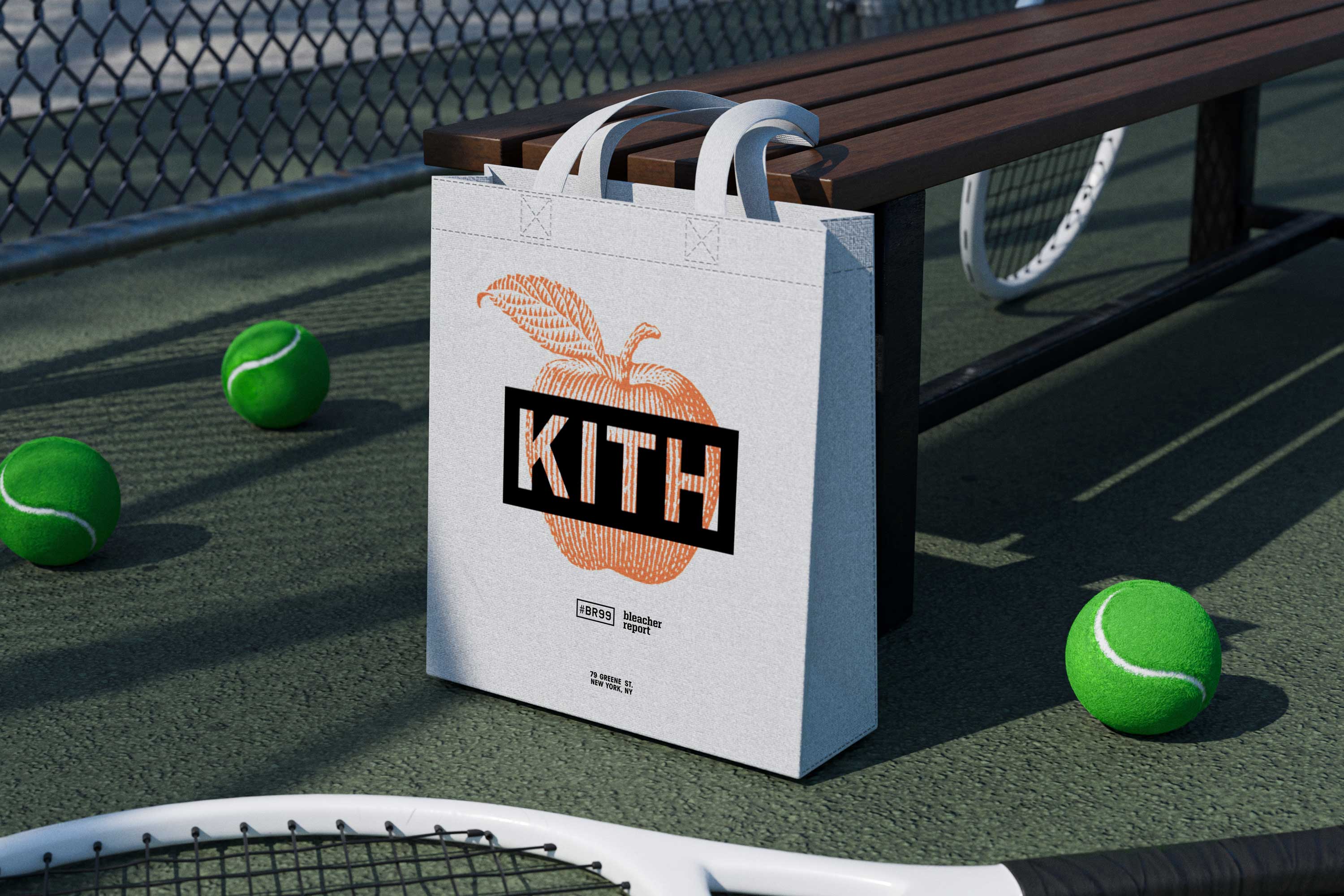
This pop up marked a turning point in my evolution from a craft-focused designer into a systems-level creative leader responsible for aligning vision, operations, and cultural impact. The project demanded that I think beyond individual deliverables and instead design frameworks that teams, partners, and audiences could activate in real time. I learned to balance creative ambition with operational reality, making decisions that protected the integrity of the experience while accommodating budgets, timelines, and the unpredictability of human behavior. Leading across partners like Kith, Madbury, and Game Seven required fluency in multiple creative languages and the ability to synthesize them into a single, coherent narrative. I began to see design less as artifact creation and more as behavior orchestration, shaping how people move, interact, document, and remember. The feedback loops we built between physical space and digital distribution revealed the power of designing for participation rather than presentation. That insight became foundational to my later work, informing how I approached large-scale activations, brand systems, and cross-platform storytelling. BR99 showed me that leadership in modern design is not about control but about creating conditions where culture can emerge and scale. It was the moment I understood that the role of a creative director is to build environments where others become the storytellers.
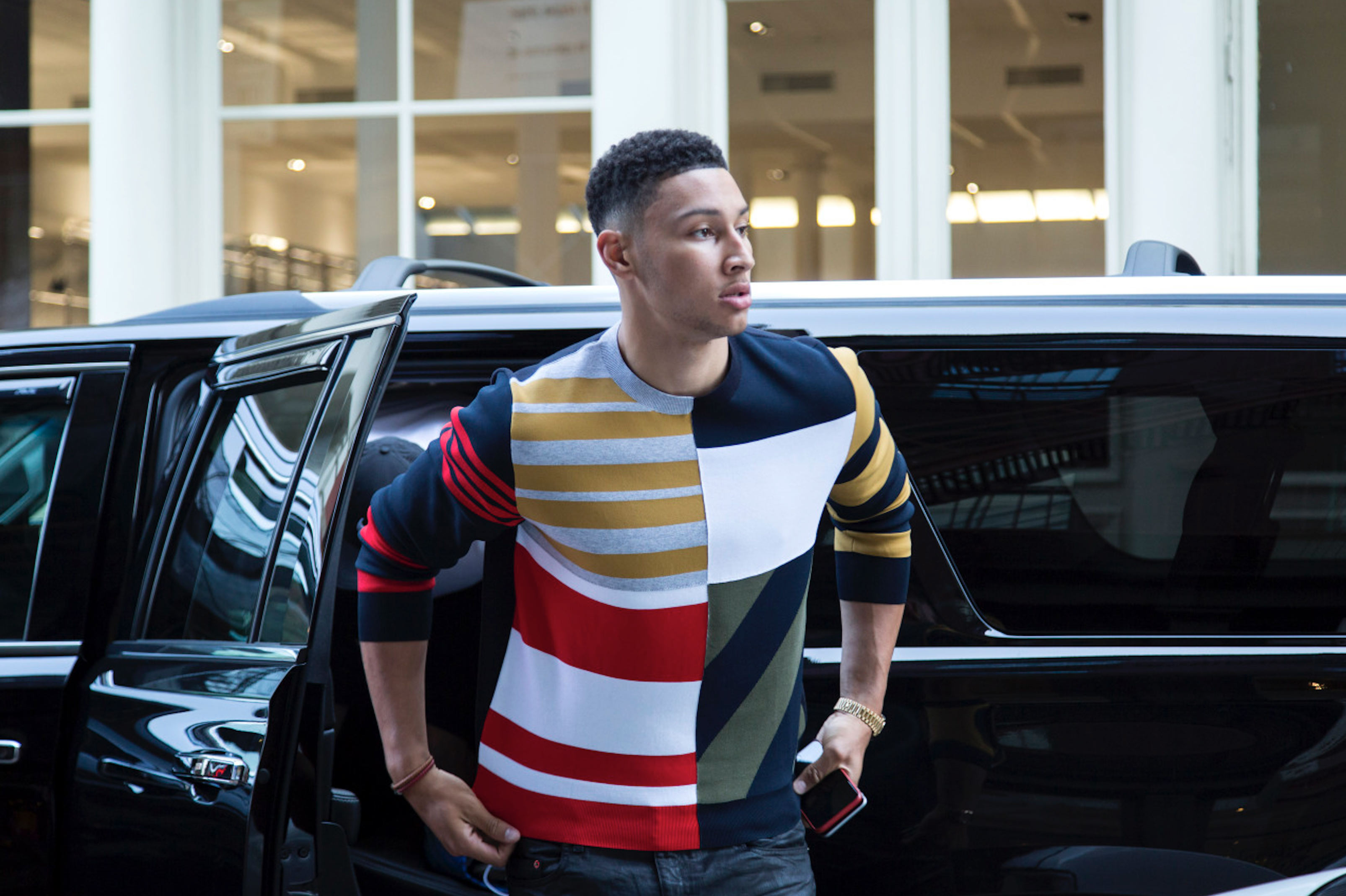
SoHo that summer moved with a constant, anticipatory buzz, the kind of ambient energy where every line hinted at a drop, a sighting, or a moment worth documenting. BR99 quickly became part of that circuit. People slowed as they approached the storefront, scanning the windows, checking the queue, trying to decode whether this was a merch line, an event, or something harder to categorize. The line lengthened in waves, doubling back on itself as curiosity turned into commitment, phones came out, and group chats lit up with location pins. The storefront began to function like a live signal on Greene Street, broadcasting that something culturally relevant was unfolding inside, even for those who had no idea what Bleacher Report was when they first walked up. Operating within tight build timelines and New York retail constraints, we designed modular elements that could be installed rapidly without compromising the experience. The activation functioned as a live system, where environment, programming, and audience behavior formed a feedback loop that extended the experience beyond its physical footprint.
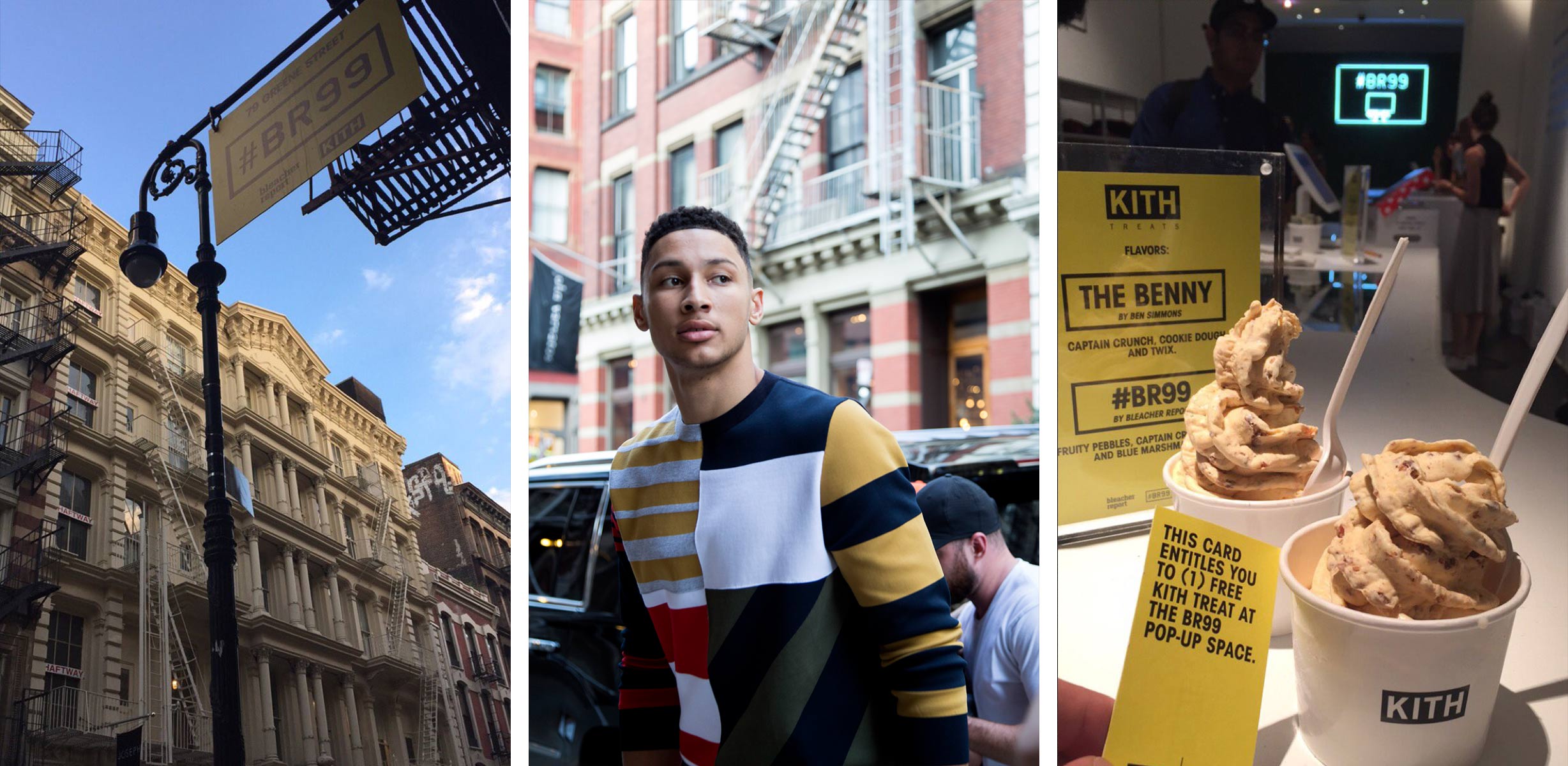
In 2016, experiential marketing was still largely treated as a novelty, a photo op bolted onto a campaign rather than a core expression of brand strategy. BR99 operated ahead of that curve by treating the pop up not as an event but as a living interface where product, content, community, and commerce converged. The activation borrowed the discipline of streetwear drops and the restraint of luxury retail, blending scarcity, spatial storytelling, and participatory moments into a system designed for both physical presence and digital afterlife. In the years that followed, this playbook became standard practice as fashion houses, tech platforms, and media brands invested heavily in immersive environments that functioned as cultural signals as much as retail channels. What felt experimental at the time now reads as an early proof point that audiences were shifting from passive consumption to embodied participation, and that the brands willing to build spaces people could enter, document, and share would define the next era of relevance. The doors closed, but the stories kept circulating. We intentionally designed the storefront to make the line visible from multiple angles, allowing curiosity to convert into social proof. The guest list spanned athletes, musicians, and actors, signaling that the space had crossed from activation into cultural waypoint.

Klutch Basketball athlete Ben Simmons stopping by BR99 in the days leading up to the draft brought a jolt of electricity that you could feel from the sidewalk before you even saw him. He was the consensus No. 1 pick, the most scrutinized prospect in years, and the “next LeBron” label was already following him from LSU highlight reels to every sports debate show in America. Bleacher Report had covered his ascent relentlessly, from mixtapes and scouting breakdowns to cultural pieces framing him as a new archetype of athlete: positionless, globally marketable, and equally at home in tunnel fits and transition offense. When he walked into the space, it was more than a cameo. It was a collision between the future of the league and the future of sports media, happening inside a pop-up that existed to prove those worlds were already intertwined.

Fans packed the floor, phones raised, trying to capture proof that the player they had been arguing about in comment sections was suddenly within arm’s reach. Simmons moved through the space with the calm of someone used to cameras, pausing at the customization lab, taking in the artwork, and engaging with the environment in a way that validated the entire experiment. His presence signaled that this was not a novelty activation but a credible cultural node, a place where athletes, fans, fashion, and media converged in real time. For Bleacher Report, having the most talked-about prospect in basketball choose to spend time in the space reinforced our role as a bridge between the league’s next generation and the communities that would define its legacy.

What made BR99 feel bigger than a pop up was the caliber and chemistry of the partners involved. Working alongside Kith, The Madbury Club, and Game Seven, we built an ecosystem rather than a storefront, each collaborator bringing a distinct competency that elevated the experience. Kith contributed its retail credibility and design rigor, Madbury infused cultural strategy and brand storytelling, and Game Seven translated the vision into a physical environment that felt intentional down to the millwork and sightlines. Layering Klutch Sports into that mix through Ben Simmons added a direct line to the league’s future, turning the space into a living intersection of athlete representation, fashion, media, and commerce. It was a rare alignment where every partner expanded the surface area of the idea rather than diluting it.
.jpeg)
Ben’s visit became a centerpiece moment, not only because of his draft buzz but because we were able to integrate him into the experience in ways that felt native to the culture. With Kith Treats still in its experimental phase, we collaborated on a custom menu item inspired by Simmons, a playful but strategic move that translated athlete hype into a tangible, shareable artifact. Fans weren’t just meeting a future star; they were literally consuming a piece of the moment, turning cereal, ice cream, and milk into a cultural souvenir. That level of personalization demonstrated how retail, hospitality, and sports storytelling could merge into a single, memorable touchpoint that extended far beyond traditional merch or largely disposable swag comparable media companies like us were doing at the time.

To amplify the moment, we handed Ben the keys to Bleacher Report’s Snapchat, allowing him to take over our Story during his visit. The result was an unfiltered, athlete-driven perspective that felt immediate and intimate, showing fans the pop up through his eyes as he moved through the space, interacted with activations, and reacted to the crowd. At a time when athlete social access was still tightly controlled, this kind of takeover signaled trust and cultural fluency, reinforcing B/R’s position as a platform where players could show up as themselves. The combination of physical presence, custom product, and real-time social storytelling turned a single appearance into a multi-platform moment that reached far beyond SoHo, proving that when the right partners align, a pop up can function as a cultural broadcast.

The custom Kith Treats menu became one of the most unexpected and effective bridges between culture, hospitality, and fandom inside BR99. Rather than treating the cereal bar as a novelty, we leaned into it as a storytelling surface, introducing bespoke flavors that anchored the experience in personality and place. “The Benny,” curated with Ben Simmons, blended Captain Crunch, cookie dough, and Twix into a maximalist mix that mirrored both his larger-than-life draft hype and the indulgent, celebratory tone of the moment. Alongside it, the #BR99 house creation combined Fruity Pebbles, Captain Crunch Berries, and blue marshmallows, a playful nod to team colors, nostalgia, and the sensory overload of sports culture itself. These weren’t random combinations. They were edible artifacts of the brand’s point of view, translating athlete narrative and fan memory into something you could hold, taste, photograph, and share. I grew up on a steady diet of cereal so this was literally a dream perk of any job.
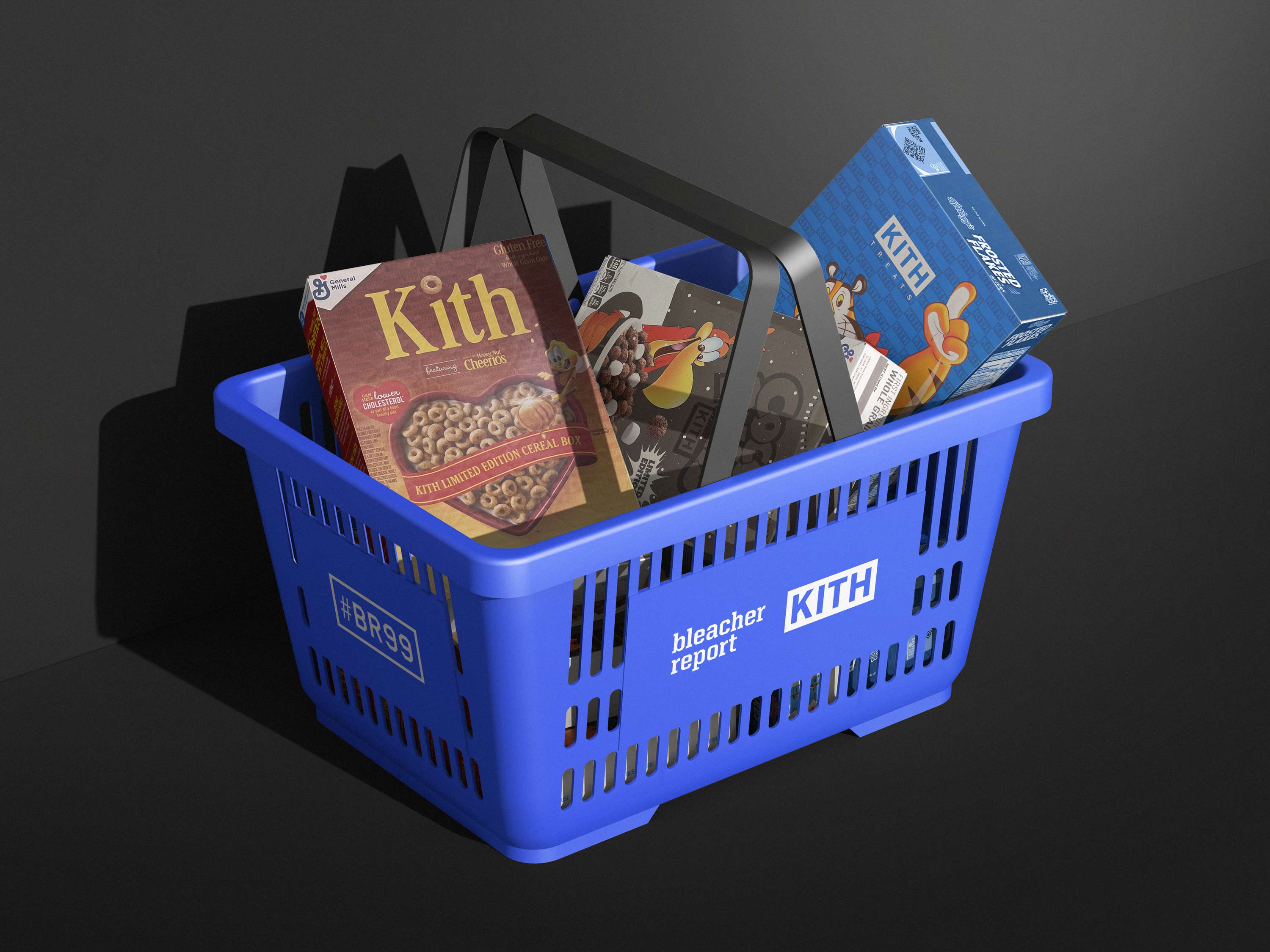
Beyond raw attendance and social reach, BR99 generated behavioral insights that reshaped how we thought about fan engagement. We observed extended dwell times far beyond typical retail benchmarks, repeat visits across multiple days, and high conversion from participation to purchase, especially among visitors who engaged with the Media Lab. The most telling signal was the density of user-generated content tied to physical interaction points, proving that when fans are given tools to co-create, they become distributors rather than spectators. These patterns informed future B/R activations by demonstrating that experiential design can function as both a growth engine and a research surface, revealing how audiences actually want to engage with sports culture in real space.

What made the flavors resonate was how naturally they extended the Bleacher Report ethos of participation over spectatorship. Fans weren’t simply observing a collaboration between media, fashion, and sport; they were consuming it in real time, lining up for a scoop that doubled as a cultural souvenir. The cereal bar format encouraged social sharing, from Snapchat clips to Instagram posts, turning each cup into micro-content that amplified the pop up far beyond SoHo. In hindsight, the experiment foreshadowed how integral Kith Treats would become to the brand’s retail identity, but in that moment it functioned as proof that experiential retail could be multisensory and deeply personal. By pairing athlete-inspired flavors with a media platform’s voice, we demonstrated that fandom could live not only on screens and apparel, but in taste, texture, and memory. Kith treats really is beloved now and a destination for many when they visit the city.

BR99 functioned as a prototype for what a media company could become when it stops treating audiences as viewers and starts designing for participation as the primary mode of engagement. Rather than staging a static retail environment, we built a responsive space where content was created, customized, and redistributed in real time, collapsing the lag between experience and amplification. The Social Customization Lab allowed fans to generate artifacts that were instantly shareable, turning each visitor into a micro-distributor and extending the footprint of the pop-up far beyond Soho. This closed-loop system transformed foot traffic into content velocity, and content velocity into cultural presence, demonstrating a scalable model that could be replicated in future activations. What made the experiment innovative was not the merchandise or celebrity drop-ins alone, but the intentional design of feedback loops that rewarded participation and converted presence into signal. In effect, BR99 blurred the boundary between media production and audience behavior, showing that the most powerful distribution engine was the crowd itself when given the right tools and context.
Equally forward-looking was the way BR99 reframed retail as narrative infrastructure rather than point-of-sale, a shift that anticipated the next decade of experiential commerce across streetwear, luxury, and sports culture. Every surface, from wayfinding to packaging to the lighters and ephemera, was treated as a storytelling device that reinforced a cohesive world rather than a collection of products. This approach elevated perceived value by embedding items within a lived moment, making ownership feel like proof of attendance in a cultural flashpoint rather than a simple transaction. The activation demonstrated that when design, content, and commerce operate from a shared system, physical space becomes a medium rather than a container. In the years that followed, similar playbooks would surface across flagship drops, brand pop-ups, and hybrid retail experiences, but BR99 arrived early enough to test the model before it became industry orthodoxy. Looking back, the project reads less like a one-off event and more like a blueprint for how culture-led brands would merge storytelling, community, and revenue into a single, continuous experience.
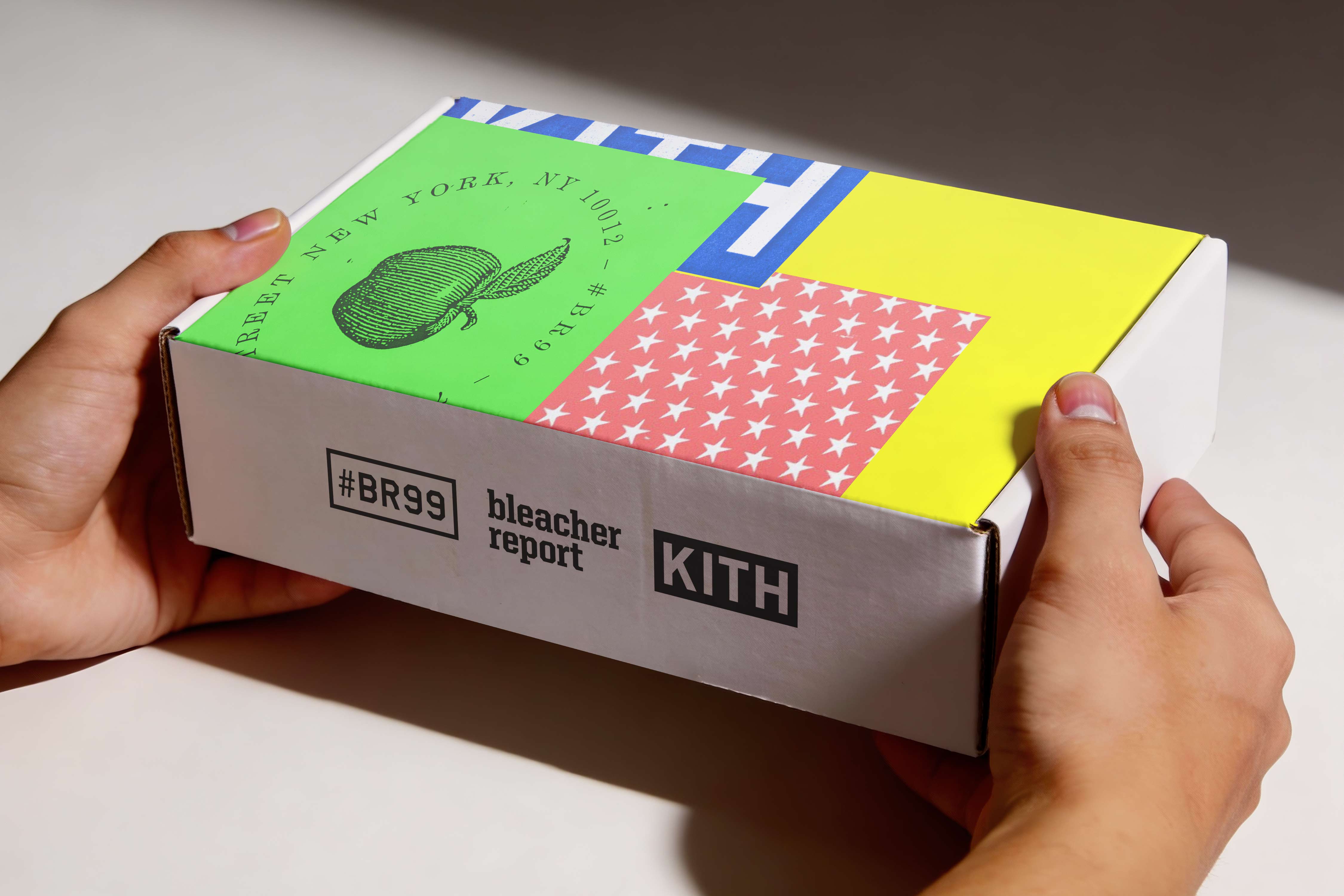
The timing amplified everything. The pop up unfolded during the NBA Finals and the lead-up to the Draft, when basketball discourse takes over group chats, bar TVs, and every corner of the internet. That context brought a steady flow of fans who were already emotionally invested, debating matchups in line, checking their phones for updates, and carrying that energy straight into the space. Over eight days, the shop felt less like a static retail environment and more like a live cultural node, constantly in motion, shaped by the conversations and reactions happening outside its doors. The wall filled organically as people responded to the moment in their own way, turning the installation into a time capsule of that week in basketball and in New York.

Fun fact, and a snapshot of how unreal that summer felt: the night Michael B. Jordan pulled up to BR99, the line absolutely lost it. The energy flipped from curiosity to full-on celebration in seconds. People were cheering, phones shot into the air, strangers were grinning at each other like they’d collectively won something just by being on Greene Street at the right moment. In the middle of that chaos he struck up a conversation with a girl I’d been talking to which, fair play, it’s Michael B. Jordan and the city was in peak main-character mode. She was intrigued, I was laughing, and months later she and I ended up dating for three years, which is my joking way of saying Creed took the box office but I played the long game. The lore kept going. I invited him to the office the next day half expecting a polite no, and he showed up, kept his word, talked ideas with the team, and jumped into a game of knockout like he’d always been part of the crew. I actually knocked him out and took the dub. No cinematic slow clap, no “and everyone cheered,” just one of those perfectly absurd Summer ’16 moments where sports, film, and street culture all collided and somehow felt normal.
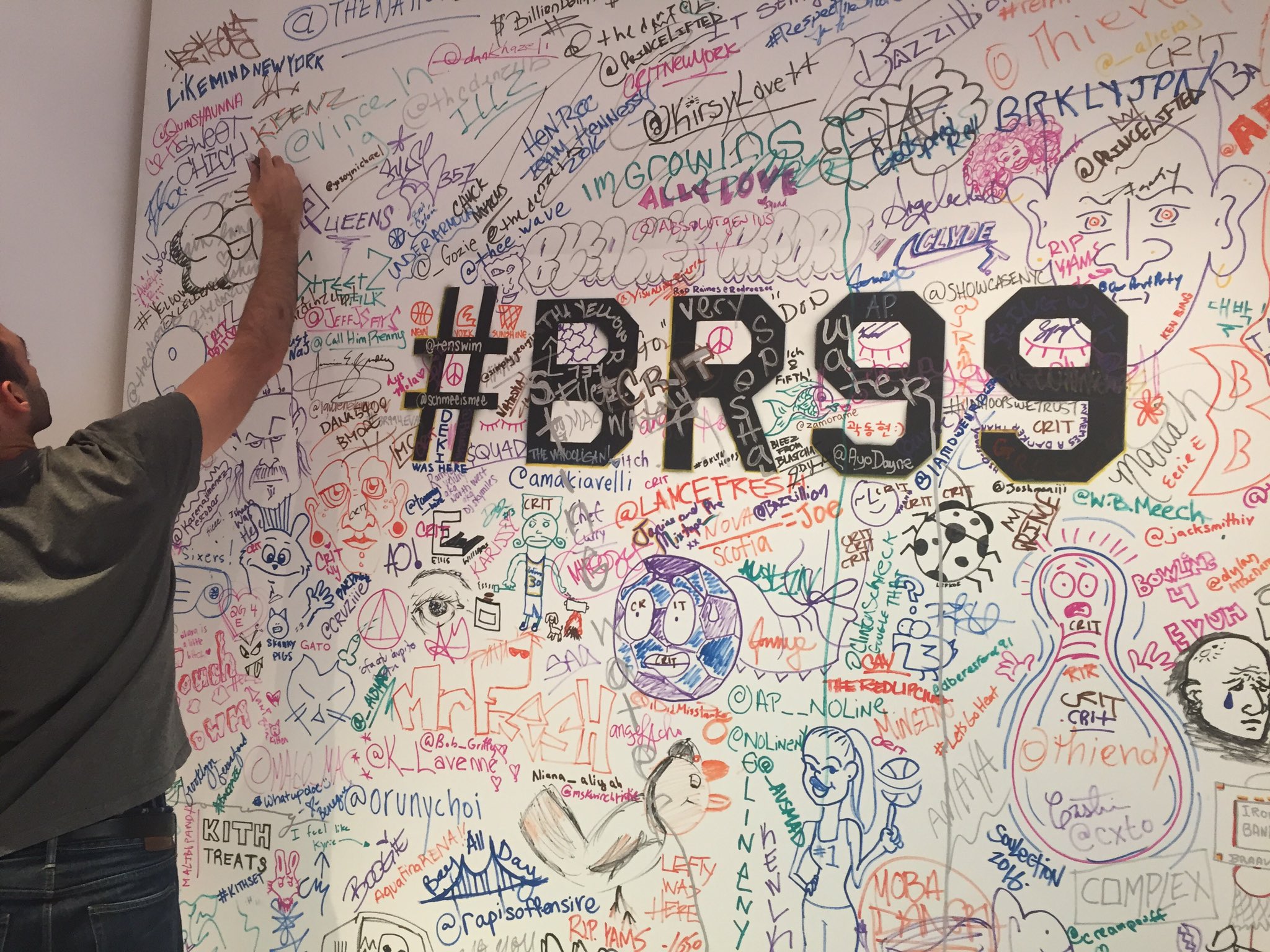
One of the sharpest instincts in the experience was the insistence on participation as a core feature, not a side quest. The signature wall and the customization moments were deliberate mechanisms for identity projection, because fandom is fundamentally about authorship and belonging. When people can leave a mark, they stop being attendees and become stakeholders in the narrative. That same philosophy mirrored my own role at B R, where my impact came from building frameworks that others could operate within, rather than single deliverables. I approached the pop up like a design system for behavior, defining the rules of engagement, the visual hierarchy, and the moments where people would naturally reach for their phones. The “leave your mark” construct also became a metaphor for how I worked inside the company, pushing the brand from content output to culture making. I consistently optimized for replay value, designing artifacts that would travel beyond the room, persist in feeds, and accrue meaning through repetition. The wall’s density became a qualitative KPI, a physical proxy for affinity that no dashboard could fully capture. It was a tangible archive of the community’s voice, layered in real time, and it validated that the brand’s strongest asset was always the audience’s willingness to participate.
%20(1).jpg)
At the heart of BR99 was a simple but powerful invitation: leave your mark. Anchoring the space was a massive white wall stamped with BR99 in bold lettering, an open canvas that visitors were encouraged to sign, doodle on, tag with their hometowns, or scrawl messages to their teams and heroes. What began as a pristine surface quickly transformed into a dense collage of handwriting, inside jokes, sketches, and declarations of fandom. Some signatures were careful and reverent, others loud and chaotic, but together they formed a living artifact of the community passing through the space. The wall became less of an installation and more of a pulse check, a physical manifestation of the same participatory culture that powered our comment sections, memes, and social threads. By the end, it wasn’t just marked. It was layered, textured, and alive, proof that fans don’t want to merely consume culture. They want to inscribe themselves into it.
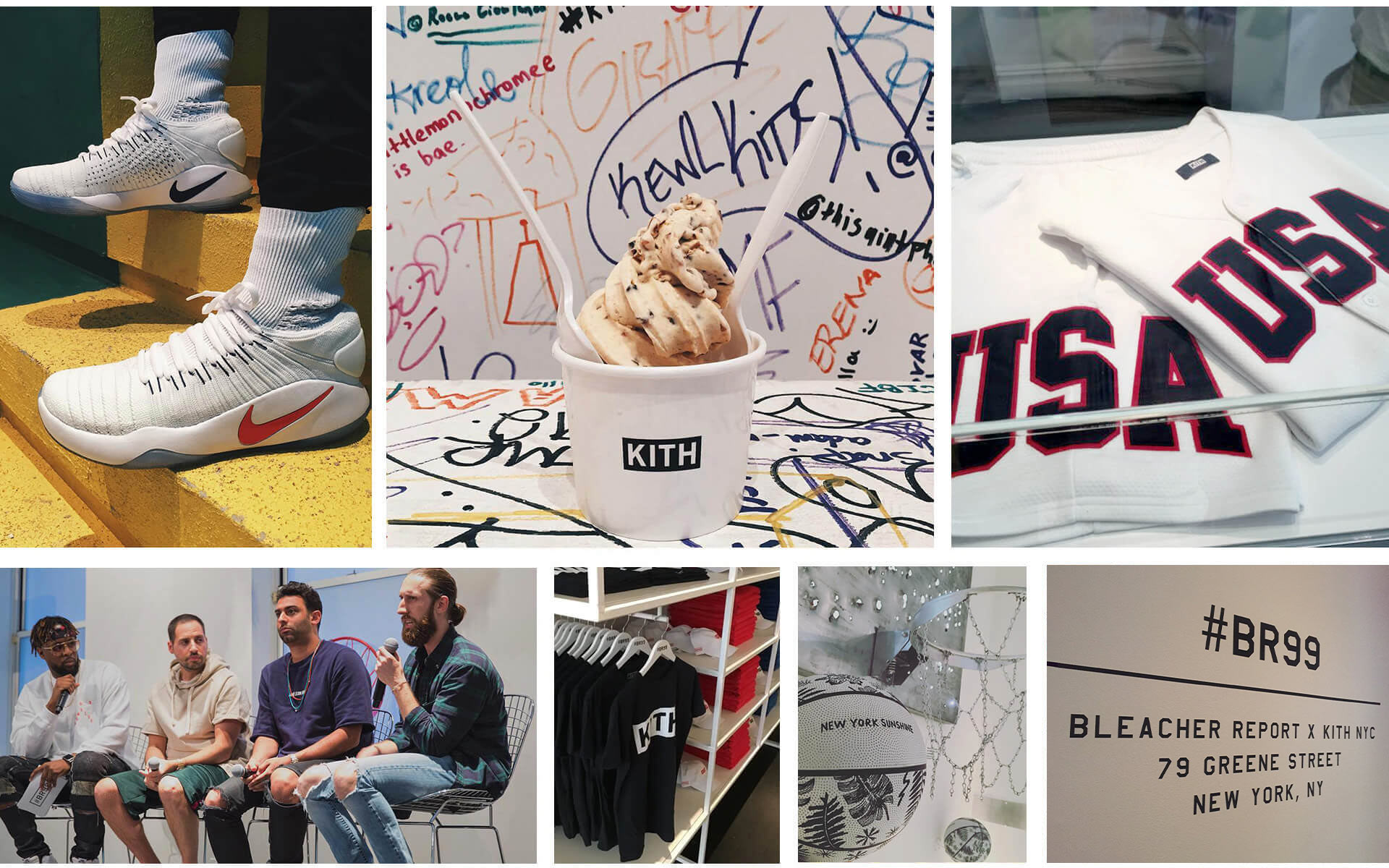
It’s not every day that a media company steps off the screen and into a physical retail collaboration with a fashion brand that already commands real estate in the cultural imagination. That novelty alone created a sense of curiosity that rippled through SoHo and across social, drawing long lines on opening day as fans, sneakerheads, and passersby tried to understand what it meant for a sports publisher to share a floor with a label known for precision, scarcity, and taste. The partnership signaled that Bleacher Report was no longer content to live solely in feeds and notifications. It was ready to occupy the same physical and cultural spaces as the brands shaping how a generation dresses, gathers, and signals belonging and now it has evolved even further in it's own right, so we truly were on to something.
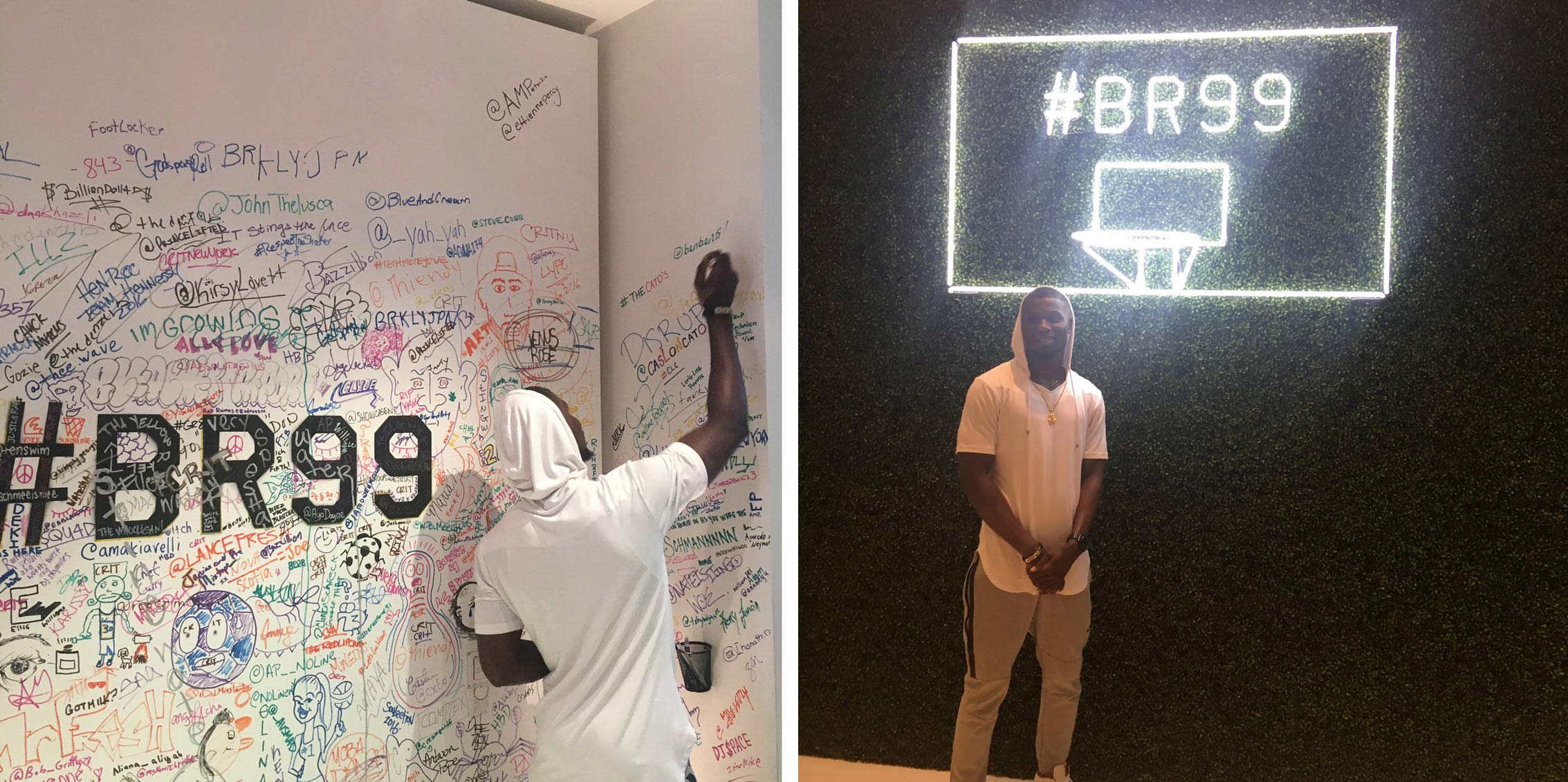
The wall took on a second life as the week progressed, evolving from a blank prompt into a dense, living archive of who showed up and what they carried with them. Names layered over tags, boroughs sat beside international shoutouts, inside jokes collided with earnest messages to teams and heroes. People photographed their marks like proof of attendance, then lingered to read what strangers had left behind, finding unexpected kinship in shared handwriting and rival allegiances. By the final days, the surface had become less a design element and more a collective artifact, a physical comment thread that captured the voice of the community in real time. It was messy, heartfelt, competitive, funny, and unmistakably human, a reminder that when you give fans a place to inscribe themselves, they don’t hold back.
.webp)
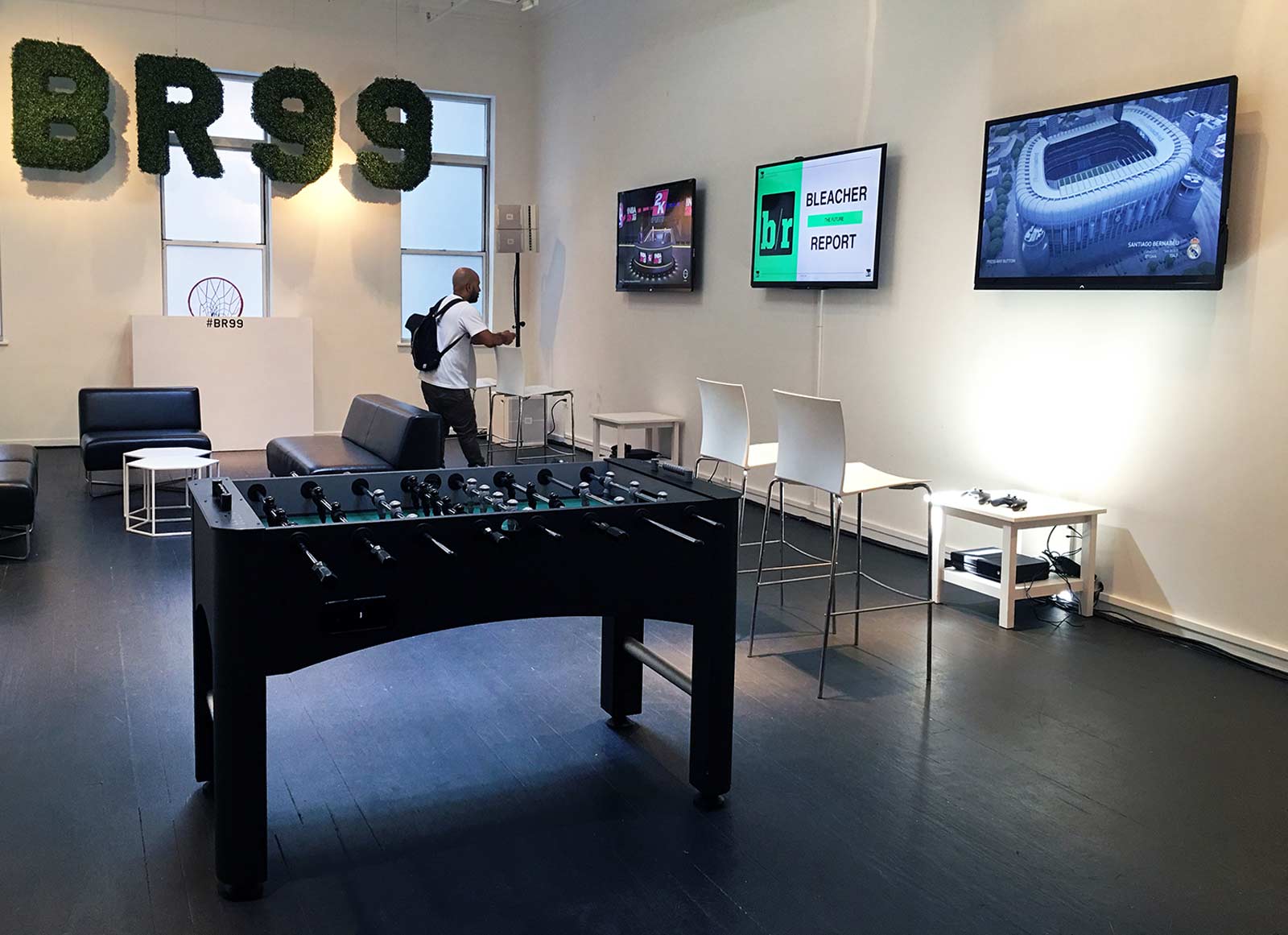
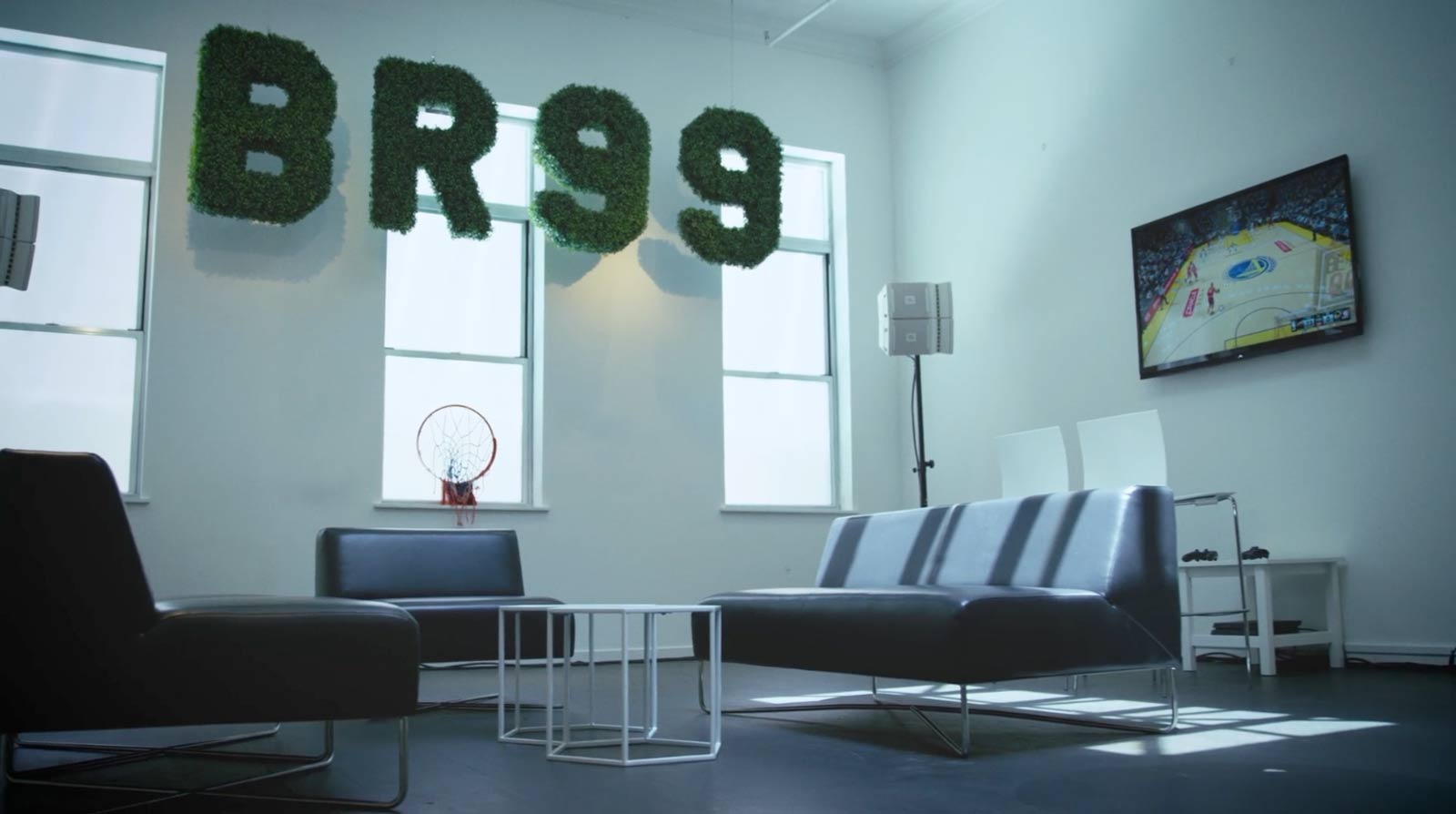
This was never conceived as a traditional retail footprint where transactions were the primary objective. While visitors could walk in throughout the run and purchase Bleacher Report x Kith apparel, the space was designed to function as a cultural clubhouse as much as a store. The second floor operated like a living room for the community, a place to sit, recharge both phones and bodies, play foosball, run video games, and linger without the pressure to buy. It acknowledged how fans actually inhabit spaces, moving between conversation, competition, and content creation in a single visit. As the sun went down, the same environment transformed into an intimate venue for influencer talks, panel conversations, and live performances, collapsing the distance between audience and talent. What began as a place to shop evolved into a place to gather, turning retail into a social experience and positioning the brand as a host rather than a seller.
Kith x Bleacher Report made sense because both brands were already speaking to the same person from opposite sides of the culture. Kith had mastered the retail theater and product discipline that turns drops into rituals, while B/R had built the internet’s most fluent sports voice, a daily stream of highlights, jokes, debates, tunnel fits, and identity signaling that lived in group chats and feeds. The overlap was obvious: jerseys as fashion, sneakers as language, athletes as style leaders, and sports as the engine of modern street culture. Pairing them was not a random logo collab. It was a strategic swap of strengths. Kith gave the activation design authority and physical credibility in SoHo, and B/R brought the audience, the distribution engine, and the cultural tempo. Together, BR99 became a real bridge between content and commerce, where a media brand could behave like a lifestyle platform and a retail brand could tap into the emotional electricity of fandom without feeling like an outsider.
Summer 2016 had this specific New York frequency where streetwear, hoops, and internet culture were collapsing into one shared language, and the city still felt like the center of the collision. SoHo lines were part of the landscape, Supreme receipts were social currency, and “drop day” had the same energy as a playoff game, people refreshing, posting, arguing, pulling up just to be seen. Instagram was turning fits into headlines, SoundCloud rap was leaking out of every speaker, and basketball discourse was constant, in barbershops, on the train, on timelines, in the park at dusk when the courts got loud and the air got heavy. It felt pre-corporate and hyper alive, like culture was still made by people showing up in person, not only by campaigns. BR99 was built to bottle that feeling: a short window where New York was sweat, heat, music, sports talk, and style, and the smartest brands were not trying to advertise at you, they were trying to host you.
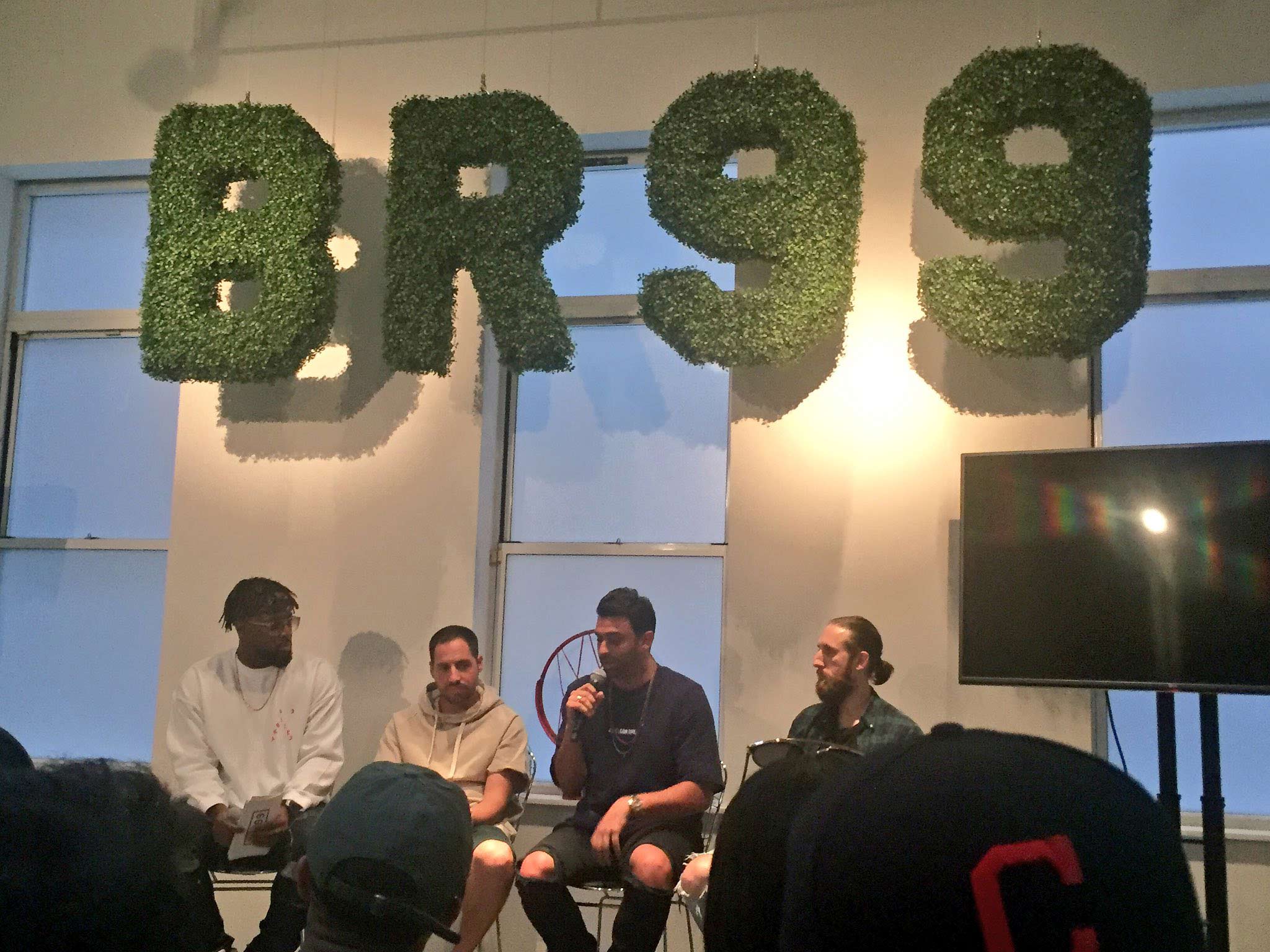
The panel programming brought a rare cross section of the basketball, fashion, media, and brand worlds into one room, turning the upstairs space into a living think tank rather than a passive stage. Players like Tobias Harris, Chris McCullough, and Gary Harris spoke candidly about life inside the league, the pressures of performance, and how personal style had become an extension of athlete identity off the court. Their presence grounded the conversation in lived experience. These were not distant icons. They were young professionals navigating the same culture shifts the audience was witnessing in real time. Alongside them, figures shaping the business and aesthetic infrastructure of that culture expanded the lens. Ronnie Fieg offered insight into building Kith from a boutique into a globally respected brand by treating product as storytelling. Shawn “Pecas” Costner brought the Roc Nation perspective on athlete branding and cultural positioning. D’Wayne Edwards spoke about Pensole’s role in diversifying and educating the next generation of footwear designers, reframing sneakers as both craft and career pathway. Robert Marshall of Hypebeast contextualized how digital media was accelerating trend cycles and legitimizing streetwear as a global language. Our own voices, including Stephen Nelson, Adam Lefkoe, and Lance Fresh, tied it back to Bleacher Report’s evolving role.

We were intentional about ensuring every square foot worked harder than a typical retail layout, which is why the upstairs level doubled as a flexible panel and networking forum. Rather than treating the pop up as a static display, we programmed it with industry talks, creator conversations, and community meetups that brought together athletes, designers, media voices, and fans in the same room. The format was deliberately intimate so the audience could ask questions, exchange ideas, and build relationships in real time, turning passive spectators into active participants. By day it functioned as a collaborative workspace and social hub, and by evening it shifted into a salon-style environment where culture makers unpacked the business of sports, streetwear, and storytelling. That layered use of space reinforced Bleacher Report’s role not only as a publisher but as a convener, a brand capable of facilitating dialogue and connection across the overlapping worlds it covers.
%20(1).jpeg)
Stepping into a physical retail footprint was uncharted territory for us. Up until that point, Bleacher Report lived primarily on screens through the app, the website, and social feeds that were already performing at scale. Translating that digital energy into a brick and mortar experience came with real uncertainty. We did not know if an audience accustomed to double tapping and scrolling would show up in person, or if the brand affinity we saw in metrics would manifest as foot traffic. Watching a steady stream of visitors move through the space from open to close, with lines forming outside and social feeds filling with geotagged posts, selfies, and organic commentary, was a validating moment. The buzz extended far beyond the four walls of the shop, rippling through Instagram, Twitter, and group chats in real time, proving that the community we had cultivated online was eager to engage in the physical world. It confirmed that Bleacher Report was not confined to platforms or devices. It was a cultural signal people wanted to experience, document, and share.
On the content side, I helped architect how physical moments became social output, defining where capture would happen, what would be camera ready, and how we avoided visual noise so photos and video looked editorial without trying too hard. I also collaborated closely with internal stakeholders across editorial, social, events, and leadership to keep the space coherent as it shifted modes from retail to programming to nightlife. In practice, it was systems leadership under real constraints: people, budgets, timelines, and the unforgiving honesty of the street. The most important part is that I didn’t only design artifacts, I designed behavior, and then ensured the team could operate the behavior as a repeatable system for eight straight days as someone who was growing from an IC to a people manager and leader, this experience was key for me.
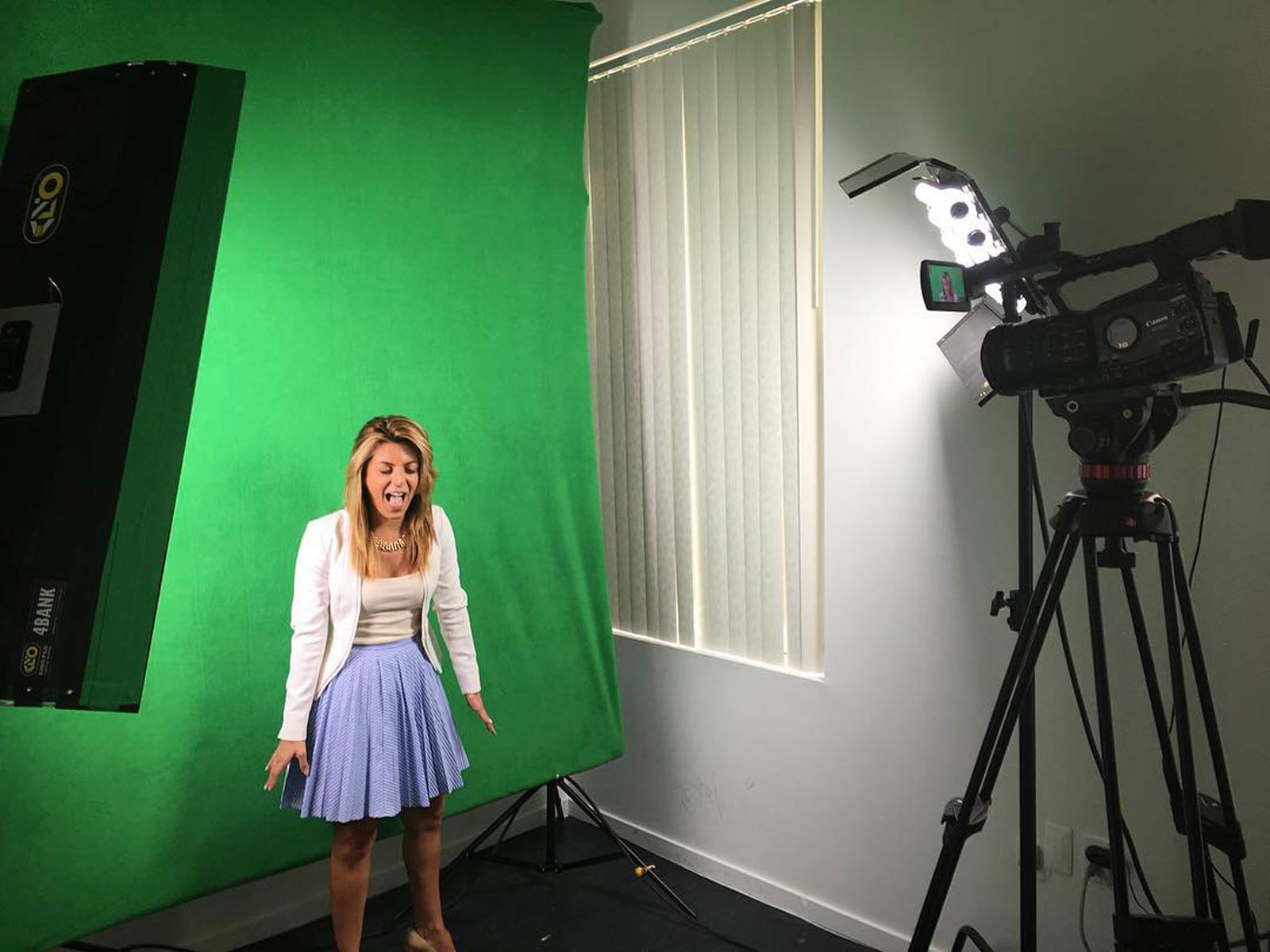
The additional square footage on the second floor proved essential, giving us the operational backbone to power the Media Lab experience rather than treating it as a novelty. We outfitted the space with a bank of edit stations where our team could process footage in real time, alongside a fully built green screen photo studio that felt closer to a production set than a retail activation. Proper lighting rigs, backdrops, and tethered capture allowed us to shoot clean headshots and short motion clips that could be keyed, composited, and dropped into our viral templates within minutes. Fans would step in as spectators and leave as protagonists, their edits rendering upstairs while they explored the space below. That behind the scenes workflow transformed the pop up from a static environment into a living studio, proving that Bleacher Report’s digital engine could operate anywhere there was culture, curiosity, and a little square footage to make magic.
On the opposite side of the floor, the panel area was designed with equal intentionality, functioning as a flexible lounge that could shift identities throughout the day. During daylight hours it operated as an open hangout zone, outfitted with modular seating, video game stations, charging points, and enough breathing room for fans, collaborators, and even our own team to decompress between activations. It had the energy of a clubhouse rather than a conference room, a place where someone could play a quick game, watch highlights looping on screen, or sit with a coffee while taking in the atmosphere below. By night, the same footprint transformed seamlessly into a panel venue, hosting conversations with athletes, designers, and industry voices. That dual purpose design made the space feel alive at all hours, reinforcing the idea that BR99 was not a static installation but a living cultural hub shaped as much by the people inside it as the programming itself.
.jpg)
When Tobias Harris pulled up to the pop up, the energy in the room shifted in that unmistakable way that happens when a pro walks into a fan space. He moved through the retail floor with curiosity, taking in the jerseys, the Kith capsule, the crowd, and the hum of cameras and phones documenting the moment. I had the chance to guide him through the Media Lab experience I designed and creative directed, which was easily one of the most magnetic parts of the entire environment. By then, Bleacher Report’s social presence had become synonymous with internet-native sports culture. Our memes, head swaps, reaction edits, and cinematic mashups after big moments were circulating globally within minutes of games ending. Tobias immediately recognized the format because he had lived inside that ecosystem as both subject and spectator. Showing him how we translated that digital language into a physical, participatory installation was a full circle moment, a bridge between athlete, fan, and platform.

The Media Lab was built to make fans feel like they had stepped inside the Bleacher Report feed. As guests entered, large side screens looped our most viral hits, from Russell Westbrook’s pregame dance clips to cinematic reaction edits that had dominated timelines. The centerpiece was a green screen photo booth where visitors could take quick headshots that our team templated into custom edits on the fly. Within minutes, fans saw themselves dropped into iconic B/R moments, composited into the Westbrook tunnel dance or other fan favorite scenes, rendered with the same motion graphics language and pacing we used on our channels. While they shopped the capsule, grabbed Kith Treats, or attended panels upstairs, our staffed workflow automated the edits and delivered ready to share videos that lived instantly on social, turning every participant into both subject and distributor. It transformed the pop up from a store into a content engine, with each personalized clip extending the reach of the experience far beyond SoHo and into the feeds of millions. In total we created 336 custom videos with that fresh Bleacher Report flair and style for lucky attendees.
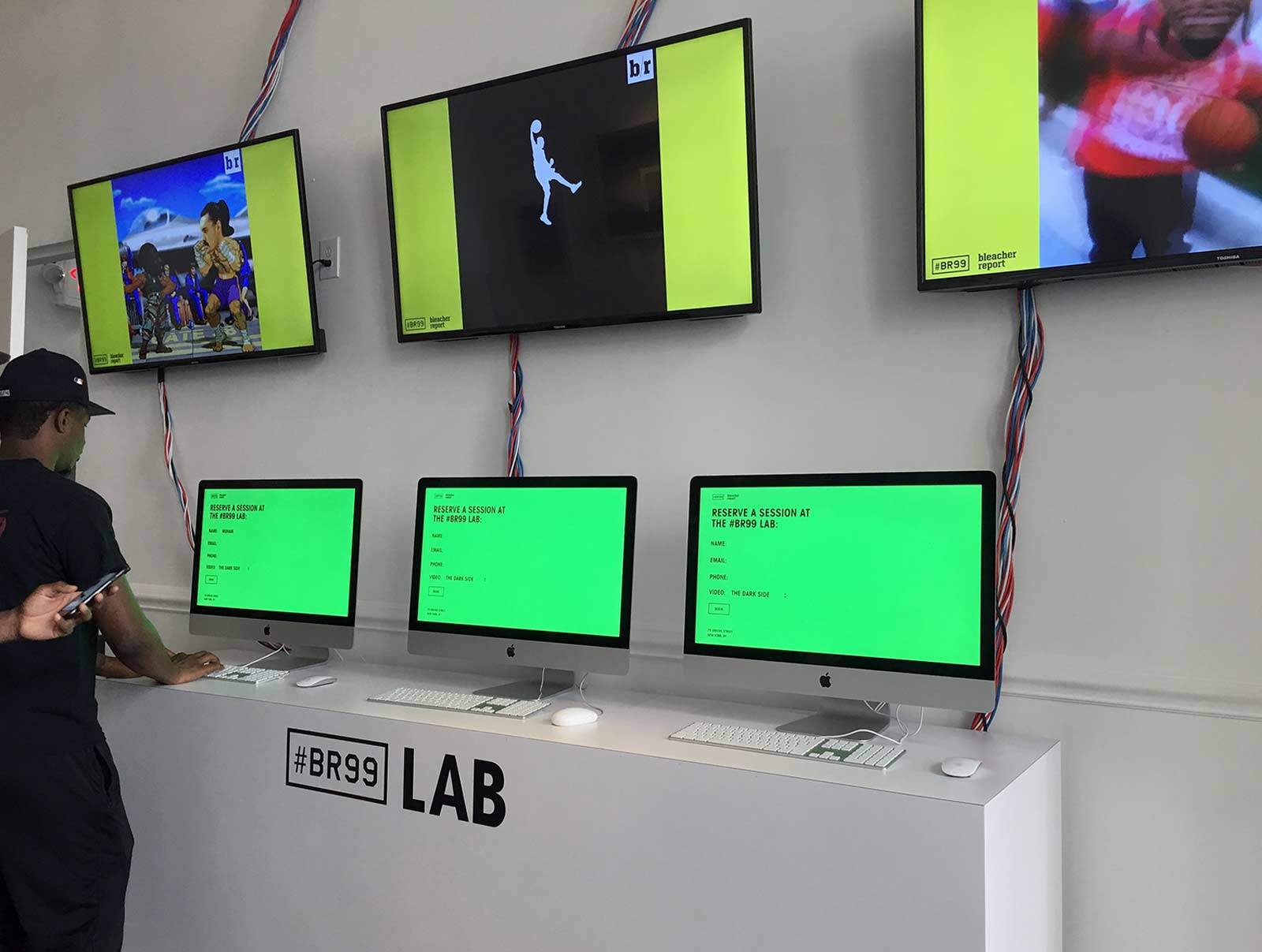
The Social Customization Lab was treated like a product, not an activation. We designed the interaction flow end to end, from queue behavior and instructions, to capture moments, to output delivery and sharing. The goal was speed, delight, and fidelity to B/R’s existing social design language, so the outputs felt native to the feed. Behind the scenes, we built a lightweight production pipeline that could ingest captures, apply templated treatments, render quickly, and hand back physical prints and shareable files without creating bottlenecks. The lab was effectively a micro studio operating inside a store, and the design had to support throughput, consistency, and emotional payoff.
.jpg)
One of the most surreal and telling moments came when Lil Yachty, still in that meteoric early rise where every appearance felt like a preview of something bigger, wandered into the store almost casually. There was no scheduled appearance, no step and repeat, no brand choreography. He came in as a fan, drawn by the buzz, and immediately gravitated toward Kith Treats like a kid discovering a new arcade. He posted up with cereal and ice cream, took photos with fans, copped merch, and kept circling back over the next few days, each visit bringing a little more attention and a few more phones in the air. Watching someone at the cusp of mainstream dominance engage with the space so authentically validated the instinct behind the entire project. We weren’t manufacturing culture. We had built a place where culture felt comfortable showing up on its own.

At one point, what started as casual hanging turned into an impromptu performance that rippled through the store and out onto Greene Street. There was no stage, no formal mic check, just a beat, a crowd tightening in, and that unmistakable electricity when something unplanned becomes unforgettable. Moments like that are impossible to script and even harder to buy. They happen when the environment feels real enough for artists to let their guard down. For me, it was a reminder that the pop up was doing exactly what we hoped. It blurred the line between retail, media, and community, creating a space where fans, athletes, and artists could collide organically. Those collisions generated stories that no campaign deck could have predicted, and that authenticity became the most powerful marketing we could have asked for.
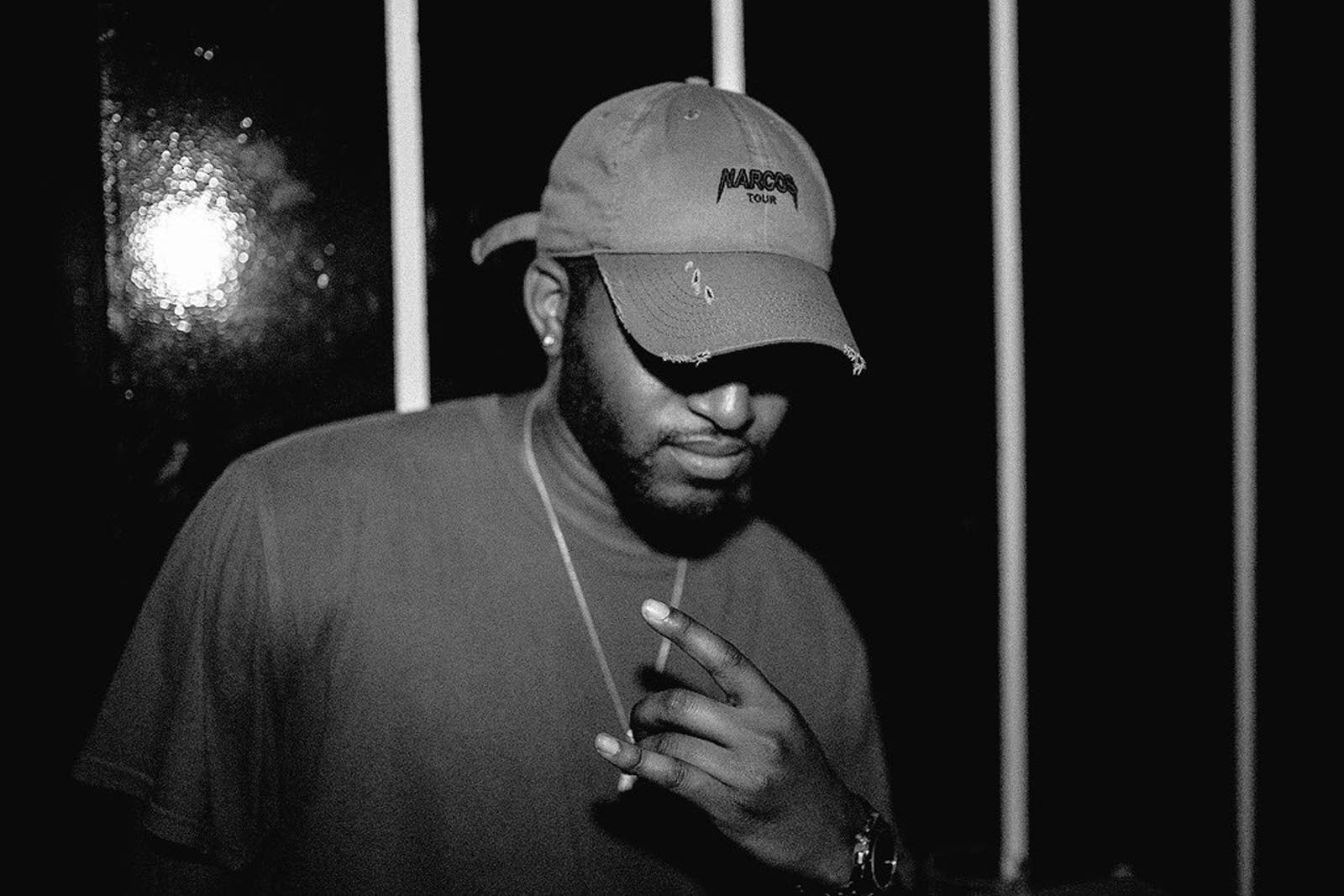
Austin Millz and Chase B (Cactus Jack) holding down the DJ booth turned BR99 into a real night, not a retail night pretending to be one. Their sets had that perfect 2016 mix of polish and chaos, bangers that made the floor feel like a function, not a storefront, with people bouncing between racks and the lounge like the whole building was one long pregame. For me, it was a surreal vantage point to be working in this exact hinge era: right after the blog days, when tastemakers lived on feeds and SoundCloud links, and right as the social era fully took over, when the event itself became the headline and the content. You could feel the shift in real time. The DJ was no longer background ambiance, he was distribution. The crowd was no longer an audience, they were amplification. And BR99 sat right at that crossover, where culture stopped being something you read about the next morning and became something you had to physically pull up to, capture, and prove you were part of.

What stays with me most is how effortlessly the boundaries collapsed. Media became retail, retail became nightlife, nightlife became community, and the sidewalk became distribution. Nothing felt forced because the audience completed the circuit for us, arriving curious, documenting instinctively, and leaving as carriers of the moment. We didn’t have to tell people it mattered; they behaved as if it did, and that behavior gave the experiment its legitimacy. In the years since, entire industries have reorganized around that same loop of presence, participation, and proof, but for one charged week on Greene Street, we watched it assemble itself in real time and had the rare privilege of standing inside the blueprint while it was still warm.
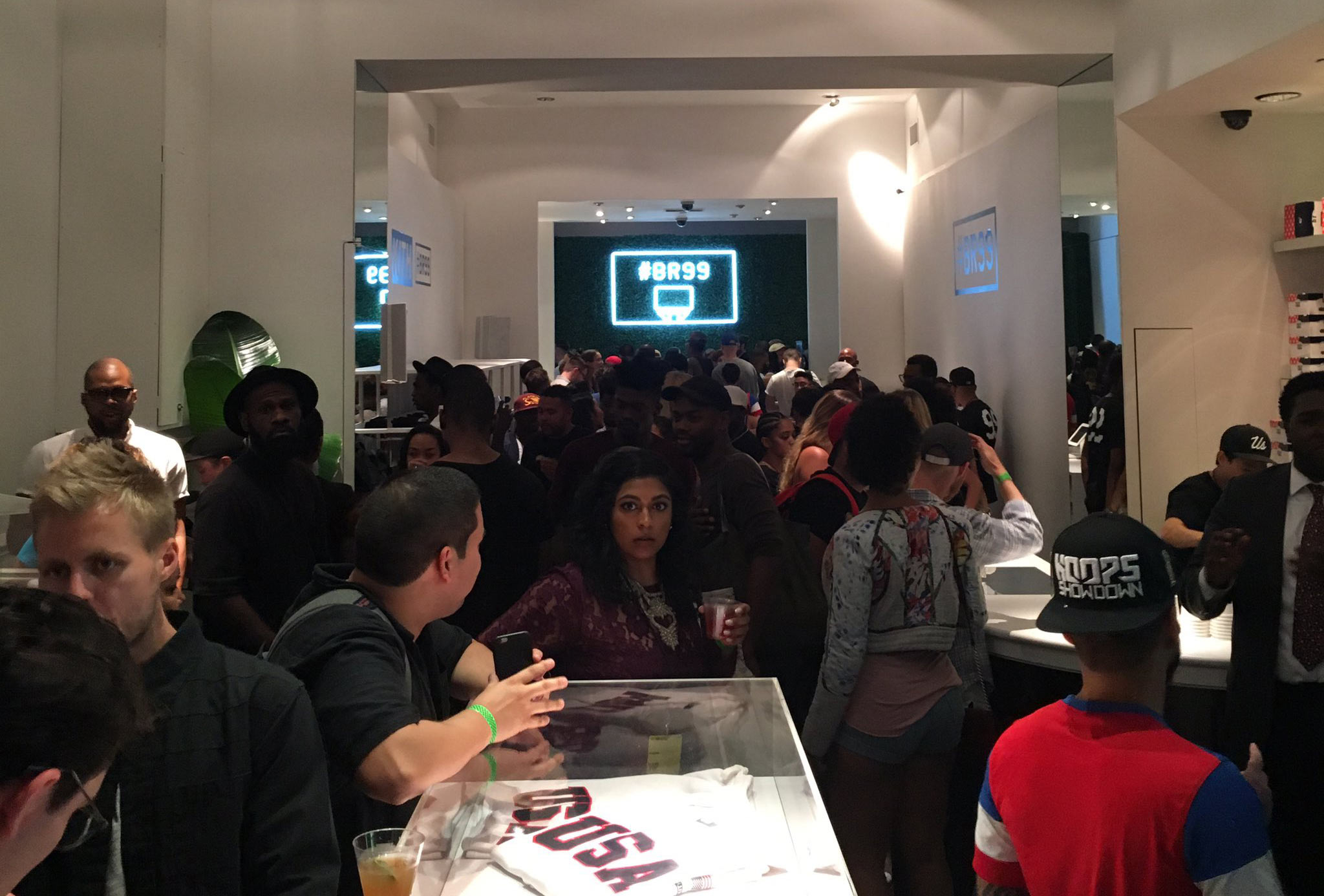
BR99 looked effortless from the outside, but the operational reality was a constant negotiation between ambition and physics: time, budget, staffing, and the simple fact that a store is not a render. We had to design for the peak moments, not the average, because SoHo does not reward “good enough” when the line spikes and the room fills and everyone’s phone is up. The Media Lab in particular demanded a throughput mindset, because delight dies the second a participatory experience becomes a bottleneck, and we had to prevent the line from turning into frustration. Every night was a reset, because the space had to recover from human reality and still open clean the next day, which meant building modularity into furniture, display, and programming zones. The constraints actually sharpened the design, because it forced clarity: what’s essential, what’s noise, what drives the loop, what breaks the loop. That’s the part people don’t see when they scroll the highlights, but it’s the reason the highlights exist in the first place.
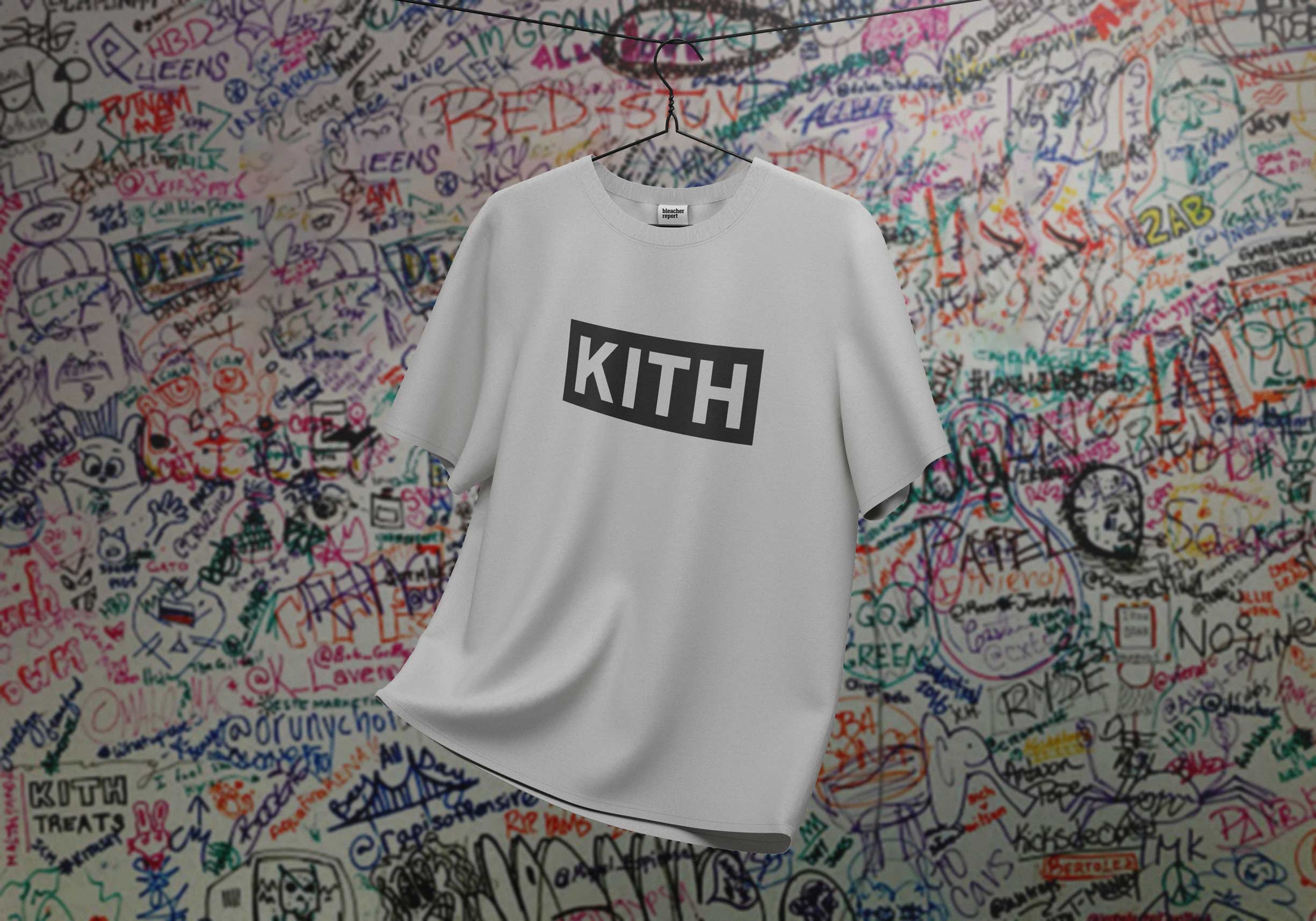
Streetwear and live music were operating on the same frequency that summer, each amplifying the other’s resonance until the line between show and drop blurred into one continuous cultural moment. The crowd dressed like the headliners and the headliners dressed like the crowd, creating a feedback loop where identity was performed in real time through fabric, sound, and presence. BR99 tapped into that overlap deliberately, staging a space where a jersey could carry the weight of merch and a DJ set could feel like a release. The room hummed with anticipation between beats, that charged pause where you could sense something about to crest, as if the racks, the lights, and the bodies packed shoulder to shoulder were all waiting for the same downbeat. It was the kind of resonance you don’t manufacture, only host, and it set the stage perfectly for the moment the music stopped being atmosphere and became the main event.
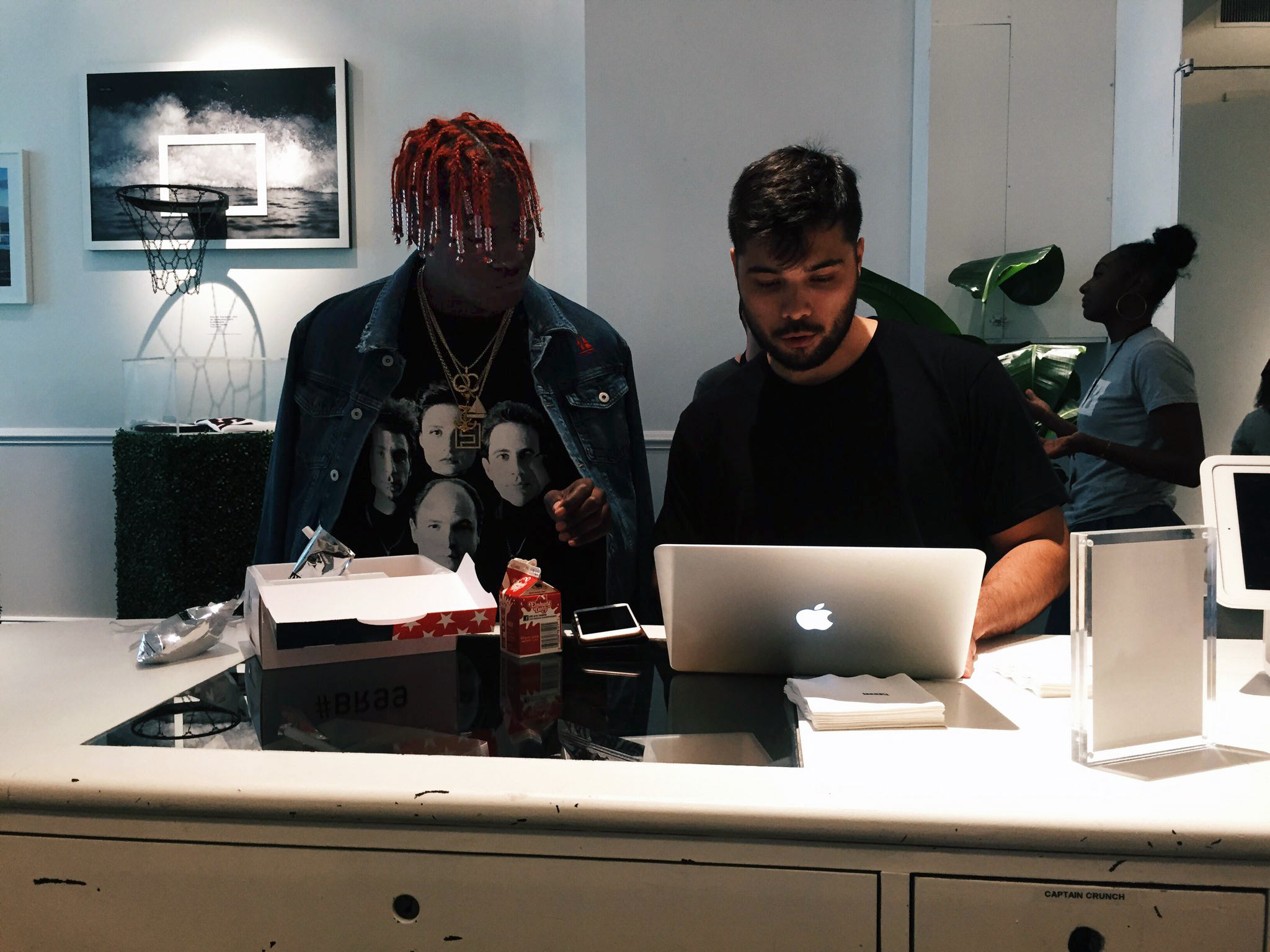
At the time, Lil Yachty was moving with the instinct of someone who understood that geography still mattered, that if you wanted your music to detonate you had to show up where tastemakers, stylists, editors, and the cool kids were actually congregating. New York was still a proving ground, and BR99 had quietly become one of those nodes on the circuit, a place where culture was being filtered, documented, and redistributed in real time. Watching him pull up, linger, and keep circling back over multiple days felt like a subtle affirmation that we had built something credible enough to matter to an artist on the brink of ubiquity. In hindsight, knowing how Lil Boat’s catalog went on to produce bangers, his walkout clip became an all timer, and his songwriting contributions to Drake records entered the modern canon, that casual presence reads differently. It wasn’t a random drop in. It was a future legend stopping through a room that, for a brief window, sat squarely inside the machinery of what was about to go viral.
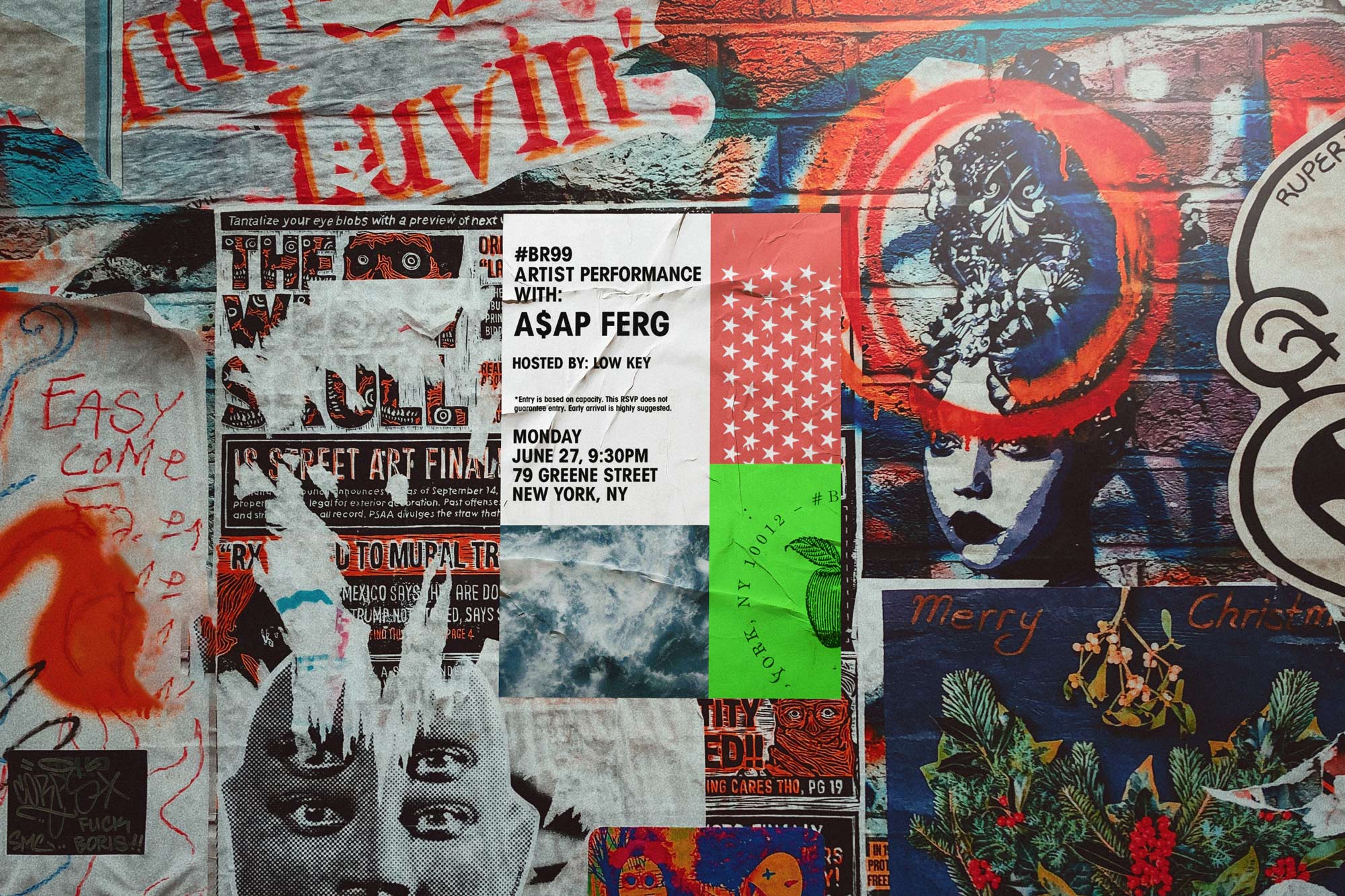
The spirit of A$AP Yams hung over the summer in a way that made every gathering feel like a continuation of the world he helped architect, where music, fashion, and internet mythmaking moved as one organism. Having A$AP Ferg in the mix didn’t read as celebrity cameo; it felt like the city co-signing the space. This was New York’s own ecosystem on display, from Harlem’s swagger to downtown’s gallery cool, collapsing into a single room where kids who grew up on Tumblr mood boards stood shoulder to shoulder with industry gatekeepers. In that context, the activation stopped being a pop up and started feeling like civic infrastructure, a place where the culture could see itself reflected back in real time. For a city that treats authenticity as currency, that validation mattered, and it signaled that what was happening inside those walls belonged to New York as much as it did to Bleacher Report. In the years that followed, similar playbooks would emerge across streetwear, luxury, and sports media, but BR99 demonstrated early that culture, when properly hosted, becomes the most powerful distribution engine a brand can build.
.jpg)
Music was the bloodstream of the space, the element that kept everything in motion and prevented the pop up from ever feeling like a static retail environment. From open to close, a rotating lineup of DJs cycled through the booth, each bringing their own tempo and regional flavor, ensuring that the energy never plateaued. One hour might lean into New York classics and Dipset era anthems, the next into Southern trap or West Coast bounce, mirroring the same cross-regional dialogue that defined Bleacher Report’s audience. The sound design was intentional. We weren’t just playing background music. We were scoring the experience, using rhythm to guide how people moved through the floors, lingered in the lounge, or gathered around activations. Over the eight day run, the booth became a kind of cultural relay. DJs handed the room off to one another, maintaining momentum so the space always felt alive, whether it was a weekday afternoon or a packed evening panel. The music bled onto Greene Street through the open doors, acting as a beacon that pulled in curious passersby and signaled that something was happening inside. It created a continuity between sport, fashion, and nightlife, echoing the reality that for many fans these worlds are inseparable. By treating music as infrastructure rather than ornament, we ensured the pop up never felt like a store. It felt like a living room for the culture, one where the soundtrack was as carefully curated as the product on the racks.
By the time the final weekend arrived, the pop up had evolved from an experiment into a living organism, equal parts retail, clubhouse, gallery, and block party. What began as a question mark for a digital media brand stepping into physical space had become a proof point that culture is not confined to screens. Fans didn’t just browse. They lingered, debated, customized, danced, networked, and documented. The space absorbed their presence and reflected it back, turning spectators into participants. You could feel that shift in the air. This was no longer about product drops alone. It was about belonging.
.jpg)
Closing out the run with A$AP Ferg as the headliner felt less like booking talent and more like sealing the project with a hometown signature. Ferg embodied the exact intersection we were building toward. Harlem energy, fashion fluency, and a deep understanding of how music, sport, and style inform one another. His presence validated the premise that this space was not an outsider’s attempt at culture but something rooted in it. When he stepped through the doors, the room reacted like family welcoming one of its own and erupted in cheers and started bumping up and down to the beat in unison. This felt like a true New York moment happening in real time.
.jpg)
Ferg’s rise alongside A$AP Yams and A$AP Rocky had already reshaped New York’s cultural export, reasserting the city’s influence in a moment when regional sounds were dominating the national conversation. To have him perform in a SoHo retail space that sat between luxury storefronts and streetwear institutions felt symbolic. It was New York compressing its many identities into a single address. Uptown swagger meeting downtown commerce. Rap lineage colliding with fashion capital. The performance didn’t feel staged. It felt inevitable and on some New York shit because the crowd was bouncing and the room was bumping.
.jpg)
As the music started, the architecture of the space seemed to disappear. Floors vibrated, racks rattled, and the crowd surged forward, phones raised, voices layered over the beat. The same walls that had hosted panels and customization sessions became a backdrop for a full blown cultural moment. It was loud in the way New York is loud. Not chaotic, but alive. You could feel the bass in your chest, the kind that makes strangers nod at each other in recognition. For a few hours, the pop up stopped being a store entirely and became a venue, a cipher, a shared memory forming in real time.
.jpg)
What made Ferg’s set resonate wasn’t only his catalog but what he represented. A bridge between streetwear and high fashion, between neighborhood loyalty and global reach. His stamp of approval signaled to fans and industry alike that the experiment worked. This wasn’t a brand borrowing credibility. It was a platform amplifying voices that already defined the culture. In a city that can smell inauthenticity from a block away, that distinction mattered.
Looking back, the performance crystallized the broader ambition of the project. We weren’t trying to replicate existing retail models or chase hype for its own sake. We were testing what happens when a media brand with a massive digital footprint invites its audience into a physical dialogue. The answer was in the way people moved through the space, how they returned with friends, how they posted, tagged, and debated. The pop up became a node in a larger network of fandom, extending Bleacher Report’s presence from feeds into lived experience and from apps to an IRL feeling people could sit with for months to come.

The success of the week wasn’t measured only in foot traffic or social impressions, though both exceeded expectations. It was measured in the subtle indicators. Fans wearing newly purchased pieces out the door. Strangers striking up conversations over teams and artists. Industry figures staying longer than planned because the room had momentum. The kind of organic dwell time that no marketing plan can force. Those signals suggested we had tapped into something durable, not a trend but a behavior.
.jpg)
As the lights came up after Ferg’s set and the final visitors filtered out onto Greene Street, there was a sense that the space had left an imprint on everyone who passed through it, including us. We set out to bridge digital and physical culture and ended up building a temporary landmark in the city’s ongoing story of sport, music, and style. The walls would be cleared, the racks emptied, the signage taken down. But for eight days, in the middle of SoHo, Bleacher Report didn’t just cover the culture. We lived inside it.
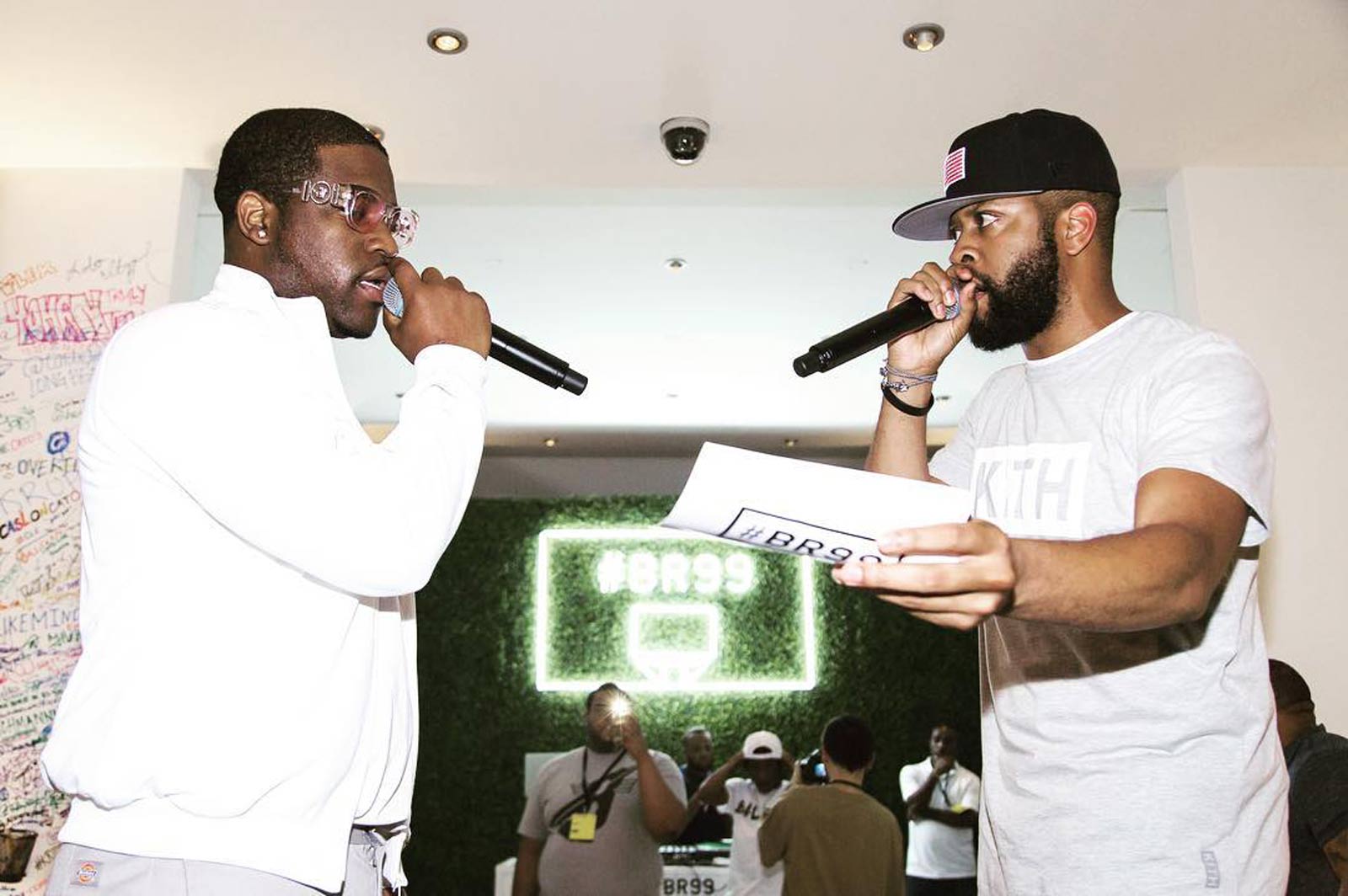
Ferg’s performance felt like the perfect exhale at the end of night seven, a thunderous, sweat-slicked affirmation that the space had become exactly what we hoped it would be. Then came the final night, the cherry on top that no run of programming could have scripted better. Fresh off hearing his name called first overall and stepping into the league as the newest face of Klutch Sports, Ben Simmons arrived to celebrate his draft night in the very space that had tracked his rise, debated his potential, and welcomed him weeks earlier as a prospect. The energy was different from the concert. Less chaotic, more electric with possibility. Overnight he had become an NBA player and a multimillionaire, but inside those walls he was still a young athlete surrounded by fans, friends, and collaborators who had witnessed the journey in real time. Cameras flashed, music pulsed, and conversations blurred into a hum of congratulations and future talk. It was a fitting final note. A pop up built on the idea of proximity to culture closing with a moment where sport, business, fashion, and media converged around a single life changing milestone.
.jpeg)
Working alongside Klutch Sports around the pop up created a rare proximity to the machinery behind modern athlete branding, and building relationships with Rich Paul, Farah Leff, and Luc Newton offered a masterclass in how talent, narrative, and opportunity are orchestrated at the highest level. Rich moved with a clarity of vision that made it obvious he was not only representing players but reshaping the power dynamics between athletes and the industries that profit from them. Farah brought a sharp operational intelligence, ensuring every appearance, activation, and brand touchpoint aligned with long term positioning rather than short term hype. Luc operated at the intersection of culture and logistics, translating big ideas into moments that felt effortless to the public but were anything but behind the scenes. Being in dialogue with them inside a space we built from scratch reinforced that BR99 was not a sideshow. It was a credible platform where sport, business, and culture could meet on equal footing.
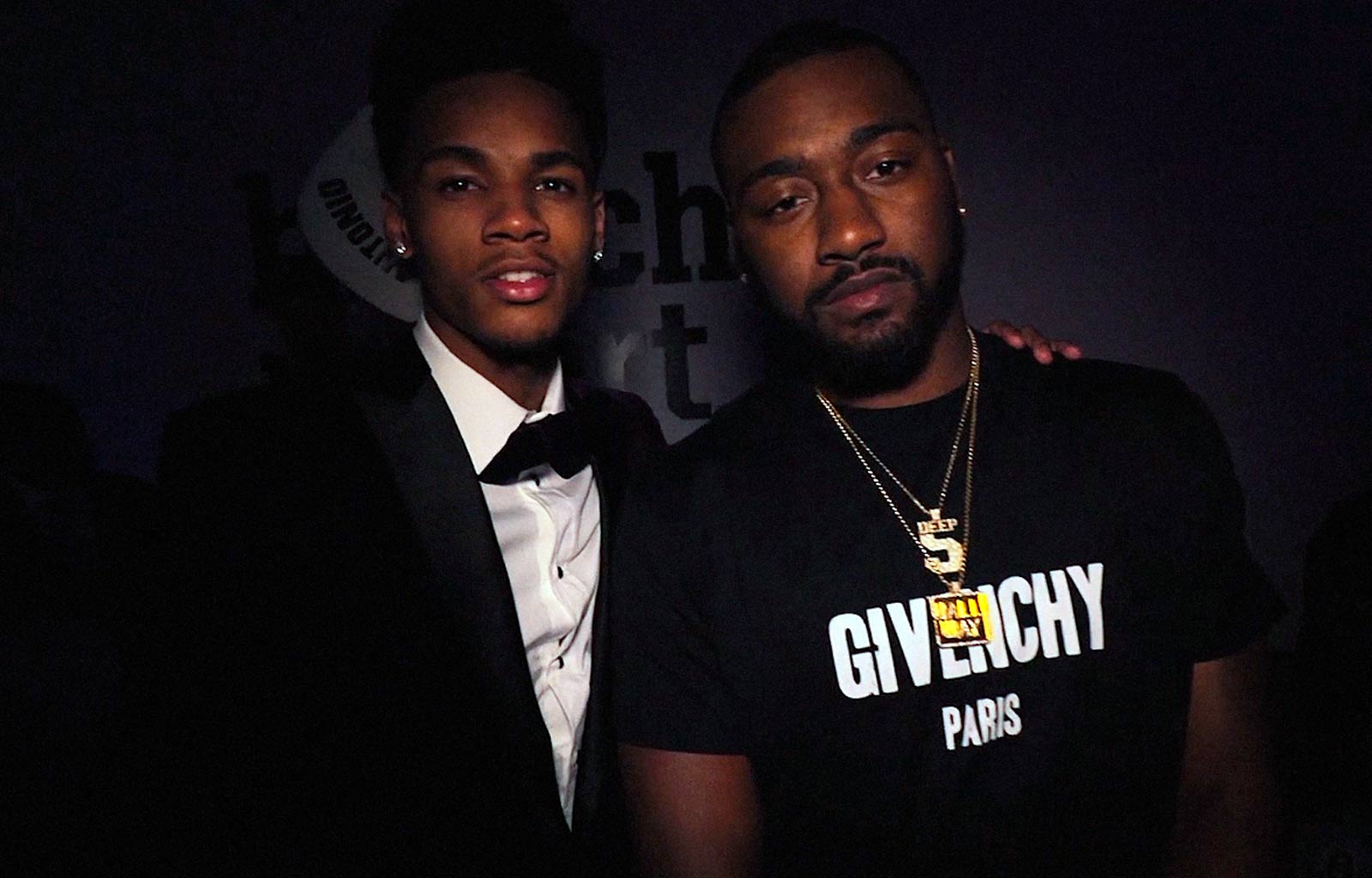
Throughout the eight day run, fans who couldn’t make it to SoHo still experienced BR99 in real time through our Snapchat and Instagram Stories, which became an extension of the physical space rather than a highlight reel after the fact. The coverage was intentionally raw and immediate. Vertical clips of lineups forming on Greene Street, quick interviews with visitors, behind the scenes moments in the Media Lab, and surprise drop ins from figures like Michael B. Jordan or visiting athletes all unfolded in a way that felt unfiltered and personal. Instead of polished recaps, we shared the atmosphere as it happened, letting followers feel like they were standing in the room, hearing the music, seeing the merch up close, and witnessing spontaneous moments as they emerged. That intimacy reinforced the authenticity of the experience and underscored a core belief behind the project: the space belonged to the community as much as it did to the brand, whether you walked through the door or followed along from your phone.

Draft night amplified that legitimacy. While Ben Simmons’ selection marked the headline moment, we also celebrated Dejounte Murray going 29th to the San Antonio Spurs, a reminder that the league’s future is built across the full spectrum of picks, not only the lottery. The energy in the room carried a sense of arrival for both players, families, and the ecosystem supporting them. Agents, creatives, media voices, and fans were shoulder to shoulder, witnessing careers begin in real time inside a space designed to honor that journey. And when John Wall, another Klutch athlete and established star, pulled up to show love, it underscored the trust being built. His presence signaled that what we were creating resonated not only with prospects chasing their moment but with veterans who understood the value of culture done right.

Over 6,200 visitors passed through the space, generating nearly 45 million social engagements and coverage from GQ, Vogue, and Hypebeast, but the true impact was qualitative. We proved that a media brand could manifest physically without diluting its voice, and that experiential retail could function as both a revenue driver and a brand building engine. For me, #BR99 crystallized a larger lesson about the future of media brands. The lines between content, commerce, and community are porous. When you give fans the tools to participate, when you materialize a digital identity into spaces they can inhabit, the brand stops being something they follow and becomes something they belong to. That shift from audience to community was the real success of the pop up, and it set the stage for how Bleacher Report would continue to show up in the world beyond the screen. This was the basis for future All Star events and more because it set the stage.
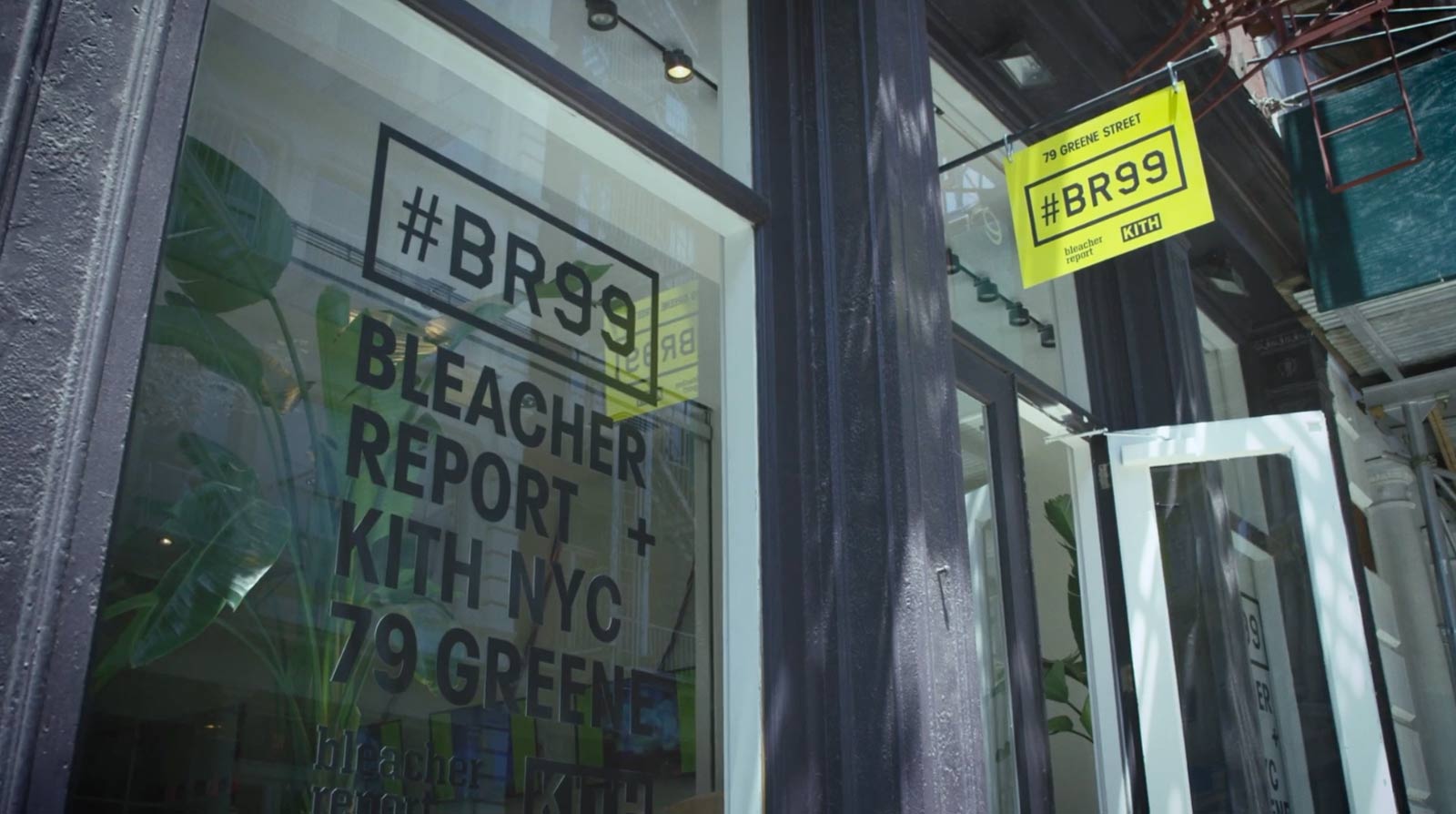
Internally, the project carried real risk. Bleacher Report was a digital-first publisher stepping into one of the most expensive retail corridors in the world with no guarantee that online affinity would translate into foot traffic. There were valid concerns around operational complexity, brand dilution, and whether a media company could credibly inhabit a fashion context without feeling opportunistic. BR99 answered those questions in public. The turnout, press validation, and organic athlete participation demonstrated that the brand’s cultural authority extended beyond screens, giving Turner confidence to explore new revenue models and physical activations that would have been difficult to justify without this proof point. A defining success factor was restraint. In a neighborhood hypersensitive to inauthenticity, the space avoided the visual noise and over-branding typical of media activations. We prioritized negative space, material integrity, and disciplined merchandising so the environment read as a legitimate retail concept rather than a themed installation. That restraint signaled confidence and cultural fluency, allowing the brand to feel native to SoHo’s ecosystem instead of interrupting it. The result was a space that invited documentation without begging for it, an important distinction in an era when audiences can instantly detect when something is engineered for clout.
Being in New York gave the pop up an added gravitational pull, the sense that it was plugged into a city where culture doesn’t just happen but compounds. This is a place where a block can hold as much mythology as a museum, where Dimes Square conversations ripple into trends, where a drink at Bemelmans Bar sits in the same lineage of spectacle and scene-making as Studio 54. In that context, the shop wasn’t an isolated activation, it was part of a living circuit of taste, art, nightlife, and sport that only coheres in a city dense enough to hold all those frequencies at once. To design here is to accept that your work enters a continuum, measured against decades of iconic spaces and fleeting moments that somehow become permanent in collective memory.
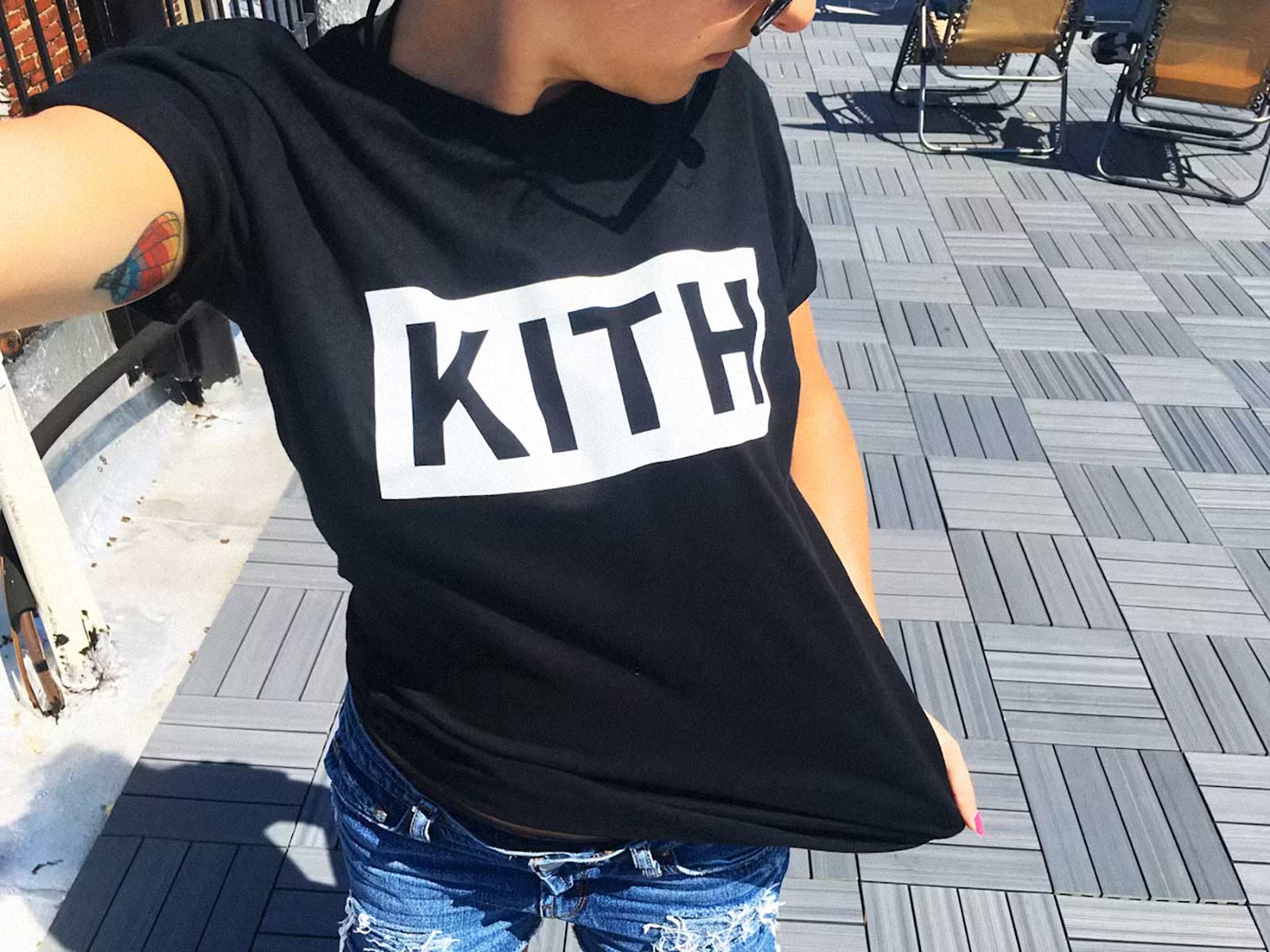
The funniest part about real cultural real estate is it never stays still, it simply gets reinterpreted by the next wave. Today, 79 Greene Street is a Loewe flagship, which feels like the cleanest punctuation mark on what BR99 represented at the time. A decade later the address is still doing the same job: hosting brands that understand craft, narrative, and experience as the product, then using space as a medium to convert attention into memory. Seeing Loewe there reframes BR99 in hindsight as an early signal of where the whole market was headed, toward immersive retail environments that behave like galleries, studios, and social stages at once. The walls changed, the fixtures upgraded, the clientele shifted, but the premise stayed consistent: SoHo rewards brands that can translate identity into physical form with taste and rigor. That’s why I love the detail. It’s a reminder that we didn’t borrow a storefront, we occupied a cultural runway for a week and proved we belonged on it. And if you know, you know: for eight days in 2016, that address spoke fluent Bleacher Report and millenial vibes for just the right amount of time. But hey, you know we on a new level.
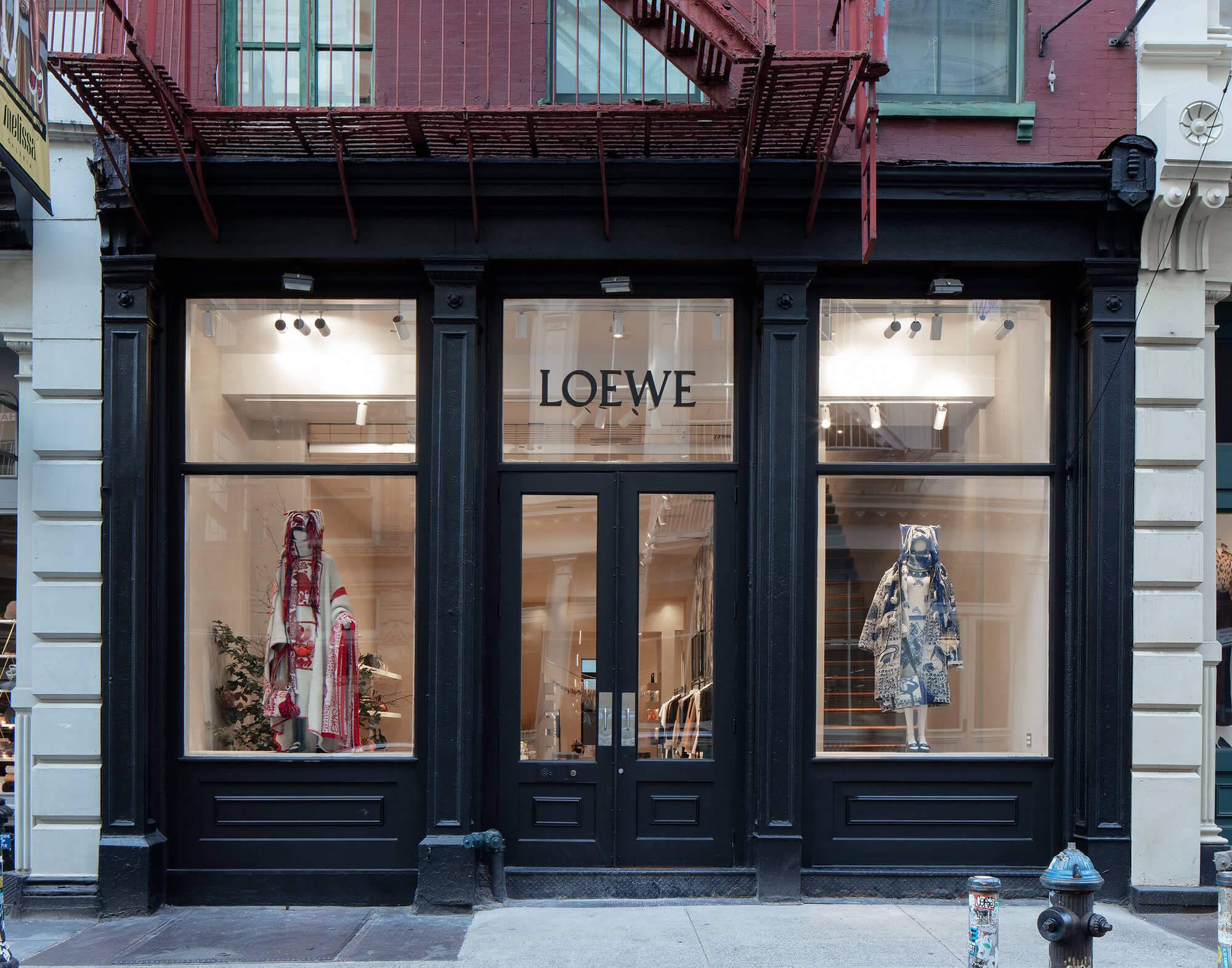
BR99 didn’t stop at proving we could sell product. It validated a repeatable format Turner and B/R could scale, the idea that a sports media brand could build physical moments that fuse drop mechanics, athlete access, and content capture into one flywheel. That’s the DNA that eventually evolved into our “drop up” model and later informed B/R Kicks as an experiential platform, not only a content vertical. Same core playbook, refined: limited product as the hook, community as the fuel, talent as the spark, and real-time social distribution as the multiplier. The point wasn’t a one-off pop up. It was showing the business that experiential commerce could be a system we owned, where every event drives revenue, creates stories, and recruits the next wave of fans who want proof they were there. What surprised many of us was the range of people the space attracted. Alongside sneaker kids and streetwear regulars were parents with their children, international tourists, longtime Knicks fans, and media veterans curious to see how a digital-native brand translated to physical form. That cross-generational mix reinforced that sports culture operates as a shared language across demographics, and that when framed through design and participation rather than nostalgia alone, it can welcome both the initiated and the newly curious. BR99 didn’t segment its audience. It created a common ground where multiple definitions of fandom could coexist.

What people carried with them was not only a purchase or a photo but the feeling of proximity. BR99 collapsed the distance between the culture fans consumed and the people who shape it, allowing them to stand in the same room as athletes, artists, and designers they had previously only encountered through screens. That proximity created memory, and memory creates loyalty. Long after the signage came down, the stories continued to circulate, in group chats, on timelines, and in the way people referenced “being there” as a marker of belonging. That emotional residue, more than any metric, is what transforms an activation into a cultural moment. As a prize for scrolling all the way to the bottom of this page of the portfolio, I would love to showcase you a blast from the past with our very own Call him Renny NYCs own doing the Running Man Challenge in the most 2016 pop up shop energy video ever. Sit back, throw on some passionfruit by Drake in the background and enjoy the best summer in recent memory the way it was meant to be enjoyed. Part of BR99’s magnetism came from its built-in impermanence. In a moment just before every cultural event defaulted to full livestream coverage, the experience retained a sense of “you had to be there” urgency that drove turnout and documentation.
The BR99 pop up was more than an activation. It was a moment when a digital voice learned how to occupy space, when timelines became hallways and memes became objects you could hold. On Greene Street, in a neighborhood accustomed to fashion drops and gallery openings, Bleacher Report proved it could belong to the same cultural conversation, not by imitating streetwear or chasing hype but by translating its own language into something physical and participatory. Fans did not arrive as consumers. They queued, created, documented, and carried the experience back into the feeds that first brought them there, completing a loop between digital and real that felt native rather than engineered. For me, it was the project where events stopped being line items and became living systems, environments where design shapes behavior and community gives the work its afterlife.
Key Collaborators: Bennett Spector, Philip Annand, Mike Chen, Will Lievenberg, Sivan Raya, Oruny Choi, WB Meech, Christian Pierre, Lance Fresh, Isis Haywood, Matt Sanoian, PJ Selzer, Rory Brown, Rich Paul, Farah Leff, Luc Newton
Tools: Adobe Premiere, After Effects, Final Cut Pro.
Deliverables: Event Space, Experiential Activation, Retail, Apparel, Interactive Experience, Social Content