

Mitchell & Ness and Bleacher Report, in collaboration with the NBA and its member teams, launched a limited-edition apparel collection designed by some of hip-hop’s most influential voices, each reimagining the visual identity of their hometown franchise across T-shirts, hoodies, shorts, hats, and jerseys. The capsule lives squarely at the intersection of sport, music, and civic pride, transforming team gear into a canvas for storytelling about place, memory, and cultural lineage. Each piece channels what fans hold sacred about their cities, from neighborhood iconography to sonic heritage, creating garments that function as both uniform and personal manifesto. As a consulting creative director, I helped shape the vision, conceptual framework, and cultural positioning of the project, ensuring it felt native to Bleacher Report’s voice while elevating it into a true commerce-driven brand moment. My focus was on infusing the collection with the same energy, irreverence, and cultural fluency that powered our social presence, guiding everything from early concept development to talent alignment and narrative cohesion. The result helped evolve Bleacher Report into a credible destination for sports e-commerce, proving we could convert cultural capital into tangible product without diluting authenticity. By fusing hip-hop and basketball at the hyperlocal level, we sparked conversations among the very communities that dictate taste and influence, positioning the collection not simply as merchandise but as a living artifact of modern fandom.


“Every basketball player wants to be a rapper” - Kevin Durant
The purpose of the collaboration was to invite some of hip hop’s most influential voices to show love for their hometowns by reimagining NBA throwback jerseys through their own cultural lens, and my focus sat squarely at the intersection of design, talent, and creative direction to ensure the project felt culturally authored rather than commercially assembled. Building on the momentum of our rappers in NBA jerseys social series, I helped evolve the idea into a fully realized product ecosystem, guiding the visual language, material storytelling, and brand cohesion across jerseys, tees, hoodies, shorts, and hats so that each piece carried the weight of local pride and personal narrative. I worked closely with the artists to translate their relationships to their cities into design motifs, color stories, and logo reinterpretations that honored team heritage while introducing a fresh, music driven point of view. In parallel, I collaborated with Jake Cohen and Justin Dreyfuss on talent selection, advocating for artists whose credibility and regional influence would resonate authentically with fans and whose creative instincts could push the work beyond surface level customization. My role extended through art direction and launch storytelling, ensuring that the social packaging, campaign visuals, and rollout moments reflected the voice we had built across platforms and felt native to the culture that birthed them. Seeing fans connect with the work on a tangible level through products they could wear and collect was especially meaningful, and the process also gave me a deeper understanding of the supply chain, production constraints, and operational choreography required to bring culturally sensitive design from concept to physical reality at scale. The end result was not simply merchandise but a series of culturally charged artifacts that allowed fans to wear their city, their music, and their team allegiance in one unified expression, reinforcing Bleacher Report’s position at the crossroads of sport, style, and community.


.jpg)

Bleacher Report has established itself as the definitive sports media brand for hyper-connected Millennial and Gen Z fans, delivering experiences that collapse the boundaries between sport, culture, music, fashion, and digital community. Our mandate has always been to live beyond the game, transforming fandom from passive viewership into active cultural participation. This collaboration embodied that mission by translating the emotional resonance of basketball into wearable storytelling, meeting fans where identity, nostalgia, and self-expression intersect. Rather than treating merchandise as a peripheral revenue stream, we approached it as a medium through which fans could physically inhabit the culture they engage with daily across our platforms. Mitchell & Ness brought an unmatched authenticity rooted in decades of NBA heritage, with throwback jerseys that carry the memory of childhood heroes, playground debates, and the golden eras of the sport. By layering Bleacher Report’s contemporary design language and social-first sensibility onto that legacy, we created a bridge between past and present, honoring the mythology of the game while making it legible for a new generation. The result was a collection that felt both archival and immediate, leveraging nostalgia as a foundation while amplifying it through modern storytelling, digital activation, and culturally fluent creative direction.
%20(1).jpg)
Mitchell & Ness throwback jerseys have long occupied a sacred space at the intersection of sports heritage and hip-hop style, a crossroads where Bleacher Report’s brand identity naturally resides. Partnering with them allowed us to translate that shared cultural DNA into a contemporary expression that honored nostalgia while reframing it through a modern, music-driven lens. Rather than treating the archive as static, we activated it, applying Bleacher Report’s design language and cultural fluency to re-contextualize classic NBA iconography for a generation that experiences the game as much through playlists, tunnel fits, and Instagram feeds as through the hardwood itself. Through Mitchell & Ness’ longstanding licensing relationship with the NBA, we were able to secure official team marks and invite artists to reinterpret the logos of their hometown franchises, weaving in visual cues from album artwork, personal branding, and regional symbolism. This approach transformed each piece into a narrative artifact, merging civic pride, sonic identity, and basketball mythology into a single garment. The collaboration mirrored what already exists courtside, where Hollywood, hip-hop, and professional sports converge in real time, making the collection feel less like a manufactured crossover and more like a natural extension of the audience’s lived reality.
The genesis of the project was rooted in the cultural momentum our social team had already built at the intersection of basketball and hip-hop, where our content was consistently outperforming benchmarks and organically circulating through the very communities we aimed to serve. BR Kicks, Social Moments, and our hip-hop–inflected illustrations weren’t just generating engagement, they were being reposted by the artists themselves, validating that we were speaking the language of culture rather than observing it from the sidelines. We recognized that this wasn’t a fleeting trend but a durable signal, and that securing access to NBA marks through a partnership could transform our viral digital storytelling into a tangible capsule that fans could wear, collect, and identify with.
From pilot formats like the Lonzo Ball and 21 Savage “Finish The Lyric” episode to graphic explorations that merged sneaker culture with team iconography, the connective tissue was always the same: shared cultural touchpoints where sport and music amplify one another. My role was to help translate that energy into a cohesive creative and commercial framework, ensuring the collection felt like a natural extension of the content ecosystem we had cultivated rather than a forced brand exercise. By elevating what was already resonating on social into product and experience, we moved from documenting culture to actively shaping it, giving fans a way to participate in the crossover they were already living every day.

The NBA Remix capsule has been a great way to connect the rich history of the league with a current, influential artists and I helped conceptualize and execute this as a consulting art director and social media integrated marketing strategy standpoint. Bleacher Report lives at the intersection of sports and culture, and the NBA Remix Collection is probably the best physical representation of this mission. Jake Cohen, who was brought in to build out our e-commerce team worked closely with myself Lance Fresh and Ryan Hurst and our social team to help build out the initial strategy and consult throughout the process on design, social packaging and more. Our mission was to take the DNA from these projects and figure out how we could infuse it into a clothing collection.
The project was a pilot for us to take some of the investment that Turner had infused into Bleacher Report to create new revenue streams to help diversify our ability to create content and reach our consumers in a very competitive sports media marketplace. We new we had traction with the success of BR Kicks and the social posts that we had done on this topic, and this project felt like the right thing to kick off by bringing that brain trust together and asking how we could take it to the next level, thankfully Mitchell and Ness helped us to do exactly that and taking the concepts pitched in those brainstorm sessions to reality.

As can be seen with projects like the sports inspired NBA artwork I created in collaboration with Will Lievernberg to fill a conference room in our New York offices, Bleacher Report has always sat at the intersection of sports and culture, we truly lived and breathed it and so the jersey concept felt like a great evolution of this. The NBA Remix collection and future drops all fuse hip-hop music and basketball at the local level, with innovative designs that will drive conversation amongst a community of fans who are the new vanguard of style. These tastemakers and cultural influencers were the target audience for drops like these.

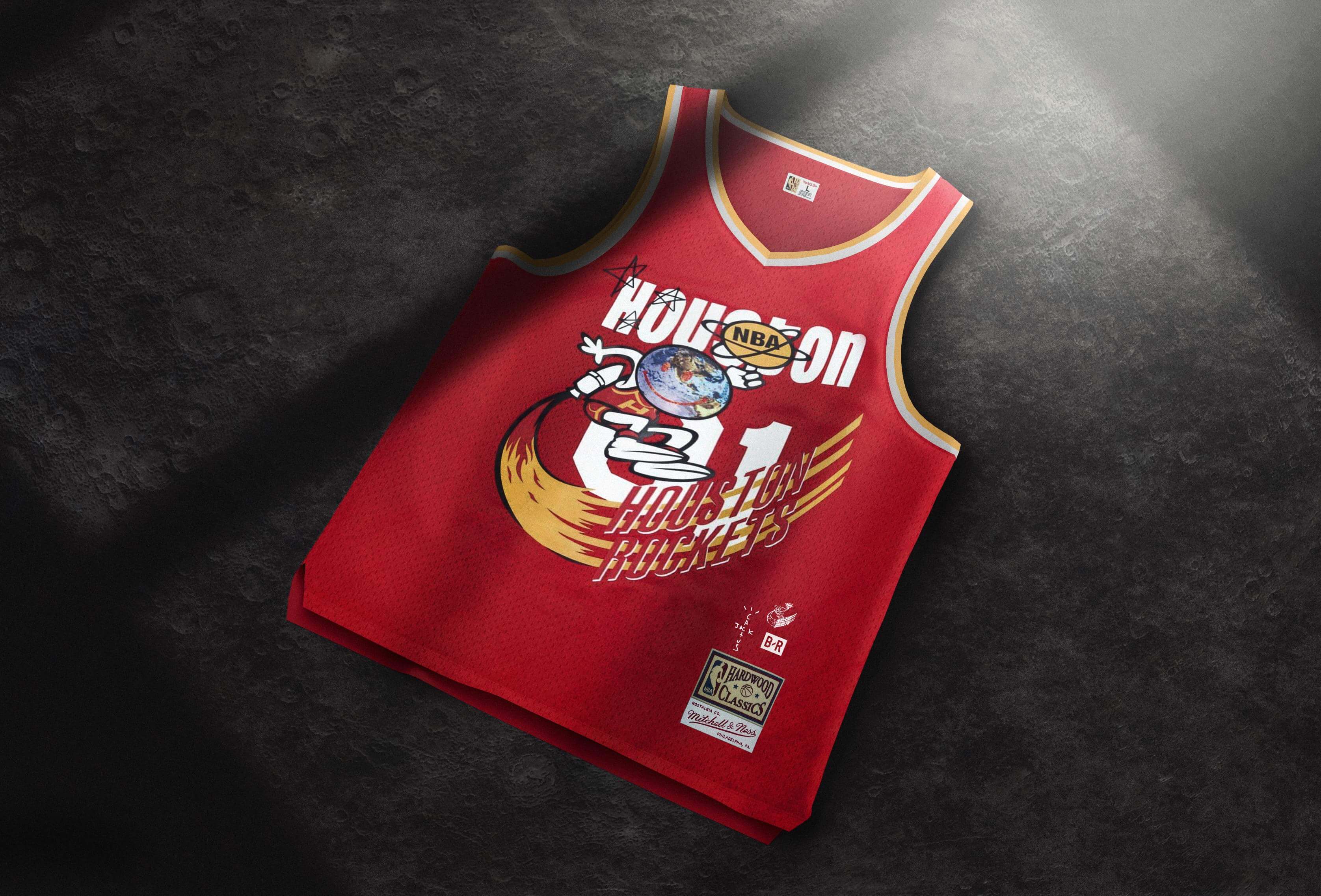
The initial pilot capsule featured Travis Scott with a Houston Rockets jersey before expanding to include more artists in the subsequent drops. The idea was to take the classic jerseys and heritage of the team and all of their old brand elements, and some of the rapper and label imagery and visual assets and look and feel to combine together and tell a compelling story about the team, the music and the city as a way to really authentically connect with the fans.
.jpg)
Mitchell and Ness handled production and fulfillment while we worked to develop the visual language, the social promotional assets, the e-commerce shop on our end along with an original shoot with Travis Scott and other rappers over time as well as can be seen above. The products found a solid amount of success online and we even eventually expanded to pop up and retail installations with Mitchell and Ness down the line.
.jpg)
As we expanded the collection to include more artists and more cities, I stayed on to help provide creative development and feedback, but my primary contributions were really in setting the backbone for this project and proving viability through our NBA x Hip Hop content on social and paving the path and coming up with the concept for this type of a collaboration between a media company like Bleacher Report and a clothing company like Mitchell and Ness.I was glad I had a chance in being able to shape and art direct the concept while finding unique ways to activate around it, like AR filters.
.jpg)
One of the really cool ways that I was brought in to socially package and promote the jersey launch on social was to create an augmented reality filter under our BR Kicks banner for Instagram, Snapchat and TikTok that was released to the public through our social media channels and drove over 25+ Million engagements and counting to this day. This allowed me to tap into our innovation team and bring in our kicks vertical to promote while finding fresh ways to engage our fans. We initially put out a teaser asking if fans wanted us to drop the filter, and after an overwhelming amount of comments we released the filter. The snapchat lens is still available to test out right here.
.jpg)
Packaging and developing and originating this type of a concept NBA Remix partnership with Mitchell and Ness was something that would set the stage for a lot of growth for new revenue streams. We were able to take what we were really good at in the social and pop culture world, and expand it to include e-commerce and merchendise in a meaningful way. A great example is the James Harden x Travis Scott "Yosemite" mix tape that Ryan Hurst helped put together for this launch as seen here.
What was great about his NBA remix project was that it really helped us build inroads at places like Interscope and Universal and paved the way to further partnerships with these labels to vertically integrate our social channels for album releases and other collaborations, as perfectly reference by the subsequent Cactus Jack collaboration to promote Highest in the Room with a mixtape that we worked on with Luis Domingo and Ryan Hurst on for the start of the season.

Over time, we began to really expand the collection with the likes of ScHoolboy Q for the Los Angeles Lakers, Future for the Atlanta Hawks, Big Sean for the Detroit Pistons, Wale for the Washington Wizards, The Diplomats for the New York Knicks, E-40 for the Golden State Warriors, No Limit for the New Orleans Pelicans, and DJ Khaled for the Miami Heat. These collections gave us more room to experiment with the type of designs, the pattern usage and how far we could dive into the individual personality of each rapper. You can see us really try out cool things like the metallic text, the tie dye, the graffiti typography and even the 3D extrusions.
.jpg)
A critical part of my contribution to the launch centered on brand positioning and ensuring the collection landed as a cultural moment rather than a standard merch drop. I worked closely with marketing and social teams to architect a rollout strategy that mirrored how fans actually discover and validate style within basketball and hip-hop ecosystems. This included creative direction for social-first storytelling, intentional seeding with artists and athletes at high-visibility touchpoints like NBA All-Star Weekend, and embedding the pieces within organic cultural moments rather than relying solely on paid media. We explored experimental vehicles such as curated mixtapes, augmented reality filters, and platform-native content formats to extend the narrative beyond product into experience, reinforcing Bleacher Report’s role as a cultural tastemaker. By treating the capsule as both a brand statement and a community activation, we were able to build authenticity, drive demand, and position the collection as a natural extension of the voice we had cultivated across social and live events.

Beyond the limited-edition jerseys, we built out a full ecosystem of companion apparel including t-shirts, hoodies, long sleeves, hats, shorts, and accessories, ensuring the collection met fans at multiple entry points rather than positioning itself as an unattainable drop. This tiered pricing strategy, ranging from $40 to $175, was intentional: it democratized participation in the moment, allowing younger fans and streetwear collectors alike to engage with the collaboration without being priced out. The pieces were released in limited quantities through the Bleacher Report Shop, preserving a sense of scarcity and cultural currency, and as expected, the most coveted items moved quickly, reinforcing both the authenticity of the partnerships and the pent-up demand at the intersection of hip-hop, basketball, and lifestyle culture.
.webp)
From the Dipset eagle stamped across a New York Knicks classic to the flaming key DJ Khaled emblazoned on a Miami Heat swingman, the NBA Remix collection crystallized how deeply hip-hop and basketball aesthetics are intertwined. Each piece functioned as both uniform and album cover, layering hometown pride, sonic identity, and visual iconography into garments that felt culturally lived-in rather than manufactured. These remixed jerseys spoke to the full sensory experience of the game: the basslines in the arena, the colorways on the hardwood, the cadence of local slang, the mythology of block legends turned global stars. The Detroit collaboration with Big Sean exemplified this ethos, translating Motor City grit and optimism into wearable form, a story compelling enough to earn coverage from WXYZ Channel 7’s ABC affiliate, underscoring how a hyperlocal narrative could resonate on a broader cultural stage.
We rarely had the luxury of extended access to the artists, which meant the creative process had to be both efficient and deeply collaborative. Working in tight windows alongside record labels, talent teams, and management, we developed the jersey designs iteratively, gathering feedback in real time and refining details until each piece felt authentic to the artist’s voice and hometown story. Securing photoshoots ahead of release added another layer of complexity, requiring precise coordination across multiple booking agencies and label schedules to ensure the talent could show up and represent the product in a way that felt natural rather than staged. December 32nd’s Justin Dreyfuss was instrumental in navigating these relationships, leading artist and label procurement for an all-star roster of collaborators and helping translate creative ambition into executable partnerships that ultimately brought the collection to life.

On our Kicks vertical and at events like BR Drop Up, we are always talking about how the NBA pregame tunnel has become it's own fashion runway of sorts with the images regularly appearing on our instagram timelines where we break down their sneakers and their fits. On the Friday February 28th game against the Brooklyn Nets, our very own Atlanta Hawks All-Star Trae Young actually rocked our NBA remix jersey en route to a dub. The idea was to take the merchandise on a tour and help it feel true to the NBA.
The NBA Remix project created a rare full-circle moment when we were able to seed Trae Young with one of the custom pieces ahead of the Brooklyn matchup, building on our earlier collaboration with Intel around their 360 camera technology. Seeing him arrive in the jersey was validation in itself, but hearing him talk about it postgame elevated the project beyond a typical product drop. When he said it was the kind of jersey you wear once and then get framed, he articulated exactly what we had been aiming for: transforming merchandise into memorabilia, something that lives at the intersection of sport, culture, and personal history rather than existing as disposable fan gear.
.jpg)
Over on the West coast, we had SchoolboyQ rock his TDE x Lakers jersey courtside to witness LeBron drop a 40 piece while Lakers sharpshooter Danny Green took to the pregame tunnel to rock his collar jersey with Top Dawg Entertainment and the Lakers with a california dreaming blue hue. We were making sure to show up where the action was to embed ourselves into the culture in an authentic way and it doesn't get any bigger than celebrity row at Staples.
.jpg)
Another tangible seeding opportunity and chance to interact with fans came with Mitchell and Ness having a presence at the 5th avenue flagship NBA store where we were able to do a Jersey signing event and fan meet and greet. It's really great to see fans react to the merchandise and hold the actual product, and the success of this would bolster our confidence in future pop up shops with the NBA remix brand at things like Art Basel and Fashion Week.
The customized Hardwood Classics Knicks jersey became a living artifact of New York’s early-2000s cultural moment, when hip-hop, basketball, and street fashion fused into a single visual language. With the Diplomatic bird cresting the chest and “Harlem” stretched across the back, the piece reframed the jersey from a sports uniform into a civic banner, one that spoke to borough pride, mixtape era bravado, and the unapologetic style that defined the city at the time. On Fifth Avenue, the energy around the release felt less like a retail drop and more like a neighborhood block party transplanted into Midtown, where tourists, locals, and longtime fans recognized the garment as a symbol of a specific New York rhythm: Dipset anthems blaring from passing cars, the orange and blue of the Knicks stitched into daily life, and a fashion sensibility that treated jerseys as statements of identity rather than mere fan gear.
.jpg)
A large part of this project was about taking advantage of existing supply chain realities and our capabilities to market and scale a collection like this. Mitchell & Ness x Bleacher Report is a partnership that allows both brands a continuous momentum into the area where sports and entertainment collide together to bring iconic lifestyle apparel and headwear capsule collections to market. Camron had just released Purple Haze 2 and this aligned with their press tour so they were down to do things like sit courtside at the Knicks game or go to the NBA store to promote the collection and get fans excited about the drops.

For a heritage brand like Mitchell & Ness, which had long been revered by purists and hardwood nostalgists, this collaboration marked a strategic inflection point toward broader cultural relevance and lifestyle positioning. By tapping into hip-hop’s influence and the storytelling power of hometown pride, the brand was able to transcend its “throwback jersey” perception and enter a more expansive streetwear and lifestyle conversation. The project positioned Mitchell & Ness not only as a steward of sports history but as an active participant in contemporary culture, aligning with parallel partnerships of the era, including high-profile collaborations with labels like BAPE, that signaled a deliberate move into fashion-forward, cross-cultural spaces. With Bleacher Report’s digital audience in the tens of millions and our deep fluency in the overlap between hip-hop and sports fandom, we were uniquely positioned to amplify the collaboration at scale, ensuring it resonated not only with core hoop heads but with a global, culture-first generation. In this context, the jerseys functioned as more than archival reproductions. They became cultural artifacts that lived at the intersection of sport, music, and style, enabling the brand to engage new audiences who may never have stepped onto a court but deeply identified with the aesthetic and identity the pieces represented.
.webp)
As the project gained momentum, we expanded the scope with a second wave that deepened both the cultural reach and geographic authenticity of the collection. Artists like Aminé with the Portland Trail Blazers, Big Boi with the Atlanta Hawks, Denzel Curry with the Miami Heat, A$AP Ferg for the New York Knicks, Joey Bada$$ with the Brooklyn Nets, and Lute from Dreamville representing the Charlotte Hornets brought hyperlocal credibility to each release, turning every drop into a hometown moment rather than a generic collaboration. This steady expansion wasn’t about scale for its own sake, it was about building a living map of basketball and hip-hop fandom across the country, pairing voices who embodied their cities with teams that shaped their identities. With each release, the project evolved from a successful capsule into a cultural platform, widening its purview while proving that when the right artist meets the right franchise, merchandise can become memory, pride, and storytelling all at once.
%20(1).webp)
For Millennials who came of age in the golden era of music television, Mitchell & Ness throwbacks weren’t merchandise, they were cultural currency. From late-night BET rotations to MTV countdowns, original NBA, NFL, and MLB jerseys from the Philadelphia brand became a visual shorthand for credibility, regional pride, and deep sports knowledge. Rappers wore them not as costumes but as declarations of lineage, signaling where they were from and who they represented. That legacy created a powerful foundation for our collaboration because we weren’t manufacturing relevance, we were tapping into an existing overlap in the zeitgeist where hip-hop, sport, and streetwear had already fused. By honoring that heritage while inviting a new generation of artists to reinterpret their hometown teams, we extended a lineage that fans instinctively understood, making the project feel less like a campaign and more like a continuation of a cultural tradition.
This was an awesome full circle moment to collaborate once again with A$AP Ferg after he had been the headlining act for our BR99 Pop Up shop with Kith back when we were first really dipping our toes into the lifestyle and fashion space, and to see that we were now collaborating with a brand in the sports and apparel space like Mitchell and Ness to put out actual merchandise for our fans to buy was a pretty impressive evolution and growth trajectory. His jersey is one of the most out there, leveraging the old school Knickerbocker logo and some classic AGWE style psychedelic organic thermal and scan and torn up effects and distortions to add personality to the gear.

Within our internal E Commerce initiative, the social and design teams partnered closely with art director Cade Beaulieu to shape a visual language that felt both archival and immediate, honoring Mitchell and Ness’s heritage while injecting the raw specificity of contemporary music culture. What made the process especially rich was the depth of collaboration that extended far beyond traditional brand stakeholders. We worked hand in hand with label marketing teams, the rappers themselves, and often members of their inner circles, from childhood friends to family, who surfaced hyper local references, personal symbols, and subtle easter eggs that transformed each garment into a narrative object rather than a generic collaboration. These details ranged from block numbers that mapped to neighborhoods, to color accents tied to high school teams, to stitched phrases that only true fans would recognize, embedding layers of meaning that rewarded proximity and cultural literacy. My role was to help translate these stories into coherent design systems that could scale across product categories while preserving the intimacy of each artist’s contribution, ensuring that the final pieces felt intentional rather than overdesigned. This level of customization and storytelling set the collection apart within the Mitchell and Ness catalog, elevating it from a licensed throwback offering into a culturally authored series that demonstrated how merch can function as memory, identity, and community signal all at once.

We had a great location in Chinatown to shoot the Knicks jersey key photography and for the Brooklyn Nets one we were able to finesse the actual Barclay's Center Practice courts thanks to an assist from BSE and their front office teams. Bada$$’s version of the NBA remix jersey includes inspiration from the Nets 1970s jerseys when the team was based on Long Island and has a real retro vibe to it in contrast to some of the others.

Dropping these jerseys became one of those rare projects where momentum built in real time and you could feel the organization rally around the opportunity. What began as a collaborative design and merchandising effort quickly evolved into a coordinated, large scale rollout that required alignment across creative, partnerships, production, and distribution to reach fans at meaningful volume. As the response grew, we were able to secure more runway and resources to truly amplify each launch, thinking beyond standard e commerce drops and into culture shaping moments. That meant planning integrations months in advance so the pieces could appear organically in music videos, on tour, and within the visual language of the artists themselves, while also securing placement in national broadcasts like TNT playoff roadshows where the jerseys lived inside the spectacle of the game. Seeing the product move fluidly from digital hype to physical presence across arenas, screens, and stages reinforced how powerful it is when design, storytelling, and distribution are synchronized, turning merchandise into a shared cultural artifact rather than a simple transaction.

The jerseys felt endemic to the culture, as can be seen with Kid Cudi rocking the Cleveland Cavaliers Moon Man jerseys we worked on with one of the designers we had tapped in for our BR Kicks Drop up Floral installation event, Christopher Chan in the Moon Man video below with Strick and Young Thug and directed by Zachary Bailey. This jersey was a part of a broader capsule that featured Outkast for the Hawks, WuTang Clan and the Knicks, Three 6 Mafia with the old school Grizzlies jerseys, Lil Baby and the Hawks, Polo G with the Chicago Bulls and TDE and Jay Rock for the Lakers.
The NBA Remix projects became a proving ground for how Bleacher Report could translate its digital-native voice into physical culture. What began as content experiments rooted in fandom evolved into a sophisticated apparel ecosystem where jerseys, hoodies, and sneaker colorways functioned as storytelling devices rather than merchandise. By collaborating with artists, musicians, and athletes, we reframed sports apparel as a canvas for identity and cultural commentary, allowing fans to wear their allegiances in ways that felt personal and contemporary. These projects demonstrated that B/R was not merely reporting on culture but actively shaping it, bridging the gap between the timelines where fans consumed content and the streets where they expressed belonging.

That momentum set the stage for one of the most meaningful extensions of this work leading up to the 2019 Women’s World Cup. Building on the Remix framework, we helped bring to life a women-focused soccer collection that centered empowerment, equal pay, and visibility in sport, collaborating with influential creatives such as Billie Eilish, Megan Thee Stallion, Summer Walker, Kehlani, Melody Ehsani, and Laci Jordan. The project treated the tournament not as a niche event but as one of the year’s defining global sports moments, aligning with B/R’s belief that women’s sport deserved the same cultural gravity and creative ambition. By merging music, fashion, and football through a distinctly Bleacher Report lens, the collection expanded our audience, deepened our credibility in culture, and demonstrated that fandom could be a vehicle for advocacy as much as celebration.

I was grateful for the opportunity to partner closely with our E Commerce team to translate the NBA Remix installations from pure brand expression into a revenue generating engine. What began as loose brainstorms around how to celebrate team heritage and street culture evolved into a fully realized retail strategy, where physical activations, limited drops, and content rollouts worked in sync to create urgency and desirability. We explored how storytelling could move customers from scroll to cart, using timed releases, athlete and creator co signs, and social first launch moments to turn cultural heat into measurable sales. Watching an idea travel from a whiteboard sketch to a sell through report offered a rare, holistic view of the business, revealing how design decisions, merchandising strategy, and audience insight converge to drive growth. This work also opened a new lens on scale and partnership, particularly in how we aligned Bleacher Report’s culture driven voice with Mitchell and Ness’ legacy craftsmanship. The challenge was to honor the authenticity of archival sports history while presenting it through a contemporary, hype fluent framework that resonated with younger fans. By building integrated campaigns that spanned content, commerce, and live activations, we were able to support new revenue objectives while strengthening brand equity for both organizations. The experience sharpened my understanding of how creative direction can influence not only perception but performance, positioning design not as decoration but as a lever for business transformation.

Key Collaborators: Jake Cohen, Justin Dreyfuss, Ryan Hurst, Will Lievenberg, Julienne Guffain, Tom Gould, Sophia Rothbart, Jeremy Hartman, Frank Mobilio, Joe Kell, Jamie O'Bradovich, Copra Recordings, Manny Munoz, Benjamin Skipworth, Vico Sharabani, Liron Ashkenazi-Eldar, Jesse Johanning, Kyle Teachen, Kat Mantziakis
Tools: Photoshop, After Effects, Final Cut Pro, Snapchat Lens Studio
Deliverables: Apparel Collection, Video Features, Social Packaging
Category: Creative Direction, Augmented Reality, Ecommerce, Social Media, Apparel, Retail, Collaboration, Partnerships