

Americans still do not fully grasp the magnitude, mythos, and cultural omnipresence of global footballers. While domestic sports icons like LeBron James and Kobe Bryant occupy towering positions in the U.S. imagination, figures such as Mohamed Salah and Neymar Jr. command a planetary audience measured in billions. They are not merely athletes but transnational symbols who embody diasporic identity, political nuance, commercial influence, and aspirational mobility. Their likenesses circulate across continents as visual shorthand for resilience, faith, style, and national pride, shaping everything from street fashion to geopolitical soft power. In this context, football operates less as a sport and more as a cultural operating system, encoding narratives of belonging, struggle, and triumph into a shared global language. Against this backdrop, I led creative and art direction for a fully integrated content and marketing initiative during the 2018 FIFA World Cup, designed to translate this global reverence into a distinctly American urban vernacular. The campaign centered on a nationwide series of three monumental murals executed by acclaimed graffiti artist Brandon Mike Odums, whose practice sits at the intersection of public art, social commentary, and cultural preservation. From early-stage concept ideation through final installation, I architected the visual strategy and narrative framework, defining the iconographic system, chromatic language, typographic hierarchy, and compositional dynamics that would position footballers as contemporary mythic figures rendered at civic scale. My role extended beyond traditional art direction into cross-functional creative leadership. I collaborated with brand strategists, community stakeholders, production teams, and local cultural organizations to ensure the work resonated authentically within each city’s socio-cultural fabric. By bridging sport, art, and community, the campaign reframed football as a shared cultural ritual and mobilized public space as a platform for storytelling, identity formation, and collective pride. It stands as a case study in how integrated creative leadership, grounded in cultural fluency and visual rigor, can elevate brand storytelling into the realm of civic engagement and enduring cultural memory.


"To be a part of the New York skyline for me is unbelievable." - Egyptian Football Superstar Mo Salah
Leading up to the 2018 FIFA World Cup in Russia, Bleacher Report Mag partnered with New Orleans based mural artist Brandon “BMike” Odums to create a series of three “Larger Than Life” murals celebrating global football icons Mo Salah, Neymar, and Paul Pogba, placed respectively in Times Square in New York City, Miami’s Brickell Arts District, and the Lafitte Greenway neighborhood in New Orleans. Working as a consulting producer and art director on the project, I was involved from concept to completion, helping to shape the creative vision, develop the visual identity, and ensure that each piece reflected the player’s personality as well as the local spirit of the city it inhabited. I worked with BMike and the Bleacher Report creative team to define the color palettes, composition, and iconography, drawing inspiration from national heritage, club identity, and street art culture. The Salah mural carried a deep red glow that captured both Egypt’s pride and Liverpool’s fire, the Neymar piece in Miami radiated tropical energy with bright, fluid motion that echoed his creativity and flair, and Pogba’s mural in New Orleans fused bold geometric shapes with expressive brushwork that embodied his charisma and cultural confidence. Each wall presented unique challenges, from securing building permissions to scaling sketches into massive public art installations that could withstand weather and lighting shifts while maintaining their emotional impact. I coordinated across teams to align visual storytelling with social rollout and audience engagement, developing the #LargerThanLife campaign strategy to extend beyond physical locations and reach millions of fans digitally. The process required managing production timelines, creative approvals, and city logistics while ensuring artistic consistency across three very different environments. Seeing the murals come to life across these cities, uniting sport, art, and culture, was a reminder of how design can transcend mediums and become a living part of the urban landscape and a tribute to the beautiful game.





Sitting at the intersection of many of our core departments, I was lucky enough to collaborate on some of our keystone projects in a way that allowed me the flexibility to be multidisciplinary in focus. A great example of that was the world cup mural project we kicked off to position Bleacher Report’s budding sub-brand, @BRFootball, as the one-stop-shop for all things football, with the goal of building brand awareness and new social followers the Instagram account and covering the event from a video first and editorial perspective with great written features that were all packaged for consumption over our various long form broadcast, website, and social platforms. From startup to digital powerhouse, Bleacher Report has helped lead a fundamental shift in how media companies create and distribute content around sports, and with this project I had a chance to be at the center of architecting that transformation. Larger Than Life reimagines global football icons as civic monuments, translating the mythology of the world’s most beloved sport into the shared visual language of American cities. Conceived as a cultural placemaking initiative rather than a traditional campaign, the project embedded Mo Salah, Neymar Jr., and Paul Pogba into the urban fabric of New York, Miami, and New Orleans through monumental public art and integrated storytelling.
In order to bring this Larger than Life project to life, we scouted three locations in the US for massive murals in the lead up to the World Cup, and partnered with BMike, a renowned muralist, to capture each footballer’s transcendent impact through editorial and video. In doing so, B/R Football delivered a distinct message to Americans, and a global football audience, that football is the nucleus of world culture. The key was driving eyeballs and attention during the world's biggest sporting event towards Bleacher Report while leveraging our editorial strengths. I helped bring the pieces to life by providing high level art direction and collaborating with BMike to add elements and imagery true to the regions these players originally came from, while respecting the DNA of the cities they are showing up in by drawing parallels and bringing out their essence. By aligning each athlete’s identity with the socio-cultural rhythms of their host city, the work positioned football not as a foreign spectacle but as a living, diasporic force already shaping community, pride, and belonging. The result was a cross-platform narrative system that fused sport, street culture, and civic space, demonstrating how culturally fluent creative direction can transform brand storytelling into enduring public memory.
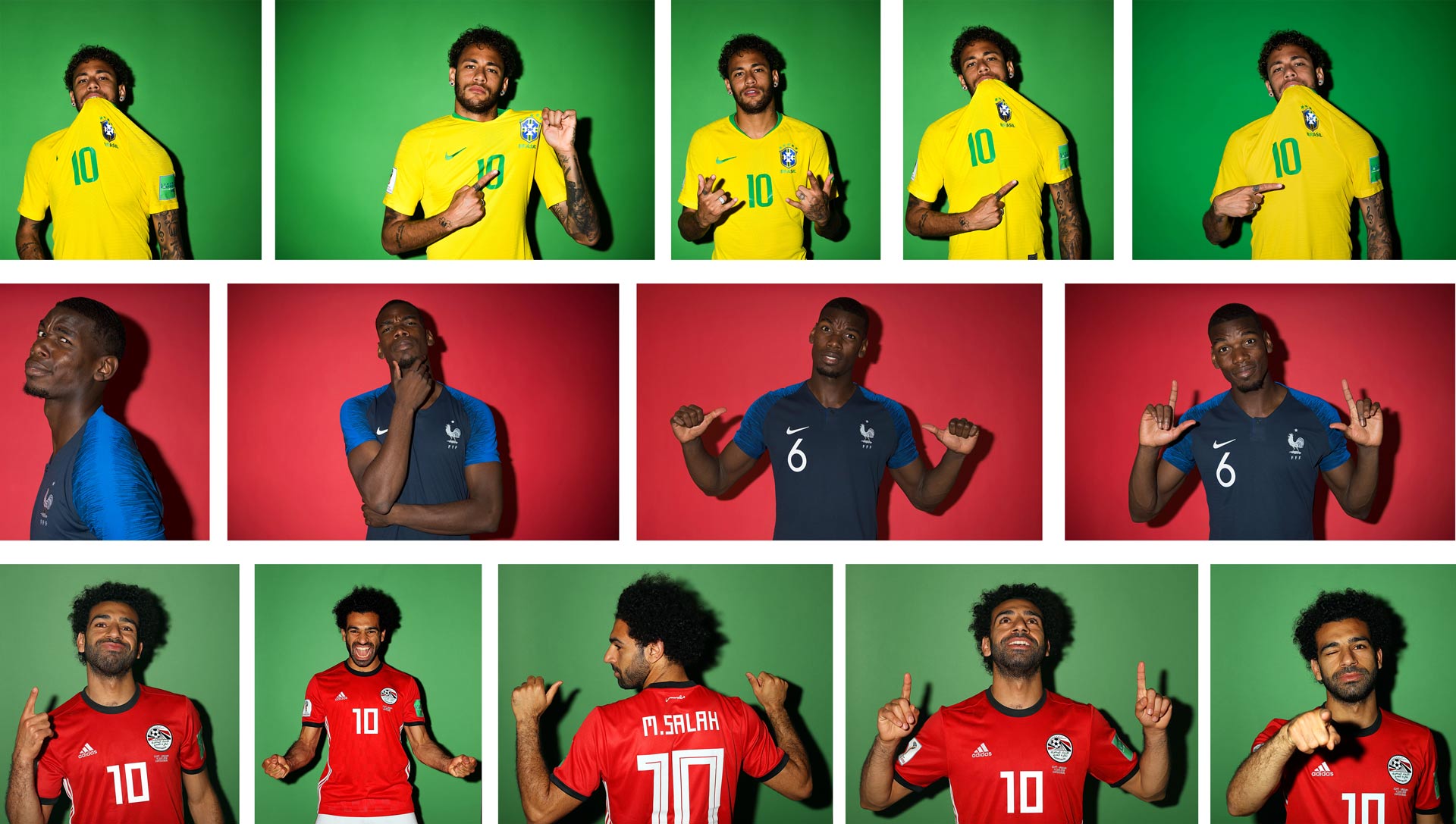
In the lead-up to the 2018 World Cup, Neymar, Salah, and Pogba were widely framed as the vanguard of football’s next era, positioned to inherit the global spotlight as Messi and Ronaldo edged into the later chapters of their dominance. Each represented a distinct evolution of the modern game and of the modern athlete as a cultural figure. Neymar embodied improvisational flair fused with commercial magnetism, a player equally at home dazzling defenders as he was shaping global fashion trends and brand partnerships. Salah’s ascent carried a different weight, defined by relentless efficiency on the pitch and profound symbolic resonance off it, becoming a unifying figure across the Arab world and a rare example of how sporting excellence can shift cultural perceptions. Pogba stood at the intersection of athletic power, creativity, and personality-driven brand presence, as comfortable dictating midfield tempo as he was expressing himself through dance, hair, and social media, signaling a future in which players would be multidimensional storytellers of their own mythologies.

Together, they suggested a generational handoff already in motion, one shaped not only by performance metrics but by global reach, identity, and cultural fluency. Their rise coincided with a media landscape that no longer separated sport from style, politics, music, and digital self-expression, making them ideal protagonists for a new era of fandom that lived on phones as much as in stadiums. Yet the narrative of succession in football has never been linear. The enduring brilliance of Messi and Ronaldo complicated any clean transfer of power, culminating in Messi lifting the trophy in 2022, an outcome that felt less like a contradiction and more like a reminder that greatness resists tidy timelines. The sport evolves through overlap rather than replacement, with generations coexisting, influencing one another, and expanding what it means to be iconic in a game that is always rewriting its own future.
As seen in the artist profile above, Brandan "BMIKE" Odums is a New Orleans-based visual artist who engages in a transnational discussion about the nexus of art and resistance through exhibits, public events, and public art works. Odums' art reflects the political enthusiasm of a generation of Black American activists who grew up during the presidency of the nation's first Black president, the rise of popular interest in police violence, and the birth of the self-care movement. His work includes luminaries such as Malcolm X, Colin Kaepernick, Martin Luther King, Jr., Harriet Tubman, John Coltrane and other iconoclasts, and it seemed like his portrayal of these various global soccer superstars in Mo Salah, Neymar and Pogba would be an appropriate addition to his amazing work. With him and a team of 10 internal staffers, I was positioned as the creative director and we worked with Ryan O'Leary the project manager and our Editor in Chief Matt Sullivan to execute this editorial project.

In the case of Mo Salah, he represented a diverse new face of fandom in the sport and a location like Times Square that was such a melting pot of cultures and individuals felt like an appropriate place, just across the street from the Bleacher Report offices to activate our mural. The man who lights up the Egyptian sky, and the entire Premier League, might just be the biggest player on the planet in terms of popularity ahead of the impending world cup, making him the perfect subject. Along with the experiential activation to this project, we also collaborated with our editorial arm of Bleacher Report Mag under editor Matt Sullivan who helped us collaborate with some of the top writers in the game to cover these superstar football players. In the case of Mo, that meant a great profile by Hanif Abdurraqib,that looked at the core of what made him such a compelling player and underdog story that so many people gravitate towards during his ascent to superstardom.
While Hanif cooked up the words and Taylor Rooks recorded an exclusive video interview with Mo, our design team was busy brainstorming and ideating with BMike on how to best visually represent all the storylines we wanted to convey with the artwork. I was a big proponent of including the indigenous flaura and fauna as an element of all of the murals as a nod to the roots of fandom and the origin of these players in their hometowns. Along with this, I wanted to visualize iconic moments like quirky hairstyles, electric goals or memorable celebrations within the elements of the spray paint composition as well. After Brandon walked us through his catalogue and the type of styles and techniques he uses to bring his art to life, our team applied the storytelling lens to include those various easter eggs as nods to the players backstories.
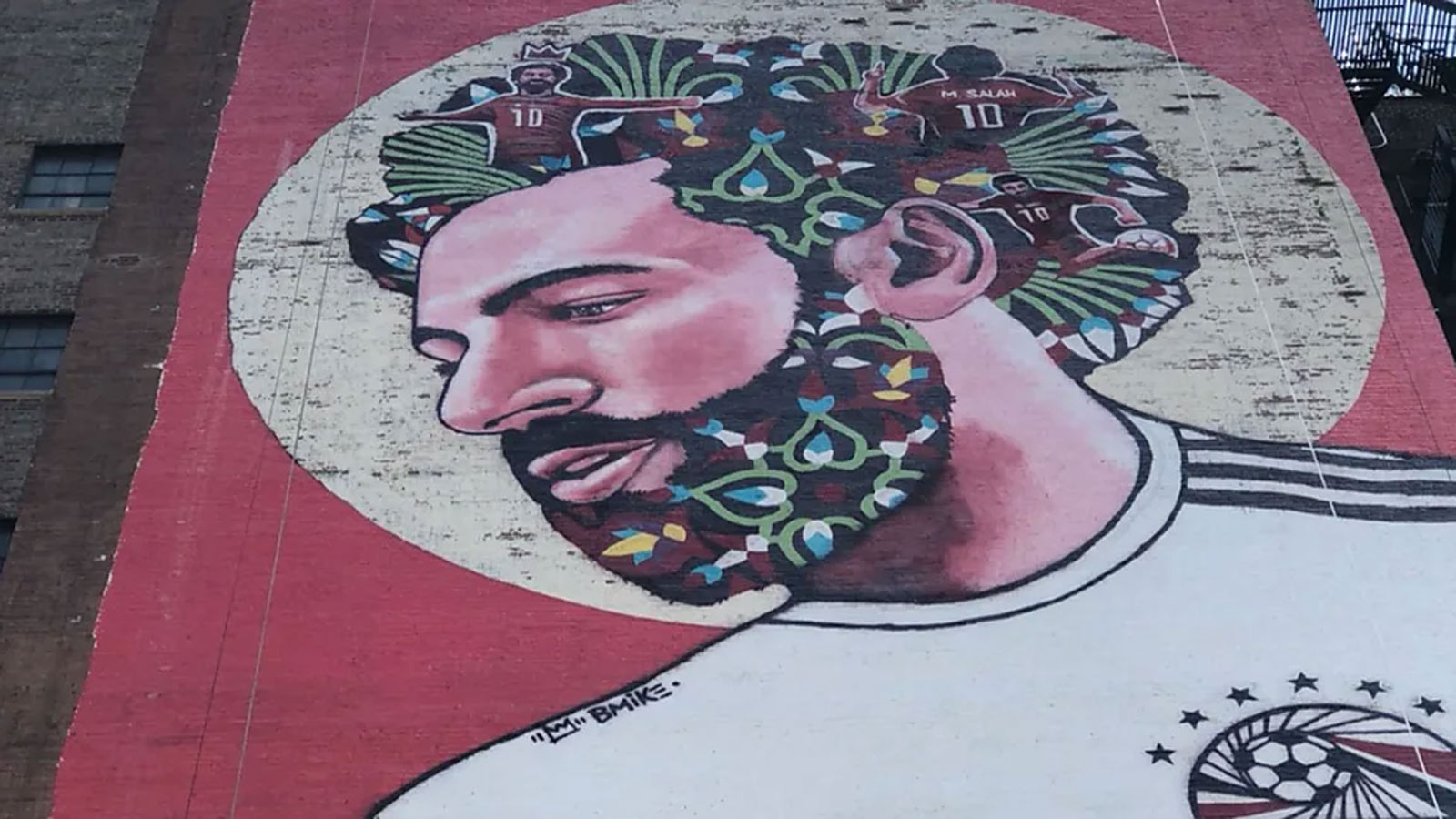
Salah represents the intersection of sports, culture, language, passion and so much more in a visceral way for many, and this is exactly what we wanted to tap into as we thought about how we could leave a mark on the city that never sleeps. What makes a city like New York iconic are the stories that become interwoven into the very fabric of the streets, whether that be the hallowed auditoriums of Carnegie Hall, the vaunted hardwood court at the Garden, or the familiar buzz of neon signs at Papaya King. The 2800 foot mural of Salah is found some 17 stories above the ground at the intersection of 51st and Broadway took about four days to complete. In it, Salah is in front of a red background with a white circle around his head. In many ways, the white represents a halo. For Eygpt, Salah is the chosen one and his trademark curly hair and beard are covered in Egyptian flowers and images of Salah celebrating in colors that harken the neon lights of Times square itself.
.webp)
The deep red field carried both Egypt’s intensity and Liverpool’s heat, while the stark white circle behind his head read as a graphic halo, turning Salah into a calm, centered figure amid the visual chaos below. That altitude amplified the message. This was not simply a portrait of an athlete, it was a public coronation, asserting that global football belongs in the American skyline and that its heroes deserve the same monumental reverence we reserve for our own. The Mo Salah mural in New York was designed to feel less like street art and more like a modern icon suspended in the skyline. The halo motif emerged organically from our initial research, not as a religious statement but as a visual shorthand for reverence, framing him within a language of sainthood that fans had already projected onto him. By grounding the mural in this layered research process, the final image functioned less as a likeness and more as a cultural synthesis, translating Egyptian heritage and Liverpool resilience into a single, legible urban icon.
.jpg)
The initial art direction for the Mo Salah mural began with an intensive moodboarding phase that treated visual research as cultural archaeology rather than simple reference gathering. We assembled a matrix of imagery spanning Salah in both Egypt and Liverpool kits, mapping the duality of his identity as a national icon and global club superstar. Photographs of him in the white of Egypt carried a spiritual clarity, evoking pilgrimage, faith, and national unity, while the deep reds of Liverpool suggested fire, industry, and the working-class ethos of a port city that mirrors Alexandria’s own maritime history. There is a vibrance and a heritage and an energy that needs to tie this all together creatively.

This chromatic dialogue became foundational to the mural’s palette strategy, allowing the work to oscillate between sacred symbolism and urban grit. Beyond football imagery, the board expanded into Egyptian visual history: Pharaonic golds, hieroglyphic patterning, geometric tessellations, desert tonalities, and the monumental stillness of the pyramids. These references informed texture, compositional weight, and the sense of timelessness we wanted the portrait to carry. Salah’s silhouette, especially his hair and beard, was studied as an instantly recognizable glyph, a modern cartouche that could hold narrative detail at multiple scales. We also analyzed fan iconography, protest imagery, historical archives, street banners, and handwritten Arabic signage to capture vernacular typographic energy that felt lived-in rather than designed.
%20(1).jpeg)
BMike actually had to pass a 16-hr class to operate the machine that would allow him to paint the Mo Salah portrait on the side of the building, per New York City regulations. The class taught us that the system wasn’t as sophisticated as one would hope, a platform suspended by two wires clamped to the rooftop of a 15 story building . Needing two people to operate on opposite sides , each harnessed to a “life line” also connected to the roof but secured by a knot. That knot was our fall protection. That would stop us from hitting the ground in the event the platform failed - mid air. The heights and cold winds weren't enough to stop us as the mural filled the wall over the course of the week, mentally preparing us for the two more that we would be making in New Orleans and Miami in the following days.
.jpeg)
The city is full of places that tourists and fans seek out, and the Mo Salah Larger Than Life mural, positioned just a few blocks north of Times Square, has quietly joined that constellation of urban pilgrimage sites for Egyptian supporters, Liverpool faithful, and global football devotees. In a city defined by icons, it is no small feat for a contemporary work to enter the visual vocabulary of New York, yet the mural’s scale, symbolism, and placement have allowed it to do exactly that. Visitors detour between Broadway theaters and Midtown landmarks to stand beneath it, phones tilted upward, reenacting Salah’s skyward point after a goal. What began as a campaign touchpoint has evolved into a ritualized stop on the cultural map, where sport, identity, and diaspora converge on a single stretch of sidewalk.
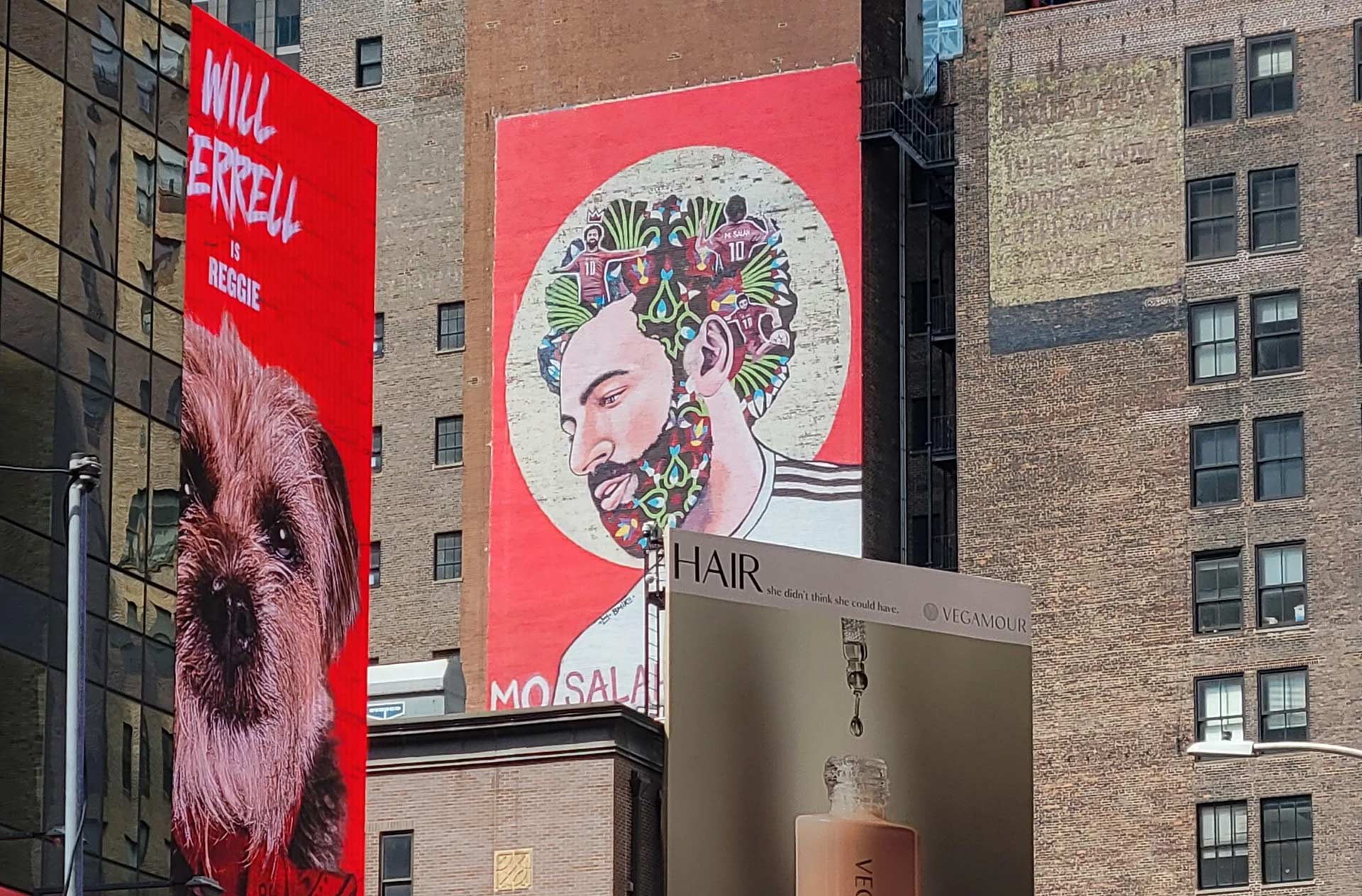
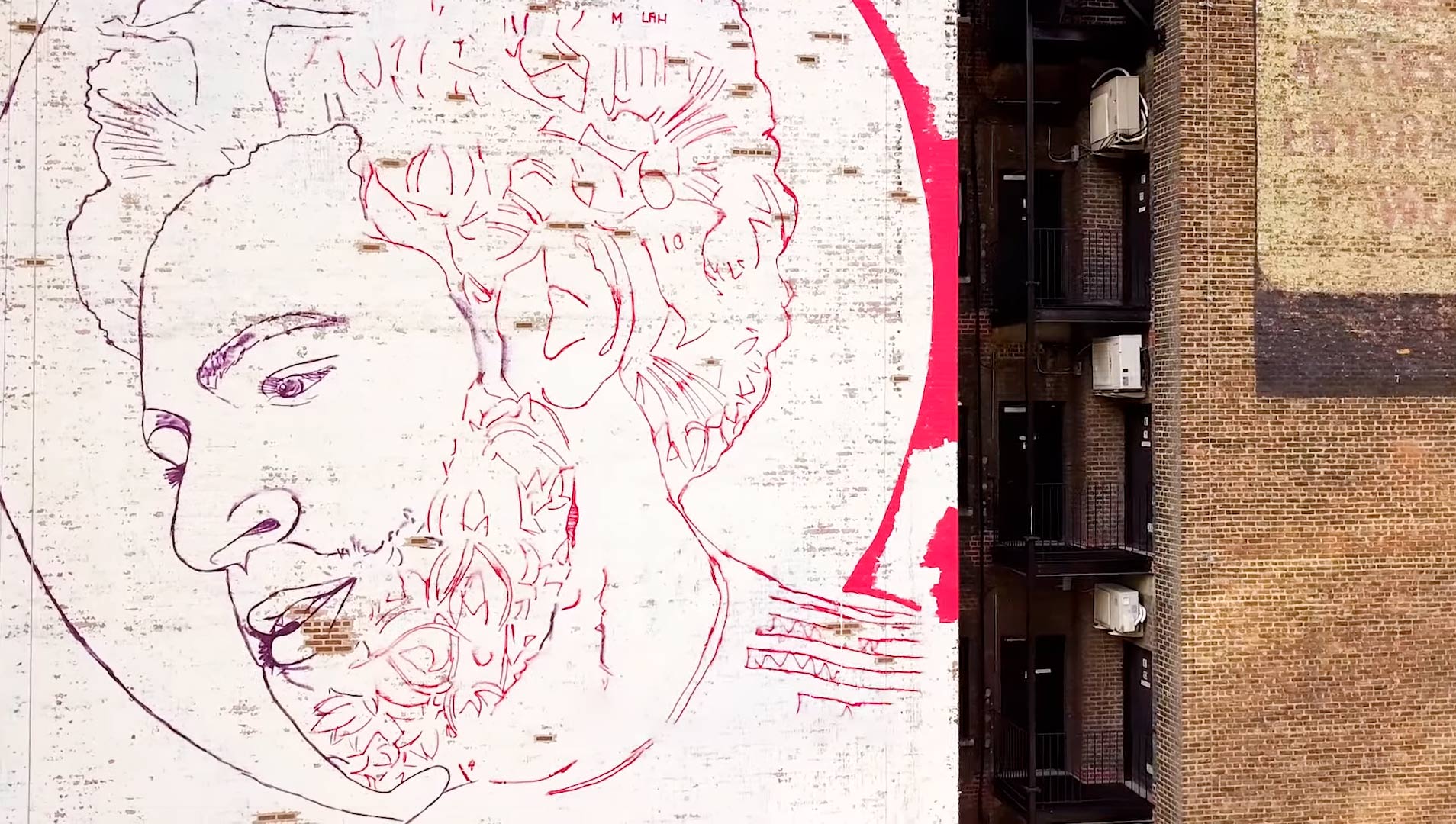
From a production standpoint, the transformation from concept to civic artifact required both technical precision and imaginative foresight. Our early reference sketches and Photoshop composites were not merely presentation tools but spatial blueprints, engineered to translate narrative intent across a multi-story façade. Using projection mapping to scale the composition onto the building’s surface, BMike worked suspended high above the avenue, methodically layering pigment against wind, weather, and the vertigo of Midtown heights. Each pass of paint reconciled fine-grain detail with monumental legibility, ensuring that the portrait would read with equal clarity from a passing taxi, a distant office window, or a pedestrian’s vantage point below. Over time, the mural has settled into the cadence of Broadway itself, a fixed visual anchor amid the churn of LED billboards, scaffolding, and seasonal displays. It now operates less as an installation and more as an enduring waypoint in the city’s evolving streetscape, a testament to how thoughtfully executed public art can transcend its origin and become part of New York’s collective memory.
.jpeg)
Despite getting derailed in the world cup, Salah's star only continued to grow and during a visit to the city during the offseason he finally had a chance to visit the site of the mural himself in person. After posting a selfie that garnered well over 100 Million impressions across social in front of the mural, the spot has become something of a tradition for fans to visit. Rituals are synonymous with the sport of soccer, and now whenever you visit the city a familiar site on the corner of 52nd and 7th street has become an indelible part of their New York City must visit list like the Seinfeld Diner or Queens Boulevard. Up close, the mural reveals a tapestry of Egyptian florals intertwined with micro-scenes of Mo’s movement and celebration, including his signature skyward point after a goal, a gesture that reads as both gratitude and quiet transcendence against the city’s relentless motion. Seeing it come together from the base level outline to the fully fleshed out and vibrant final product was a sight to see.
In a district engineered for spectacle, where Broadway marquees compete with LED canyons, the Naked Cowboy strums for tips, Elmo and Spider-Man pose for photos, the Desnudas shimmer in body paint, and the New Year’s Eve ball looms as a global countdown beacon, the Mo Salah mural has carved out a quieter but no less powerful presence. It has become a must-see waypoint within the Times Square orbit, a vertical counterpoint to the horizontal chaos below. Tourists who arrive for theater or neon excess often find themselves drawn a few blocks north, following social posts and word of mouth to stand beneath a different kind of icon. There, amid taxi horns and halal carts, they look up and encounter a portrait that feels less like advertising and more like affirmation, a signal that New York’s visual culture has expanded to include the global language of football.

Murals work so powerfully in sports because they anchor fandom to place. A jersey can be worn anywhere and a highlight can be watched on a phone, but a mural lives on a specific wall in a specific neighborhood, turning civic space into a shared shrine for collective memory. They transform athletes into local folklore, scale moments of triumph to the size of buildings, and give fans a daily, physical reminder of who they are and where they belong. In cities where teams function as emotional infrastructure, murals become landmarks as meaningful as arenas or statues, backdrops for block parties, victory parades, and everyday life. They invite participation rather than passive consumption, encouraging selfies, pilgrimages, and storytelling across generations. In that way, murals do more than celebrate sport. They embed it into the visual language of the city, making fandom visible, permanent, and inseparable from community identity.

For Egypt, Mohamed Salah represents far more than athletic excellence. He is a unifying national symbol whose image appears everywhere from Cairo shopfronts and roadside billboards to taxi dashboards and café televisions, embodying humility, faith, perseverance, and the possibility of global recognition without abandoning cultural roots. His story resonates across class lines, offering a narrative of dignity and upward mobility that feels both intimate and collective. Given that New York City is home to one of the largest Egyptian diasporas outside the Middle East, it felt not only appropriate but necessary that a version of this visual omnipresence exist here as well. Installing his likeness in the urban fabric of Manhattan allowed the diaspora to see a reflection of home within the skyline, transforming a Midtown corner into a site of cultural continuity where identity, memory, and pride could coexist in public view.

What distinguishes the mural in this hyper-commercial landscape is its permanence and sincerity. While costumed characters rotate shifts and digital billboards refresh by the minute, Salah’s likeness endures, offering a steady focal point in a district defined by constant turnover. Fans fold it into their Times Square ritual alongside Playbill photos and late-night slices, creating a layered experience of the city that blends theater, street performance, and sport. In doing so, the mural reframes what counts as a landmark here. Not only the ball drop or the bright lights, but a footballer’s gaze cast over Midtown, a reminder that even in the world’s most theatrical crossroads, there is room for global pride, diasporic identity, and the beautiful game to claim their place in the skyline. Jasmine and iris motifs, long associated with Egyptian heritage and regional symbolism, were woven into the hair alongside geometric patterns drawn from Arabic art traditions, transforming it into a decorative field that echoed both sacred ornamentation and everyday craft. These florals and arabesque forms functioned as a cultural cipher, allowing the portrait to carry the visual memory of Egypt’s textiles, architecture, and botanical iconography within a single, legible silhouette.

A location tag search on instagram or twitter reveals a litany of fans taking selfies in front of the mural, which now boasts it's very own Egyptian food stand in the proximity to cater to the newfound flurry of people from an Egyptian demographic walking around that corner of the city. The fact that I had a chance to collaborate with a talented team to bring a project like this to life that has become something that fans seek out and visit on their trips is nothing short of special. To have left a fingerprint on the edifice of New York City is to touch eternity and the fact that fans come from around the world just to make it a point to visit is extremely cool. Seeing the smiling faces of all the people that go to the corner just to take a photo pointing up to the mural, much like Mo does after he scores a goal really reinforces the global nature of the sport and how it brings people from all walks of life together for the love of the game.
.jpeg)
To help facilitate engagement we also activated with spray paint stenciled artwork on the streets of New York to drive foot traffic to the actual mural and to provide spots for fans to engage with and take photos. This type of more grassroots marketing was just the tip of the spear, along with linear television promotional content on TNT, to social vehicles designed specifically to amplify and promote this content, as well as merch and swag and an actual watch party to help capitalize on the hype of the world cup. This project became a stepping stone for an integrated marketing approach that gave us the top of the funnel advantage in targeting a new football fandom demographic for Bleacher Report and Turner Sports.
.jpg)
The Mo Salah mural towering above Times Square feels like a dream every time I see it. As a creative, having a piece of my work become part of the New York skyline is something that never stops feeling surreal. The deep red backdrop against the brick, the serene expression, and the intricate patterns in his hair all come together like a hymn to football and culture. The wall carries movement, rhythm, and pride that seem to pulse through the city around it. The way the light hits it in the late afternoon makes it feel alive, as if New York itself pauses for a moment to admire it. Every angle reveals something different, some detail that catches you off guard and reminds you how imagination can transform a blank surface into something iconic. I have enjoyed seeing it from the street down below and from the buildings that rise beside it, each view reminding me how art can shape the landscape of a city.
.jpg)
Over the years, the mural has taken on a life of its own. Egyptians traveling to New York often make time to visit it, turning that corner into a quiet celebration of identity and pride. Families and fans stand below it with flags, phones, and laughter, capturing a moment that bridges continents. On the Liverpool subreddit, people continue to post photos of the mural, sharing stories of how far they traveled just to see it in person. It has evolved into a landmark for football fans, a symbol of what it means to see your hero represented in the heart of Manhattan. It reminds me that art, when done with sincerity, can outgrow its original purpose and belong to the people who find meaning in it.
.jpg)
Right beneath the mural, a row of Egyptian-run halal food trucks has become part of the scene, serving shawarma, falafel, and koshari to fans and tourists drawn to Salah’s image. The air fills with the smell of grilled food and warm bread, blending with the sound of taxi horns and street chatter. Many of the vendors display photos of Salah or play Egyptian music, turning that stretch of sidewalk into something that feels both familiar and celebratory. It is remarkable how one piece of art can give rise to an entire atmosphere, shaping the energy of a neighborhood and creating a shared space that feels authentic and alive.
.jpg)
Years later, the mural still burns bright amid the chaos of Times Square, holding its ground in a landscape engineered to overwhelm the senses. The red radiates with the same energy that defines Salah’s play fast, confident, and impossibly fluid. Tourists crane their necks toward LED spectacles and Broadway marquees, yet his calm expression cuts through the frenzy, offering a rare moment of stillness in a place that measures time in flashes and foot traffic. It does not compete with the noise. It anchors it. In a district built on spectacle, the restraint of that gaze feels almost radical, a reminder that presence can be more powerful than volume.

For me, it remains one of my proudest creative moments, not because of its scale or visibility, but because it fused with the city’s emotional circuitry. New York absorbs everything and forgets most of it, yet this piece endured, becoming a waypoint for fans, photographers, and passersby who may not even know why it stops them. In a city defined by ambition, motion, and reinvention, that wall stands as quiet proof that creativity can outlast campaigns and timelines. It lingers, inspires, and gathers new meaning with every glance, turning a single image into a living story woven into the fabric of the streets below.
.jpeg)
Along with art direction on the murals and helping our editorial team position the storytelling I was also in charge of helping our marketing team work on some merchandise that we could give away during a World Cup watch party that would also serve as a mural reveal for the Mo Salah piece visible from the BR office during the first Egypt game. I had a chance to design a base look and collaborated with my illustrator friend Sam Melvin to help create a look and feel that could be promoted on our BR Kicks social channels to get in on the kit reveal hype and give us an e-commerce angle to this world cup project as well. Along with T-Shirts and posters specific to the players I also created agnostic universal kits for the BR Football brand to really help announce it's arrival.

This coincided with Turner getting Champions league's rights and signing Steve Nash as a commentator, so these pieces were meant to help hark in a new era. With Turner paying UEFA $65 million dollars a year for the next three years to broadcast the Champions League across TBS, TNT, and B/R Live, Bleacher Report’s focus is creating content that will help Americans fall in love with the stars who transcend culture both on and off the pitch. Getting a tangible representation of this project allowed for us to create a deeper connection with our core consumer. The kits took inspiration from iconic stripes within the BR logo dash and featured languages from across the world while taking inspiration from the likes of Juventus and Bayern Munich. The T-shirt became one of our hottest pieces of in office merch and even the Bleacher Report CEO at the time, Howard Mittman saw one of our designers wearing an eary sample shirt in the hallway and personally requested a couple for himself and both of his young kids! The jerseys were given away as a part of a client gifting suite at various Bleacher Report Football events over the course of the next few years and became the base design for our Steve Nash Showdown annual charity soccer match in the summertime as well.
This type of editorial worked opened up the door to produce more branded content through our BR Football sub-brand, the relationships brokered with athletes of Mo Salah's caliber along with their representation and agencies allowed for us to tap into them for future collaborations and brand amplification opportunities. A perfect illustration of that is the Adidas cleat campaign we activated in partnership with BR Football with Khammy Vilaysing, another example is seen in the season premiere episode of Taylor Rook's show "Take it There" where we were able to get a commitment from Mo to be a guest during the interview sessions for this world cup project. There is a distinct domino effect between these projects and how to drive revenue generation opportunities, because of this we learned to keep a keen eye on tracking analytics and impact so that it could be used to further fuel our marketing narratives. The content world really is an ecosystem where each segment has elements that feedback into others and allow for growth opportunities and partnerships such as this.
With the rapid expansion of our global soccer audience, the commercial strategy evolved in parallel, unlocking entirely new categories of brand partnerships and redefining the revenue potential of culturally fluent sports storytelling. In 2018 alone, advertising tied to Bleacher Report’s soccer coverage surged by more than 400 percent year over year, growing from a negligible 2 percent of annual revenue to roughly 10 percent of the company’s total intake. This was not merely a function of increased viewership but of a fundamental shift in how soccer content was positioned. The sport’s inherently global reach and its resonance with a young, multicultural, mobile-first audience made it uniquely attractive to premium marketers seeking relevance rather than interruption.
Brands recognized that soccer fandom is not confined to match days. It lives in identity, migration, music, fashion, and community. By building content that reflected those dimensions, we created an environment where advertising felt additive rather than intrusive. The global nature of the game enabled Bleacher Report to attract non-endemic advertisers that had historically remained outside the sports media ecosystem. Luxury and lifestyle brands such as Chanel, alongside financial institutions like Chase, entered the space, expanding the commercial narrative beyond traditional sporting goods partners like Puma and Adidas. This diversification signaled a broader repositioning of soccer from a niche American sports property to a cultural platform capable of carrying premium brand storytelling. For marketers, the appeal was clear: soccer audiences over-index on youth, diversity, and global connectivity, offering a rare convergence of demographic desirability and cultural credibility. By aligning with content that celebrated heritage, diaspora, and identity, these brands were able to participate in cultural conversations rather than simply sponsor them.
.jpg)
At the heart of this initiative was a deliberate rejection of the transactional tone that had long defined sports media. Instead of prioritizing statistics, highlights, or studio debate, the campaign foregrounded personality-driven storytelling that emphasized identity, heritage, and cultural symbolism. The murals functioned as physical anchors for these narratives, while long-form interviews provided unprecedented depth, allowing audiences to understand players as complex individuals shaped by geography, migration, faith, and community. This model disrupted the familiar sponsor-backdrop interview format, replacing it with a storytelling framework that privileged emotional resonance over media choreography. The content felt authored rather than packaged, crafted rather than commodified.

The result was a new paradigm in sports storytelling, one in which audiences formed relationships with players that extended beyond on-field performance into the realm of shared identity and aspiration. By humanizing global football icons and embedding their stories within the cultural fabric of the cities where the murals lived, we created a feedback loop between content, community, and commerce. Fans did not merely consume the work. They visited it, photographed it, debated it, and shared it, transforming brand activations into living cultural artifacts. In doing so, we demonstrated that when storytelling leads and commerce follows, the outcome is not only stronger engagement but a more durable and meaningful connection between brands, athletes, and the communities that sustain them.

Contributing to the day-to-day visual experience of New Yorkers is a rare privilege, and seeing the Salah mural become part of the city’s lived environment has been one of the most meaningful outcomes of the project. Unlike campaign work that disappears with the media cycle, this piece persists, absorbing the rhythms of the city and revealing new dimensions over time. I’ve watched it through snowstorms that soften its edges, summer light that intensifies the reds, and rain that deepens the brick tones behind it. The skyline around it keeps evolving. Billboards rotate, storefronts change hands, scaffolding rises and falls.

Yet the mural remains, a constant within New York’s perpetual reinvention. That continuity has made it feel less like an installation and more like a living landmark woven into the sensory fabric of the street. Being able to bring my brother, my dad, cousins, and close friends to stand beneath it has turned the wall into something deeply personal. What began as a professional commission has become a shared point of pride, a place where I can show the people who shaped me that a piece of my vision now inhabits one of the world’s most iconic cities. Each visit feels different. Sometimes it’s a quick glance while passing through Midtown. Other times it’s a deliberate pilgrimage, watching strangers point upward, take photos, and fold the mural into their own New York story. In those moments, the work no longer belongs to me. It belongs to the city and to the countless people who encounter it, making it a small but enduring part of New York’s living, breathing cultural landscape.
The #LargerThanLife mural initiative represented a pivotal moment in the evolution of sports media from purely digital distribution toward immersive, real-world cultural production. Conceived as an extension of Bleacher Report’s broader audience development strategy around global football, the project aligned with Turner’s significant Champions League broadcast investment and aimed to cultivate emotional affinity between American audiences and the sport’s most transcendent figures. By translating editorial storytelling into monumental public art, the campaign positioned physical space as a new channel for narrative delivery, transforming city streets into touchpoints within a larger media ecosystem. Equally significant was the project’s philosophy of public art as shared civic property. The murals were conceived not as temporary advertisements but as evolving neighborhood landmarks, designed to foster a sense of ownership among residents and visitors alike.


In keeping with the theme of young energizing players with iconic hairstyles, Clint Smith, author of Counting Descent, How the Word Is Passed, and Above Ground penned the fiery story on Brazil's mercurial star on a trip to his hometown to really help us get a feel for his origin tale as we ideated on how to develop the mural. Neymar was a part of the next generation of stars beyond the likes of Ronaldo and Messi that were taking the game to it's next evolution. Finding an amazing location in the up and coming arts district of Brickell on the side of the Gazit Horizons building at 90 S.W. 8th Street in Miami the mural would felt right at home next to the art that fills the streets of South Beach and Wynwood during the hustle and bustle of Art Basel. Miami made sense for Neymar because it’s bright, it’s vibrant, it’s colorful, it’s flashy and it’s extremely South American.
Unlike Times Square which was more of a tourist destination that represented a landmark meeting point for fans of the sport to come visit, this neighborhood was really far more of a local community with a heavy Brazilian population. We wanted to make sure to really serve as a way to help revitalize the neighborhood and we felt like helping to create this mural would also help the hole in the wall cafe across the street filled with the sounds and smells of Rio with some of the strongest Caiparinas you are gonna find in Florida. By providing a mural like this as the backdrop of the local watering hole that folks watched the games at we were really able to weave the artwork into the community in an area that was as dynamic as Neymar himself.
%20(1).jpeg)
Integrating all the elements of this project and making sure they all had the same voice across the various platforms was something I was tasked with. It was important that the energy of Neymar's game you saw when you tuned in on the field would show in the artwork when you saw the murals in person and came across in the details and easter eggs that true fans would recognize would be mirrored in both the writing, and the videos we were producing featuring the artwork. I also applied my creative vision to the project in collaboration with Brandon and Ryan to establish the cohesive threads tying all the murals and locations together in an artistically resonant way for our digital audiences.
.jpg)
The Neymar mural in Miami was conceived as an exercise in proximity rather than distance, embedding a global superstar directly into the rhythms of neighborhood life. Positioned at a busy Brickell corner, the work intersected daily routines. Morning café runs, office commutes, late-night conversations spilling onto sidewalks. This placement allowed Neymar to exist not as an untouchable figure but as a constant presence woven into the social fabric, a familiar face that watched over a community already fluent in the language of football. The corner vantage created a dynamic viewing experience, revealing different compositional tensions depending on approach, whether glimpsed from a passing car, framed by high-rise reflections, or encountered head-on at street level.
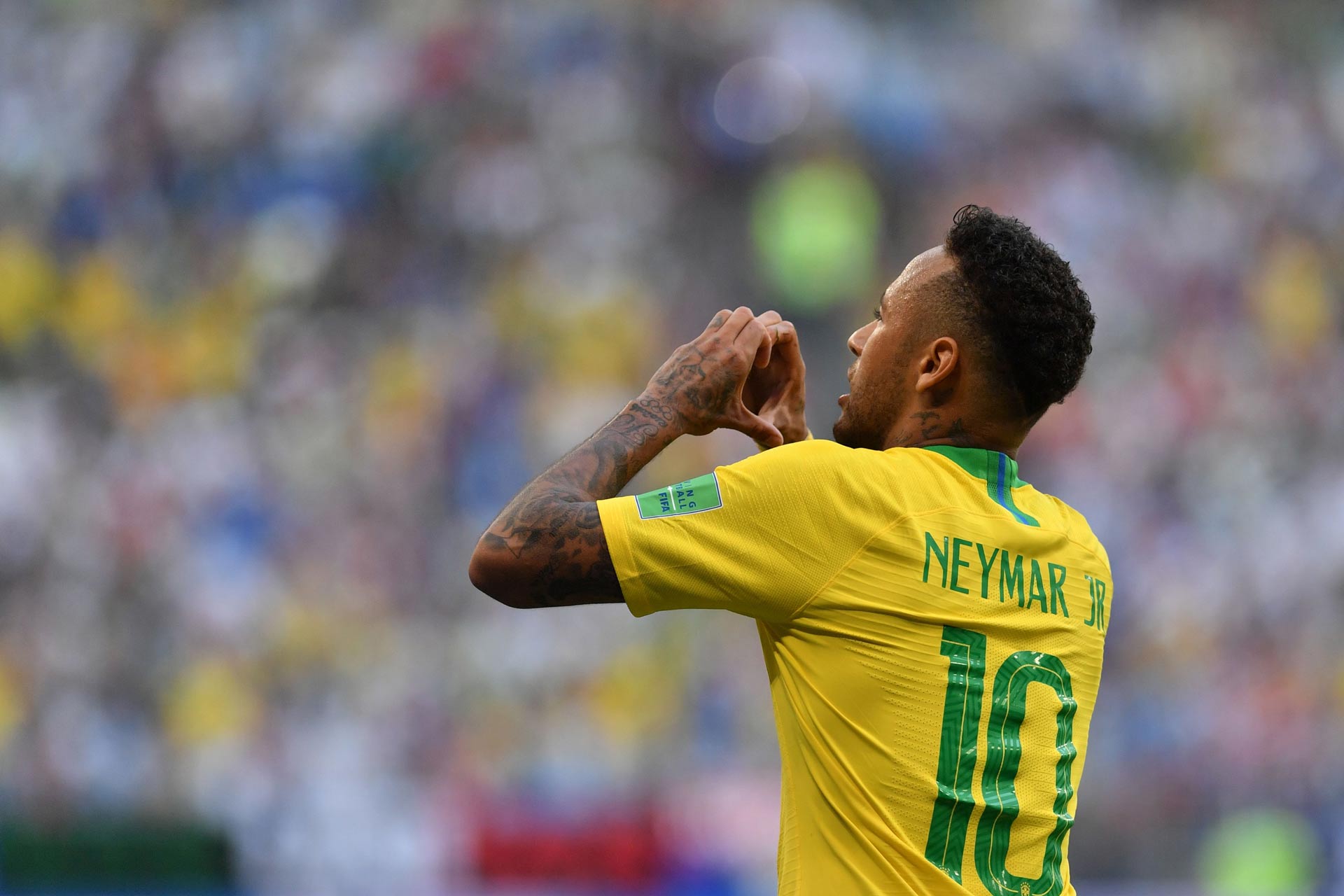
Miami is one of the few American cities where football is not an imported curiosity but a lived language. Long before MLS expansion and global friendlies, the beaches of South Florida were alive with Brazilian footvolley, Cuban pickup matches, and Caribbean street play, embedding the rhythm of the sport into the city’s daily life. In that context, a Neymar mural does not feel like an advertisement or spectacle. It reads as a mirror held up to a city that already speaks his dialect of movement, improvisation, and joy. Neymar’s presence in Miami resonates because the city itself operates in the same aesthetic register as Brazilian football. Bright color palettes, ocean light, music spilling into public space, and a comfort with spectacle all echo the expressive freedom of his game. His style, built on flair and improvisation rather than rigid structure, aligns with a place where culture is constantly remixing itself through migration and exchange. The mural becomes less about a single athlete and more about a shared philosophy of play.
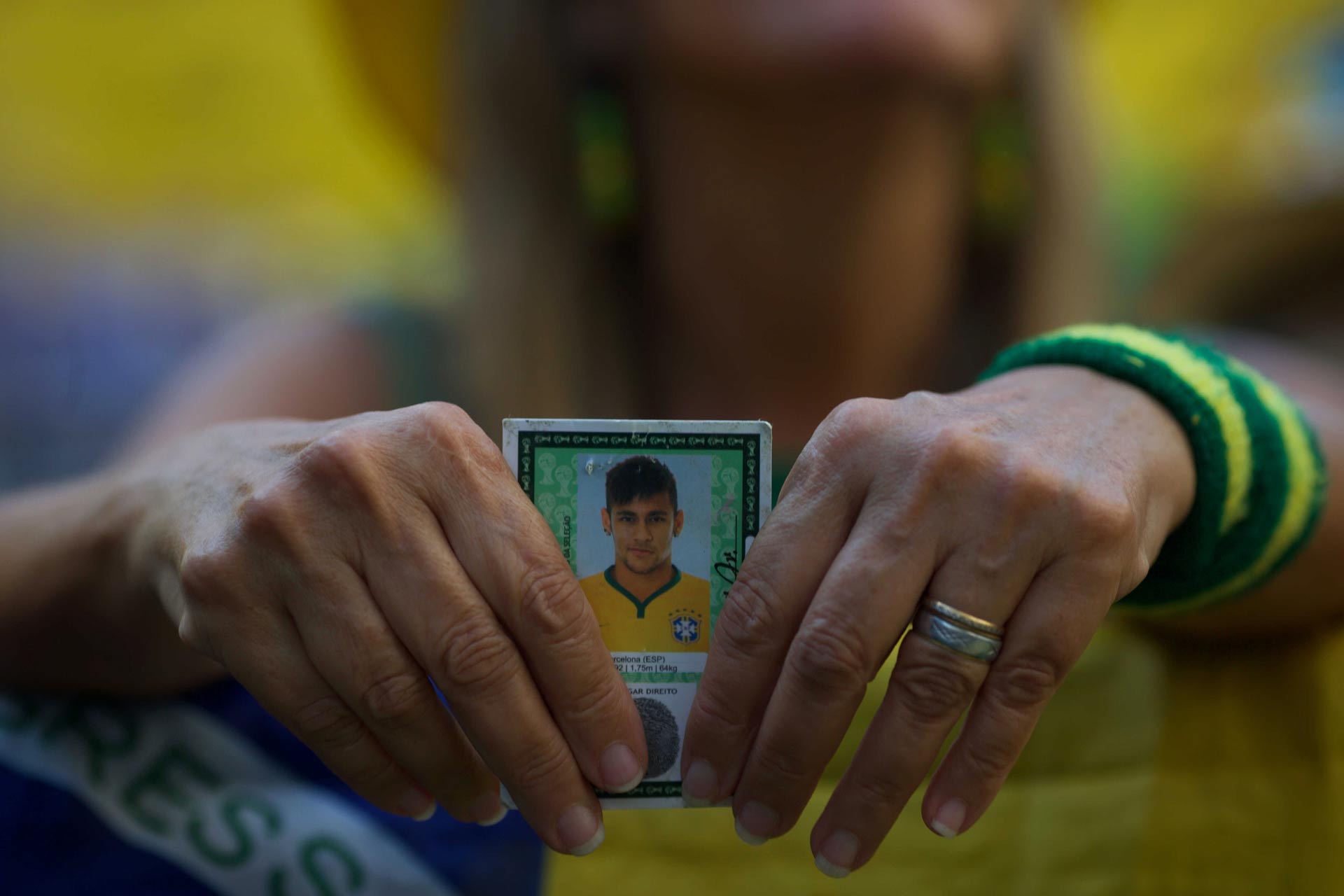
In Brazil, Neymar commands a near-devotional following that moves with the pulse of a bassline you feel before you hear, his presence reverberating through street murals, barbershop posters, WhatsApp stickers, and beachside conversations like a national groove on repeat. He embodies a lineage of joyful defiance handed down from Pelé, Romário, and Ronaldinho, remixing it for a hyperconnected era with the swagger of a frontman who knows the band will follow wherever he leads. His electric style of play is pure funk in motion: syncopated dribbles, elastic feints, and sudden tempo changes that leave defenders off-beat and crowds locked into the rhythm of possibility. Each touch feels like a dropped beat that resets the dance floor, sending voltage through stadiums and screens alike, transforming spectators into participants in a global jam session where flair, improvisation, and spectacle blur into something you don’t merely watch, you feel in your bones.
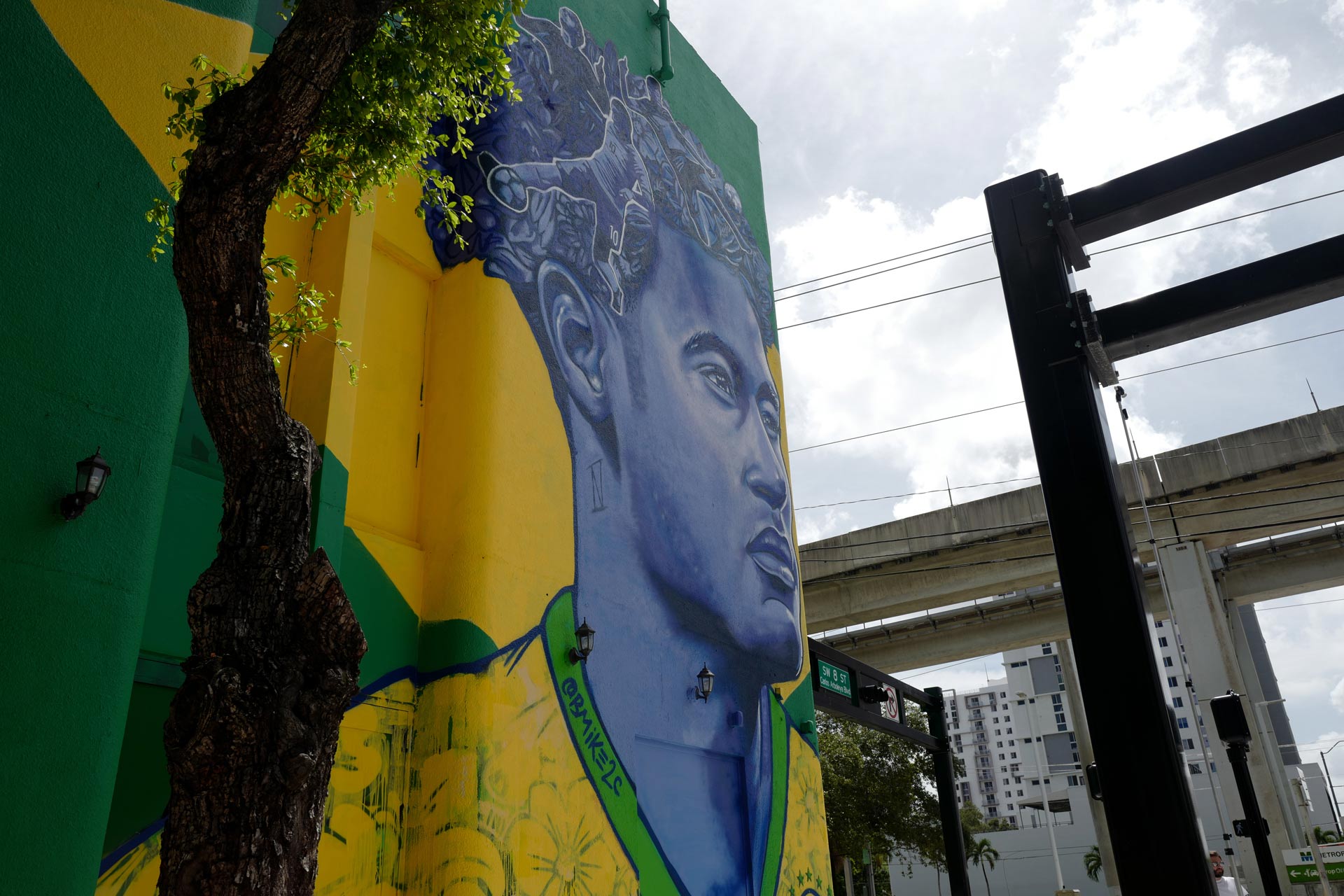
Miami’s Latin American and Caribbean communities form a living archive of football fandom, where club loyalties from Brazil, Argentina, Cuba, Colombia, and beyond coexist block by block. In barbershops, bodegas, and beach courts, debates about Messi, Pelé, and Neymar blur into conversations about identity and home. The mural sits within that continuum, acting as a cultural waypoint where diasporic pride and local belonging intersect. It affirms that Miami is not on the periphery of football culture. It is one of its unofficial capitals.
There is also a spatial poetry to placing Neymar within Miami’s urban fabric. The city’s architecture, from pastel Art Deco facades to high-rise glass towers, creates a backdrop that amplifies his kinetic energy. Against these surfaces, the mural functions like a freeze-frame of motion, capturing the elasticity and daring that define both Neymar’s play and Miami’s tempo. It transforms a static wall into a moment of suspended movement, echoing the stop-start rhythm of street football itself. Ultimately, the Neymar mural channels the spirit of joga bonito into the public square, inviting passersby to experience football as an art form rather than a result. In Miami, where sport, music, and visual culture constantly overlap, that invitation feels natural. The work does not impose meaning on the city. It reveals what was already
.jpg)
The mural also functioned as a visual hinge between Miami’s local identity and the broader arc of the sport’s future in the United States. Years before global stars and major clubs would anchor the city’s football ambitions, the image suggested a trajectory already in motion. Neymar’s upward gaze, set against the vertical thrust of Brickell’s skyline, read as both personal focus and civic aspiration, hinting at a city positioning itself within the global football map. In this way, the work captured a transitional moment. Miami as it was, vibrant and diasporic, and Miami as it was becoming, a rising hub where the world’s game would no longer feel imported but inevitable.
.jpg)
We approached each mural as both a site-specific intervention and a node within a broader transmedia ecosystem, supported by social content, behind-the-scenes documentary assets, and influencer amplification. This integrated approach transformed static public art into a living campaign that invited participation, dialogue, and user-generated storytelling across digital platforms. Visually, the campaign fused street culture, national symbolism, and the kinetic energy of the global game into a cohesive creative system that would make Bleacher Report a player in the world cup coverage for the first time on such a big stage.
.jpg)
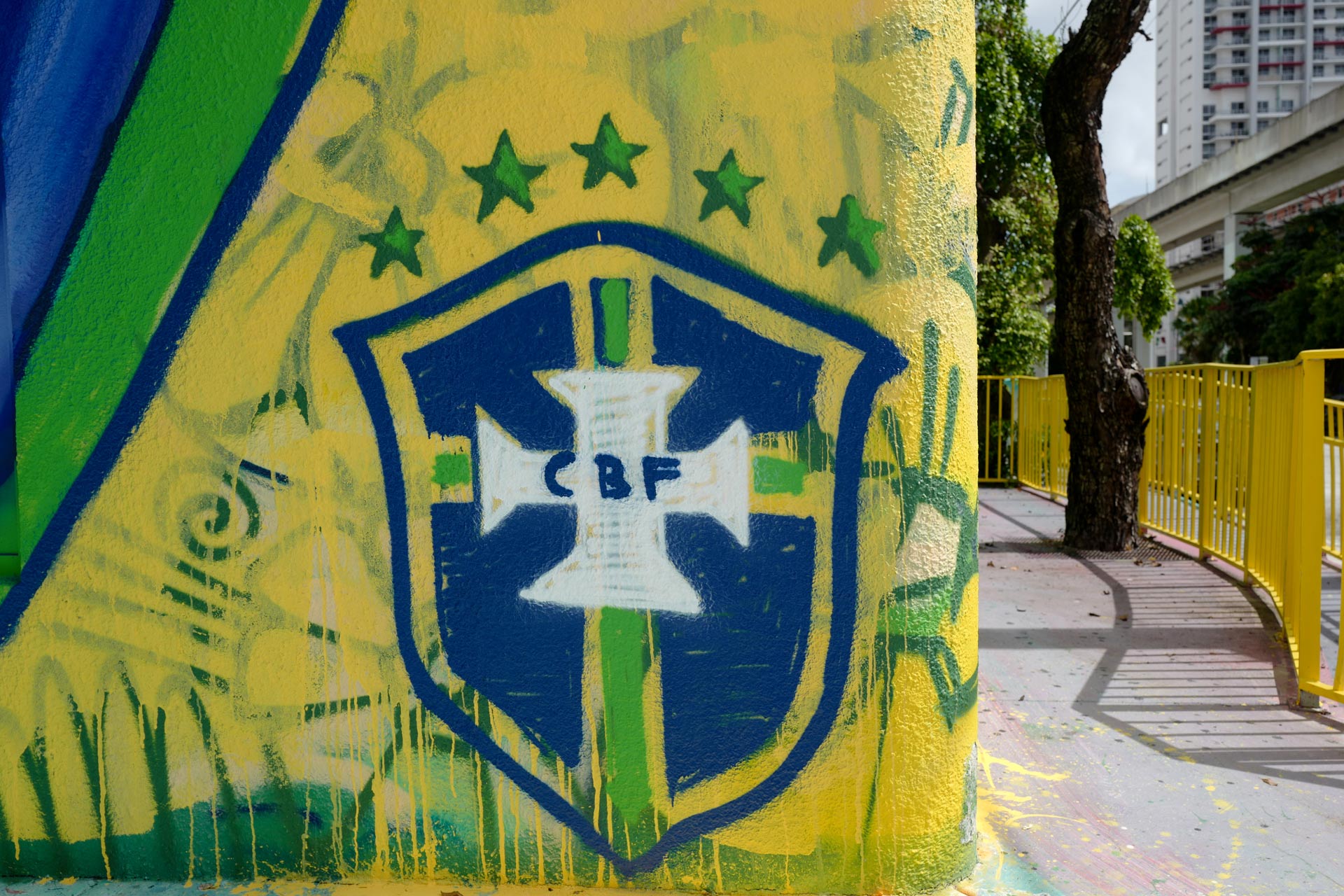
Dynamic line work and motion-inflected compositions evoked the velocity and improvisation of football, while layered textures and vernacular typography anchored the work in the visual language of American street art. By elevating players to near-mythological scale, the murals functioned as contemporary icons, collapsing the distance between local neighborhoods and the global stage. The result was both a cultural homage and a strategic brand moment, positioning football not as a foreign import but as a living, breathing force within the American cultural landscape. Ultimately, the initiative demonstrated how culturally attuned creative direction can translate global phenomena into locally resonant experiences and then into long term digital fandom. Originally, the Brickell building was painted in bright pink and blue, a palette synonymous with Miami’s coastal vernacular and Art Deco heritage. While culturally appropriate to the city’s visual identity, the facade was repainted to support the Brazilian flag’s green, yellow, and blue and to ensure tonal cohesion at monumental scale.
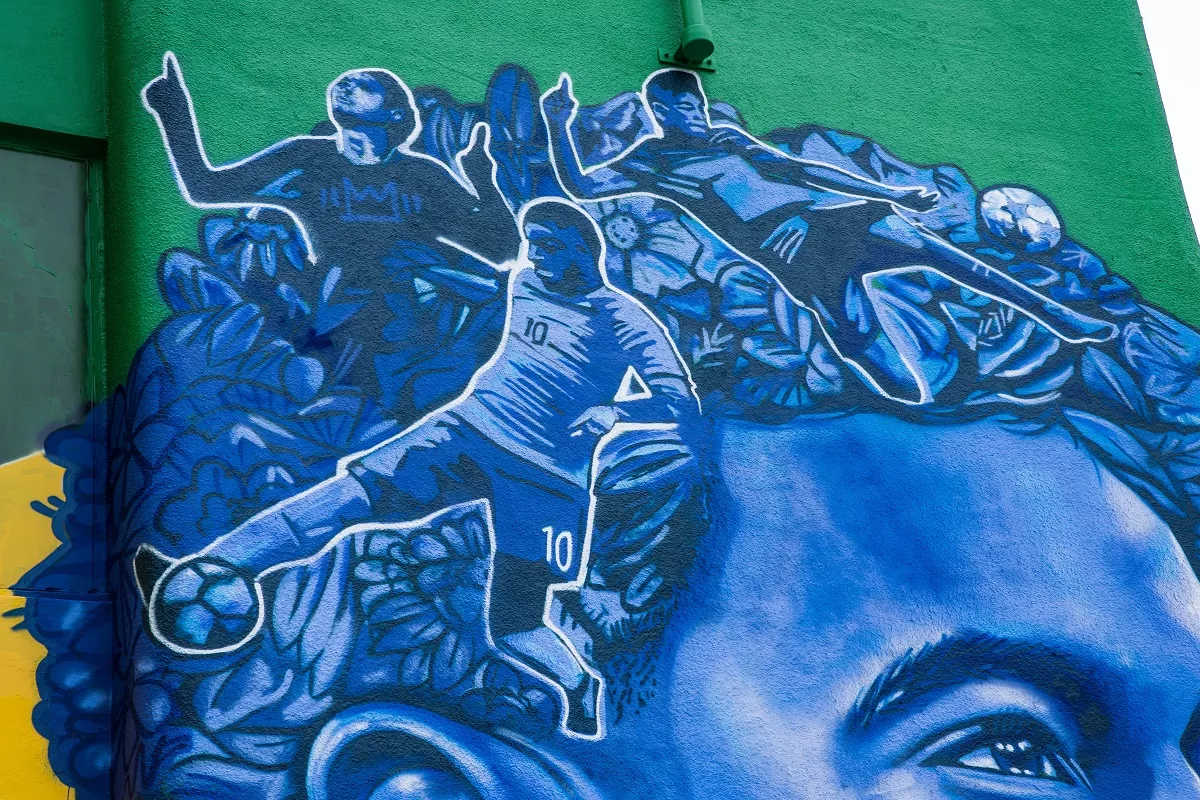
Across all three murals, hair emerged as a deliberate narrative device and the visual throughline that unified the portraits into a cohesive system. In global football culture, hair is never incidental. It is performance, identity, rebellion, ritual, and brand. From Neymar’s constantly evolving cuts to Pogba’s graphic dyes and Salah’s unmistakable silhouette, each player’s hair functions as an extension of their on-field persona and a canvas for cultural expression. Recognizing this, I framed hair not as a stylistic flourish but as a storytelling architecture, embedding within it the symbolism, movement, and national context that define each athlete’s mythos. In Neymar’s portrait, his hair became a layered collage that fused personal iconography with Brazilian visual language. Interwoven imagery referenced moments of play, fragments of the national flag, and tropical botanical forms evocative of Brazil’s ecological richness. This treatment transformed his hairstyle into a living tapestry, communicating flair, improvisation, and the joyful elasticity that characterizes Brazilian football. The composition echoed his playing style. Fluid, unpredictable, and rhythmically expressive. By encoding these qualities within the hair itself, the portrait conveyed motion and narrative even in stillness, allowing viewers to read his identity at multiple distances and levels of familiarity.
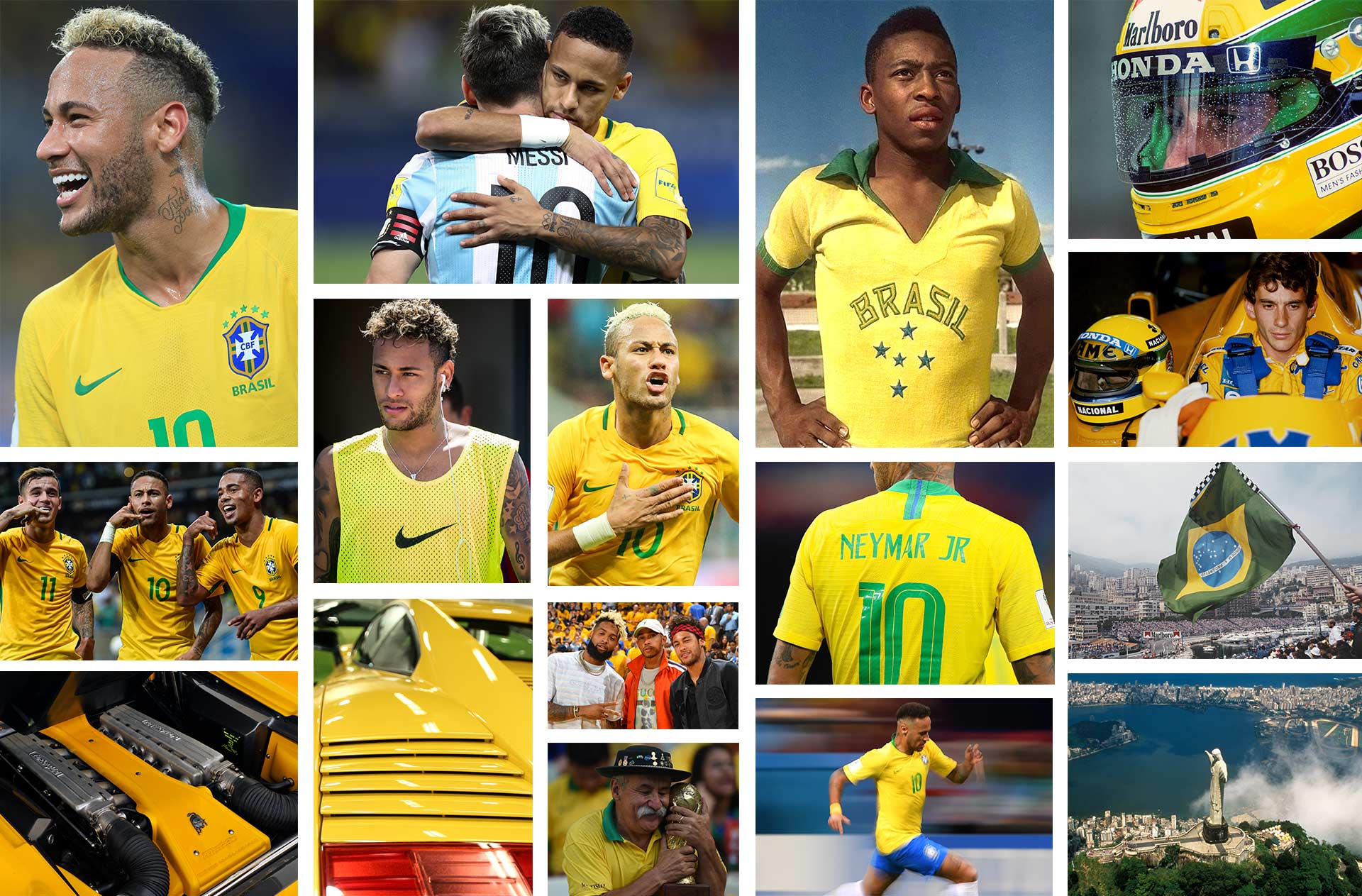
The initial art direction for the Neymar mural emerged from a moodboarding process that treated Brazilian visual culture as the core storytelling language. We gathered references of Neymar in the Seleção’s canary yellow, archival imagery of Pelé and the 1970 squad, street football in favelas, and the choreography of goal celebrations that embody the improvisational spirit of joga bonito. The board layered national symbols and textures such as the green, gold, and blue of the flag, the curvature of Rio’s coastline, the open-armed silhouette of Christ the Redeemer, and the graphic rhythm of Brazilian typography and jersey numerals. Neymar’s evolving hairstyles, tattoos, and expressive gestures were studied as living surfaces of identity, mirroring Brazil’s fluid synthesis of sport, music, and street style. This research established a chromatic and symbolic framework rooted in joy, flair, and elasticity, creating a narrative foundation that could later translate seamlessly into an urban dialogue within Miami’s diasporic football culture. Joga bonito, with its emphasis on improvisation, rhythm, and expressive freedom, framed the visual language of the mural as a celebration of football not merely as competition but as a form of cultural performance and collective joy.
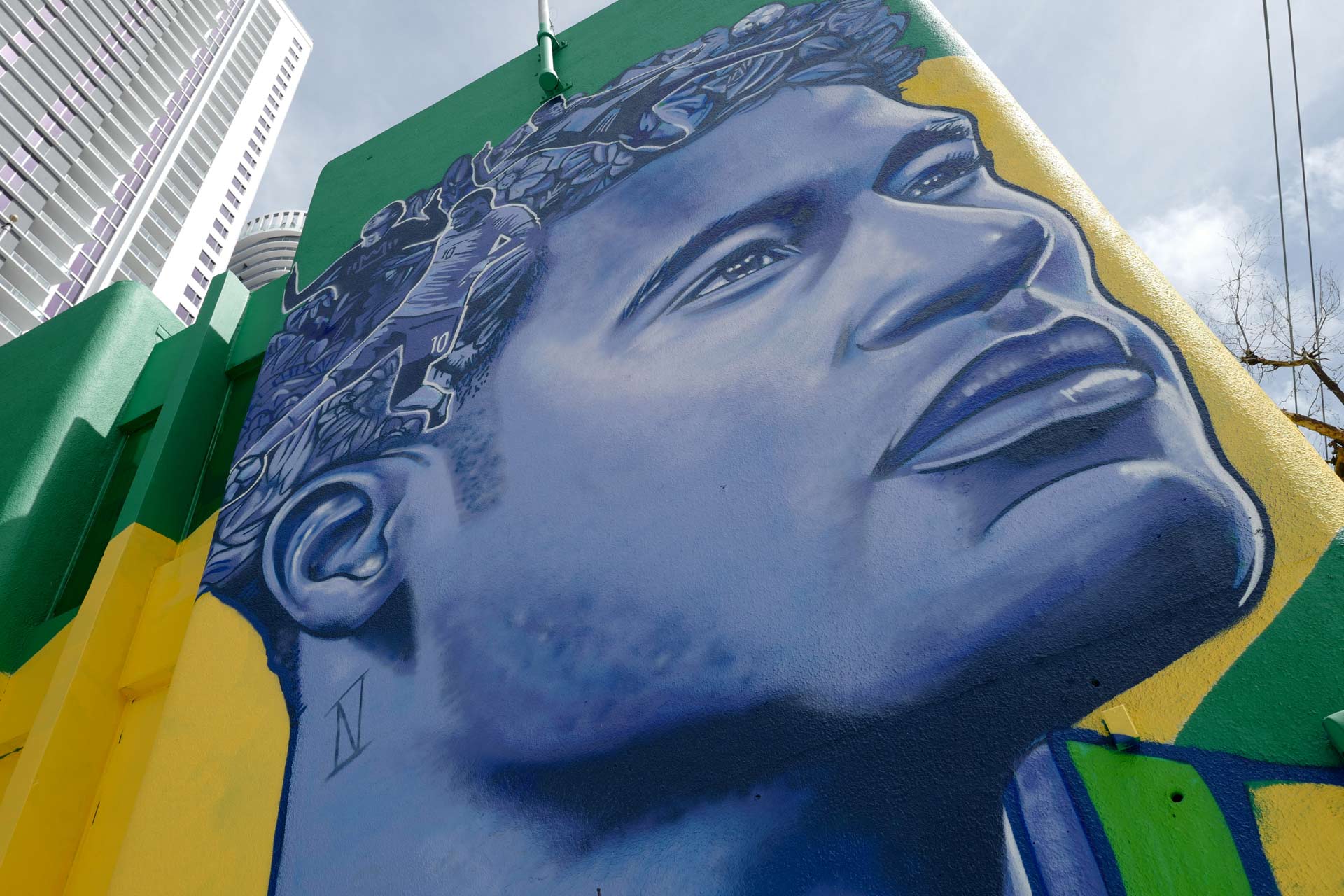
Unlike Salah’s Times Square portrait, which was elevated high above the street grid and gazed downward over the spectacle of Midtown, the Neymar mural in Miami was intentionally anchored at street level, embedded within the everyday circulation of the neighborhood. Positioned on a prominent corner in Brickell, Neymar does not loom from a distant height. He rises from within the community, his upward gaze aligning with the vertical momentum of Miami’s skyline and the city’s emergent football culture. This compositional choice reframed monumentality. Rather than a remote icon presiding over the crowd, Neymar becomes a giant of the neighborhood, a larger than life presence that pedestrians encounter at eye level before stepping back to absorb his full scale. The effect is both aspirational and intimate. His figure mirrors the spiritual and civic symbolism of Christ the Redeemer overlooking Rio, yet here that sense of protective grandeur is translated onto Miami’s streets, suggesting a city in ascent, buoyed by diaspora, devotion, and the global game, aka Joga Bonito.

Along with this, we also needed to ensure that this was all packed up properly on social and broken into bite sized pieces for our various sub brand audiences to consume. Finally, I was also working closely with Will Lievenberg on our marketing teams to ensure we could drive fans back to our social profiles to build a return on the investment, and then to see if we could package and pilot this concept in future branded content opportunities. The world cup allowed for us to use the editorial calendar to pilot concepts that could become repeatable vehicles. Finding ways to leverage existing social audiences like our Snapchat Discover portal, which drove over 12 million views to the articles on the launch day of the story, or earned media coverage that could be amplified and retweeted on our social accounts from both fans and media alike using the hashtag #LargerThanLife became signifiers of the impact of this project. The key was making an impact in a city where football was taking root as a major influence.
.jpg)
Miami was a deliberate canvas. Few American cities embody football’s global circuitry as vividly, with its Brazilian, Caribbean, and broader Latin diasporas converging in shared rituals around the sport. Installing Neymar here activated an existing emotional infrastructure. Passersby shouted national allegiances, debated rivalries, and documented the work in real time, effectively turning the mural into a participatory media node. The hashtag activation extended this engagement, transforming organic street-level reactions into measurable digital reach and user-generated content that propagated the campaign far beyond its physical footprint. By using hair as the unifying visual language across the trilogy, the campaign achieved both cohesion and cultural specificity. Each portrait remained deeply rooted in its national and personal context while contributing to a shared system that audiences could intuitively read. This approach elevated the murals beyond likeness into semiotic storytelling, where style, symbolism, and athletic identity converged. This energy was the core of this entire creative project and what spurred the entire team forward as we dealt with rainy days and delays throughout the process.
When you think about an American city like Miami, you think about the color, the energy, the deep South American roots and the energy that showcases itself in everything from the coffee to the music. Neymar has a history with Miami, having played exhibition matches here over the years with both Brazil and former club Barcelona. He has taken in a Miami Heat game more than once, partied with Drake at the Versace Mansion, and appeared at the Nike Miami store. The timing further amplified this resonance. The U.S. final of Neymar’s 61-nation Neymar Jr’s Five tournament was taking place that same weekend at Wynwood Marketplace, turning Miami into a live node within Neymar’s global grassroots ecosystem. This proximity allowed the mural to function as both a symbolic beacon and a physical waypoint for players and fans participating in the tournament. The pathway from Wynwood’s street art corridors to Brickell’s skyline created an informal pilgrimage route, linking amateur aspiration with professional mythology. For emerging players, the possibility of advancing to Santos, Brazil, to meet Neymar and compete in the international finals transformed the campaign from passive spectacle into an aspirational narrative with tangible stakes.
.jpg)
Miami was not a neutral backdrop. It was a strategic and culturally precise choice rooted in South Florida’s dense Brazilian and broader South American diasporas, where football is not a pastime but a shared social language. By situating Neymar in Brickell, the campaign tapped into an existing emotional infrastructure. Here, national pride, club loyalties, and transnational identity converge daily in cafés, barbershops, and public plazas. The mural did not introduce Neymar to Miami. It acknowledged a relationship that already existed and elevated it to civic scale, transforming the cityscape into a mirror of the community’s cultural DNA. By embedding his likeness into Miami’s built environment, the mural materialized that relationship, signaling that global superstars are not abstract figures but participants in the cultural life of the city. This authenticity strengthened the campaign’s credibility, positioning the work not as imported advertising but as a culturally literate tribute that honored Miami’s role within football’s global circuitry, especially with inter miami and stars like Messi and Suarez and Beckham not far behind after this grassroots moment.

Bleacher Report’s strategic objective was clear. Humanize global football stars for an American audience by embedding their stories into cities that reflect their cultural essence. Miami’s vibrancy, South American influence, and chromatic intensity made it an organic analogue for Neymar’s persona, while the mural itself served as a high-impact touchpoint within a larger ecosystem that included long-form interviews, social amplification, and Champions League storytelling ambitions. The 10,000-square-foot image of the Brazilian maestro took us three days to complete and on his next trip to the city for a Red Bull footy tournament, Neymar actually had a chance to check it out when we spoke with him about his tattoo journey, an opportunity that was brokered thanks to this Larger Than Life project and became a big piece in our Champions League coverage for the next season which Turner had rights to. The larger image ofNeymar and portrait itself was completed in three days, supported by an additional crew that established the expansive flag backdrop, ensuring color fidelity and structural consistency across the massive surface area prior to us even being there so when you really look at all the work and storytelling, this project really extended across months.
Operationally, the execution required tight orchestration across production timelines, municipal coordination, and on-site logistics. My role involved maintaining visual integrity across scale, verifying that typographic marks, tonal gradients, and compositional anchors held up from multiple vantage points. This attention to detail ensured the mural remained legible and impactful whether viewed from a passing vehicle, a nearby balcony, or a smartphone camera. In this way, the mural operated at the intersection of place, timing, and identity. It leveraged demographic insight, event adjacency, and celebrity affinity to create a moment that felt inevitable rather than imposed. The result was a piece of public art that resonated as both celebration and affirmation, reinforcing Miami’s status as a hemispheric capital of football culture while extending Neymar’s mythology into the everyday lives of the communities that revere him most.

The public response to the Neymar mural underscored Miami’s deep fluency in global football culture and validated the campaign’s premise that the city would not passively observe the work but actively engage with it. Passersby stopped to photograph the installation, debate allegiances, and share reactions in real time, transforming the site into a living forum of fandom. A group of German tourists playfully invoked Brazil’s 7–1 defeat in the 2014 World Cup semifinals, a reminder that football memory is collective, transnational, and enduring. Even a fleeting production error became evidence of the city’s attentiveness. When the “y” was briefly omitted from Neymar’s name in the #LargerThanLife title, pedestrians and drivers immediately called it out from sidewalks and car windows, a spontaneous act of communal proofreading that revealed both local pride and cultural literacy. The scale and location allowed the mural to intercept multiple flows of urban movement, from highway traffic to mall footfall, maximizing impressions while preserving the intimacy of street-level interaction. What emerged was not simply a static portrait but a participatory cultural moment, where civic space, global sport, and community voice converged to animate the campaign’s central thesis: that football’s mythology lives most vividly in the people who recognize themselves within it.
.jpg)
In terms of media coverage and local impact, Brazilian media framed the Miami mural as more than a portrait. It was a symbolic substitution in which Neymar’s face replaced the central globe of the Brazilian flag, visually suggesting that he embodies the nation itself. Set against the diamond form of the flag, the composition positioned him as both individual and collective identity, a figure carrying the weight of expectation, pride, and global visibility. The choice of a focused expression reinforced this narrative, emphasizing the mental discipline required to perform under immense pressure while representing Brazil on the world stage. In this reading, the mural did not merely celebrate a footballer. It translated national mythology into a single, concentrated gaze, allowing Miami’s streets to momentarily hold the image of Brazil’s aspirations.
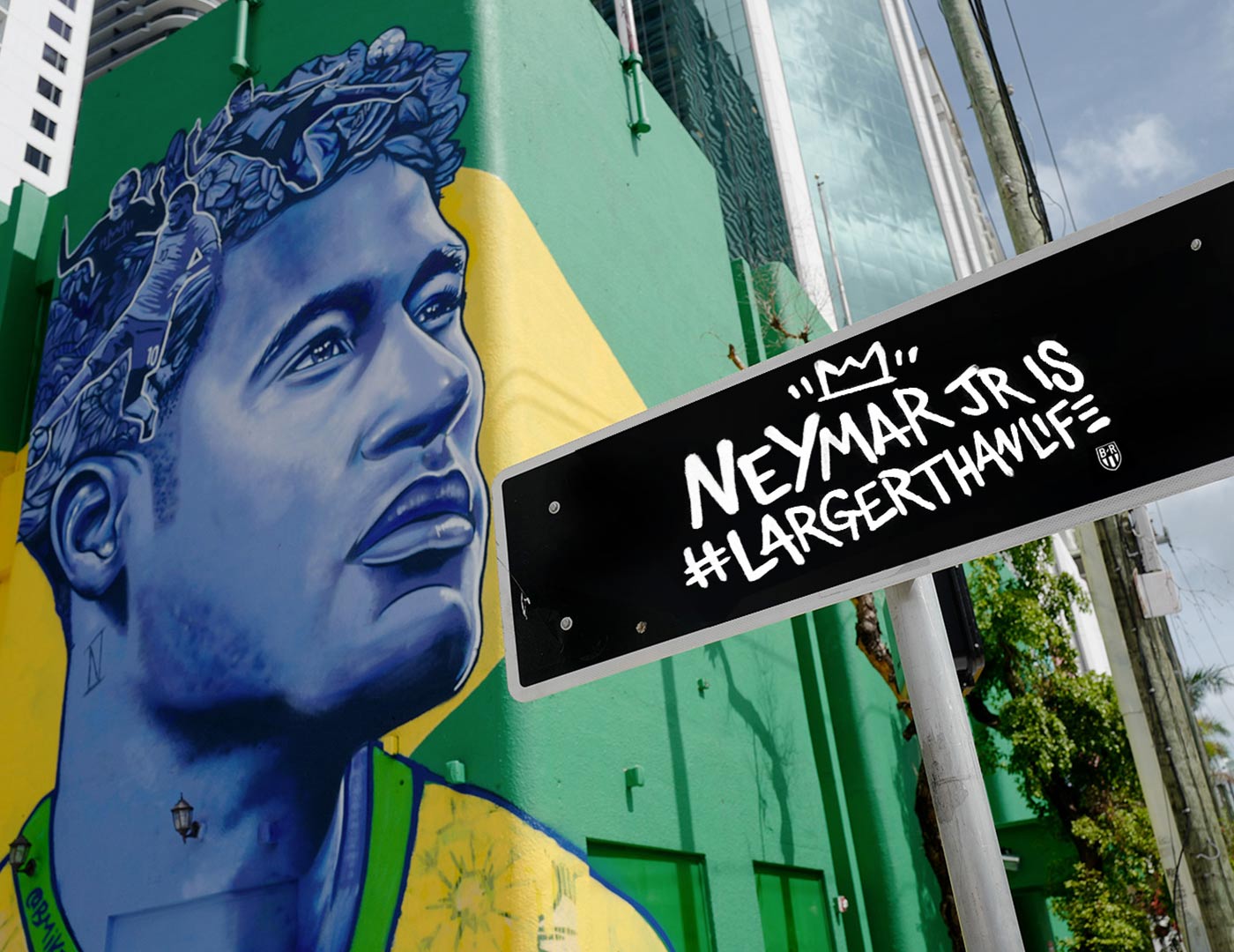
Ultimately, the Neymar mural demonstrated how public art can operate as a high-impact storytelling platform within integrated brand ecosystems. It translated Neymar’s global mythology into a localized, experiential encounter while reinforcing Bleacher Report’s positioning at the intersection of sport, culture, and street-level authenticity. More than a tribute to a footballer, the installation became a living artifact of World Cup fervor in Miami, capturing the emotional charge of the tournament and embedding it into the city’s visual memory and giving the neghborhood a rallying cry and more of a visual identity.
.jpg)
In Miami, the Neymar mural transformed a commercial corner into a civic stage where global football culture could be rehearsed in public view. The work harnessed the city’s chromatic intensity, diasporic energy, and porous relationship between street life and spectacle, allowing Neymar’s likeness to operate less as decoration and more as urban choreography. Pedestrians flowed around the wall like players finding space, conversations bent toward the image, and the corner itself began to function as an informal plaza animated by the ethos of joga bonito. Here, soccer was not confined to stadiums or screens. It was embedded in gesture, style, and shared attention, revealing how public art can recalibrate a square’s emotional temperature and turn everyday movement into a collective cultural performance.


The final player we landed on to represent the next generation of stars taking the world cup by storm was none other than Manchester United and French star Paul Pogba. Since the last World Cup, Pogba became known internationally for his celebrations—for capping off goals with powerful, joyful dabs, each of his long arms jutting out over his head in quick succession. This joyful energy and enthusiasm for the game has made him an icon amongst Gen-Z as videos of his dances go viral on TikTok all the time. We tapped in Amos Barshad to put together a story about his rise to fame while we headed down to New Orleans by the French Quarter to bring his image to life. During the interview with Pogba, he mentioned a nugget that I really think encapsulates the ethos of this entire project quite well in terms of the intersection between art and sport;

Football and art have always shared a common language of place, identity, and collective emotion. From murals that immortalize local heroes on concrete walls to hand-painted tifos that transform stadiums into living canvases, the sport invites visual expression in a way few cultural forces can. Public art tied to football democratizes creativity, moving it from galleries into streets where fans live and gather, allowing communities to see themselves reflected in color and form. These works do more than decorate neighborhoods. They narrate migration stories, celebrate resilience, and turn club allegiance into civic pride, reinforcing the idea that football is not only a game but a shared cultural memory etched into the urban landscape. What makes the intersection so powerful is the emotional immediacy both mediums demand. A goal, like a brushstroke, captures a fleeting moment and freezes it into something permanent. Artists borrow the energy of the pitch, the choreography of bodies in motion, the symbolism of crests and kits, and translate them into visuals that outlast the final whistle. In return, football absorbs artistic influence through kit design, typography, stadium graphics, and fan-made iconography, creating a feedback loop between sport and creative expression. At its best, this intersection turns cities into open-air museums of fandom, where allegiance is not only worn but painted, pasted, and projected for the world to see.
We did New Orleans for Pogba because New Orleans is a city of creativity, it’s a French city, and it’s a city rooted in culture and fun just like Pogba who really embodies not just that energy but also who much of our audience is. The building that we ended up painting in the mural actually ended up housing thousands of barrels of French wine, so it felt quite appropriate to choose that for our location. For our creative team it was key that the murals were impactful and in spots that would highlight the folks living around it, we wanted to make sure that beyond being visible, the portraits were in locations that reflected what the players represent and what they have accomplished both on and off the pitch because these parallels really are at the heart of this project.
Another important factor in this project was how it positioned BR Football as a new player in the football media space in comparison to it's UK based counterparts. Competing with the likes of Sky Sports and the BBC meant a new type of content format that they wouldn't be as ready to touch. The way that the European media has covered soccer for so long, the access isn’t there. They get a couple minutes after a match, with the players in front of a wall full of advertisers and they get very canned bites and very bland answers. There’s not a lot about personalities or stories about clubs that you really get to see, we’re not just trying to break the mold, but destroy it. Thanks to the creative team and BMike, and a willingness to push the envelope, we were able to use creative collaboration and something as simple as a paintbrush and spray can to innovate storytelling and disrupt media companies entrenched in the space for decades.
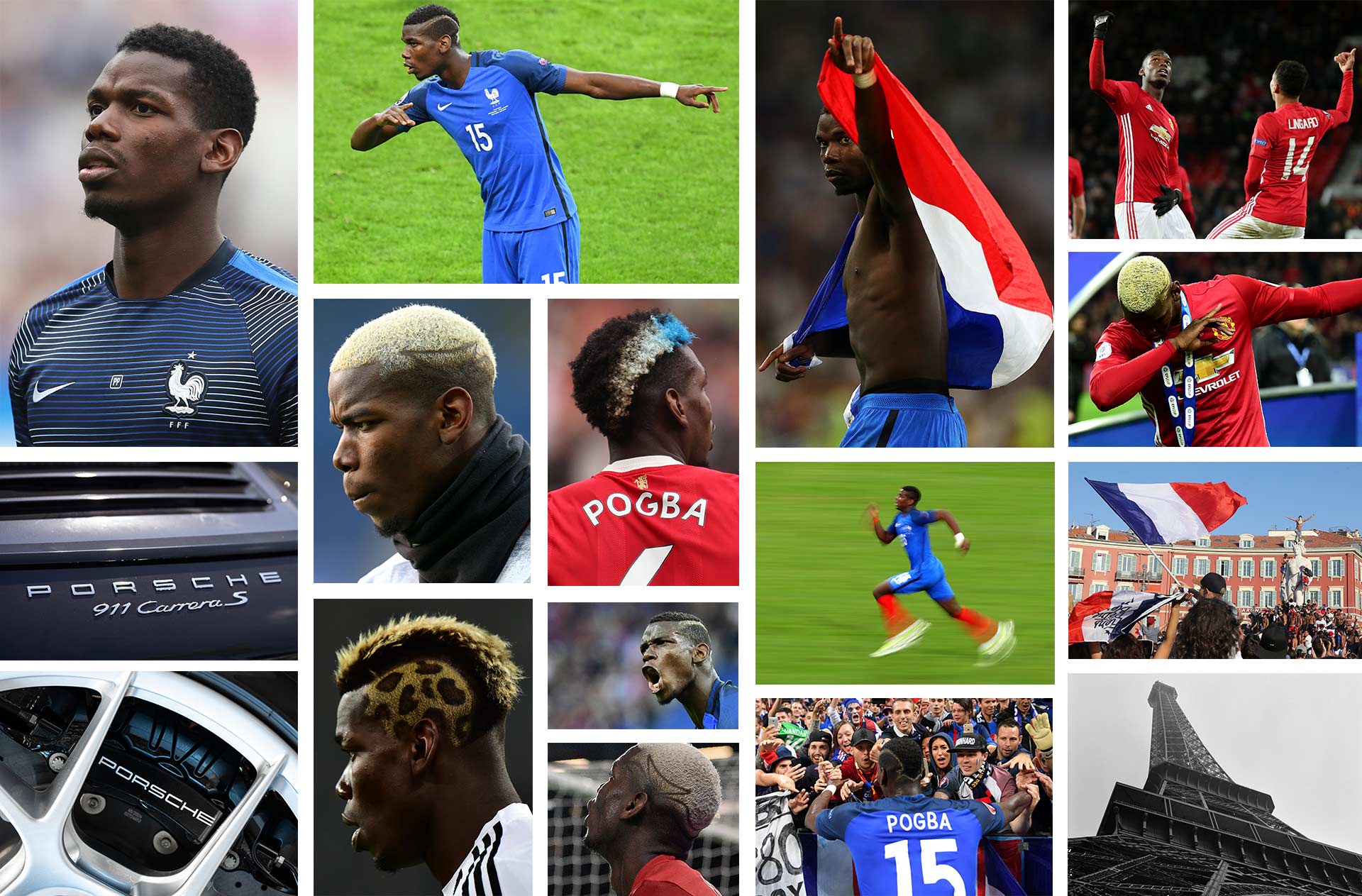
The initial art direction for the Pogba mural was anchored in a moodboarding process that treated him not as a single identity but as a convergence of geographies, eras, and cultural codes. We assembled imagery spanning the French tricolore, Parisian civic landmarks, and the iconography of national triumph alongside references from his upbringing in the Parisian banlieues, where football operates as both social mobility and creative expression.
.jpg)
His presence in the France kit provided a chromatic backbone of deep blues, stark whites, and saturated reds, while Manchester United references introduced a secondary palette of bold crimson and industrial grit that echoed the club’s working-class mythology. We studied his kinetic poses, long-limbed stride, and the theatricality of his celebrations to capture a sense of motion that could translate into static form without losing energy. His hairstyles functioned as narrative architecture: graphic dye patterns, leopard spots, lightning motifs, and platinum fades that signaled reinvention, defiance, and play. These were treated not as embellishments but as coded surfaces through which identity, diaspora, and personal mythology could be read. The resulting direction framed Pogba as a cultural polyglot whose swagger collapses boundaries between athlete, artist, and icon, allowing the mural to operate as both portrait and manifesto within the public square.

Pogba rounded out our trio of players whose hairstyles became the canvas for our storytelling as the fleur-de-lis native to both France and New Orleans blooms across the bottom of the sidewalk, really representing hope for a city and a neighborhood that really needs it in the years following it's rebuilding post Katrina. A chance to serve the community and beautify the neighborhood with artwork in BMike's hometown was something that felt like a great way to tie a bow around this project in the most appropriate way. Paul is one of the most dynamic players in the game today and his improv on the field and the rhythm and swagger with which he plays is reminiscent of the great freestyle Jazz and Blues musician's that fill the streets of the French Quarter every week.

Having to paint massive murals has its own inherent challenges, but having to do them in three different cities, with three different players, and still find a way to connect them all was the most exciting part of the project. That was the one thing that visually connected all three of them. Their hair was almost telling a story. Whether it was the sweat in their hair that showed how hard they were working or just the hairstyles themselves, all of their hair had a lot of character. In the process of trying to figure out how to connect all three of them, but also leave room for the images to be simple but have a lot of information the hair made it all possible. It is a unique facet of all three stars and became a canvas for us as well to bring to life for this project and beyond.
The Pogba mural in New Orleans was conceived as a dialogue between movement and music, translating his improvisational style on the pitch into a visual rhythm that echoed the city’s sonic heritage. Rather than presenting him as a static hero, the composition emphasized flow, syncopation, and swagger, drawing parallels between Pogba’s midfield creativity and the improvisational traditions of jazz and second-line parades. The mural’s visual cadence invited viewers to feel the work as much as see it, mirroring how New Orleans itself communicates through rhythm, procession, and communal expression. A single detail like the PP Rolls-Royce–inspired earring, glinting with the same ethos of bespoke luxury and personal branding, reinforced his commitment to treating style as an extension of authorship, where even the smallest adornment signaled craftsmanship, status, and a refusal to separate athlete from icon.

Paul Pogba’s hairstyles have long functioned as a living archive of his career, each cut and color shift marking moments of form, allegiance, and self-expression. From the Juventus years with sharp etched lines and gold accents to tricolor tributes to France, leopard prints, lightning bolts, and club crests shaved into fades, his hair became a broadcast surface as recognizable as his passing range. In the New Orleans mural, this visual language translated into the central storytelling device, where pattern, contrast, and symbolic motifs echoed the rhythm of his on-field celebrations. His iconic dab was a kinetic signature, a punctuation mark that mirrored the angularity and motion embedded in his hairstyles. Together, the hair and the gesture formed a unified semiotic system, expressing joy, confidence, and cultural hybridity while reinforcing Pogba’s status as both athlete and auteur of his own image.
Pogba’s influence extends well beyond the pitch, where his fashion and personal style operate as deliberate expressions of identity, confidence, and cultural hybridity. Known for pairing tailored European silhouettes with streetwear sensibilities, bold color blocking, and statement accessories, he moves fluidly between luxury ateliers and youth culture, collapsing traditional boundaries between athlete and tastemaker. His ever-evolving hairstyles, custom pieces, and fearless experimentation function as visual signatures that mirror his playing style. Improvisational, expressive, and unapologetically individual. In New Orleans, a city that celebrates adornment, pageantry, and self-presentation from Mardi Gras regalia to second-line suits, Pogba’s aesthetic language felt native rather than imported, reinforcing the mural’s deeper thesis that style, like football, is a global dialect spoken through local flair.

Unlike the vertical spectacle of Times Square or the skyline-facing posture of Miami’s Brickell corridor, the Pogba mural along the Lafitte Greenway meets the public at human scale, embedded within the daily rhythms of cyclists, families, and neighborhood life. Positioned adjacent to a historic transit corridor now reimagined as a civic artery, the work signals football’s grassroots ascent in the American South, where the sport grows not through spectacle alone but through community adoption and shared public space. Pogba’s presence at near-ground level transforms monumentality into accessibility. He is not a distant idol but a cultural participant, his image woven into the lived environment of a city rebuilding, remixing, and reasserting its global identity. In this context, the mural reads as both prophecy and proof: football culture is not descending from above but rising from the streets, carried by diaspora, youth play, and the improvisational spirit that New Orleans and the game itself hold in common.
.jpg)
Placing Pogba in New Orleans also foregrounded the shared French lineage between player and city, allowing the mural to operate as a transatlantic bridge. Subtle references to the fleur-de-lis and ornamental motifs rooted in French design traditions were integrated into the composition, reinforcing cultural continuity without slipping into pastiche. This layering positioned Pogba not only as a global sports figure but as a connective thread linking histories of migration, language, and identity. The mural thus became a site where heritage was not frozen in time but reinterpreted through contemporary sport and street culture.

Controversy has long trailed Pogba, often less about performance than about visibility. His dyed hair, social media presence, and celebratory dances have been framed by critics as distractions, revealing a persistent discomfort in European football with expressions of Black joy and individuality. Yet in 2018, these very traits became assets in a tournament defined by youth, speed, and personality. Pogba’s swagger was not indulgence but psychological leverage, projecting confidence that destabilized opponents and energized teammates. His celebrations, choreographed and communal, echoed the call-and-response traditions of diasporic performance, turning goals into rituals of collective affirmation rather than solitary triumph.
.jpg)
The location along the Lafitte Greenway added another dimension, situating the work within a corridor of renewal and community life. Unlike a purely commercial district, this setting invited slower engagement. Cyclists, families, and neighborhood residents encountered the mural in moments of leisure rather than transit, allowing it to function as a point of reflection and pride. In a city still narrating its recovery and resilience, Pogba’s image, confident yet celebratory, resonated as a symbol of forward momentum and collective endurance. In New Orleans, a city shaped by colonial entanglements, diasporic exchange, and improvisational culture, Pogba’s story resonated beyond football. Born in France to Guinean parents, fluent in multiple cultural registers, and comfortable navigating global celebrity, he embodies the layered identities that define contemporary France. The mural’s placement in a historically Creole environment created a dialogue between French heritage and Afro-Atlantic cultural flows, mirroring Pogba’s own transnational biography. New Orleans is a city where hybridity is not anomaly but foundation, and Pogba’s image functioned as a visual thesis on the generative power of cultural convergence rather than assimilation.

Paul Pogba’s goal scoring has never been about volume alone but about timing, authorship, and emotional weight. He has a gift for arriving at decisive moments with strikes that feel composed under pressure, whether a long-range effort that bends through traffic or a late run into the box that shifts the narrative of a match. His performances during the 2018 World Cup, culminating in a goal in the final, crystallized his resilience after years of scrutiny over form, transfers, and expectations at club level. Rather than retreat from criticism, Pogba leaned into responsibility, adapting his role to balance defensive discipline with attacking instinct. That elasticity, the ability to absorb pressure and still deliver moments of clarity, mirrors his broader career arc: a player shaped as much by adversity and public debate as by raw talent, who continues to assert himself on the game’s biggest stages with composure and conviction.

What ended up being an awesome culmination of the project was the fact that France and Pogba ended up bringing home the hardware in epic and commanding fashion, cementing this squad and Paul into the history books in an extremely unique way. One of the most polarizing players that we pegged to redefine the next generation of football alongside the likes of Salah and Neymar showed why they truly are Larger than Life. This project really showcased what a multi pronged and integrated campaign for a major tentpole event could look like, and I was able to be involved in multiple aspects in bringing it to fruition.
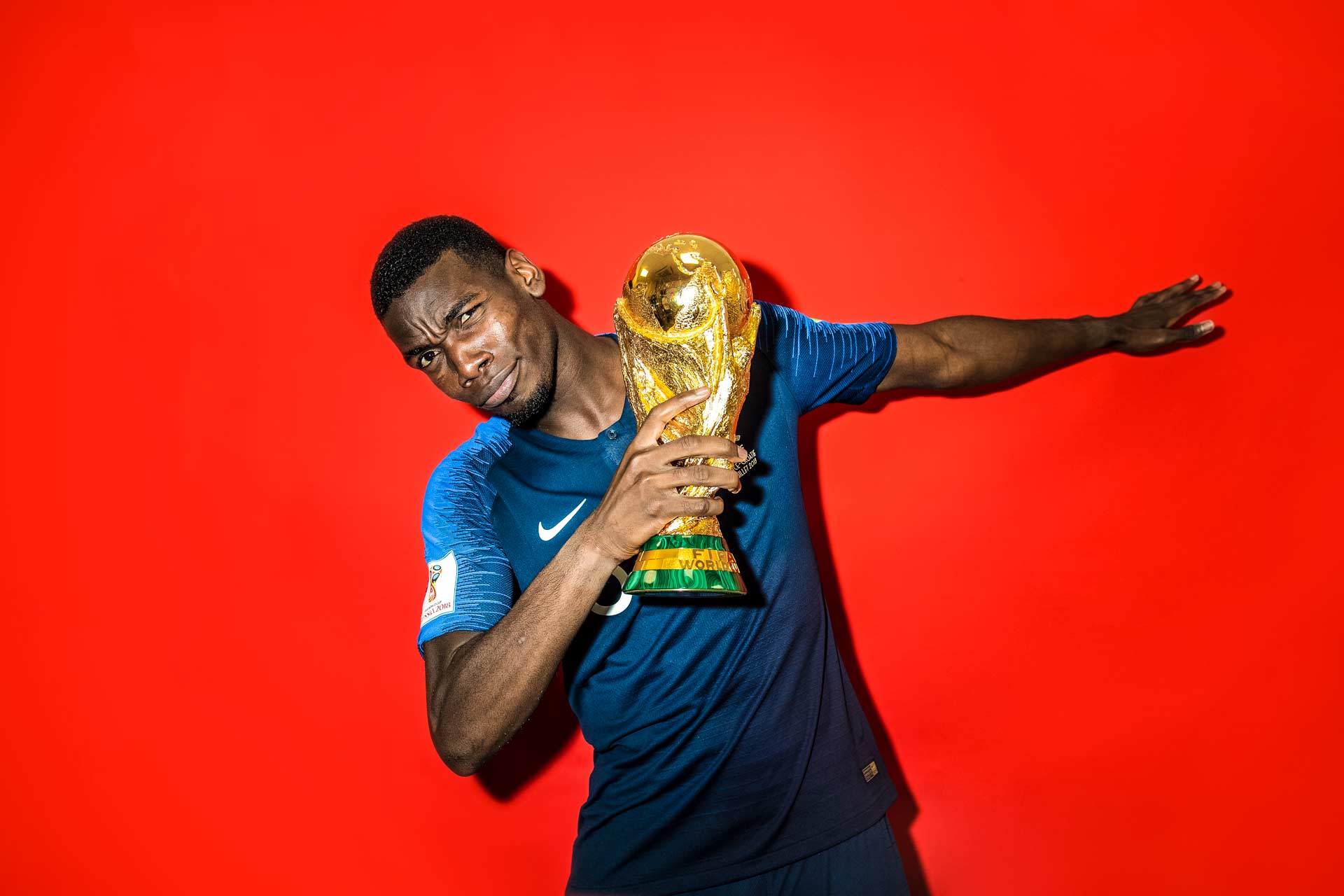
Paul Pogba’s presence in the 2018 World Cup represented a reconciliation between spectacle and discipline. Long critiqued in European media for inconsistency and perceived excess, Pogba arrived in Russia with a recalibrated role under Didier Deschamps, operating as a deep-lying orchestrator rather than a roaming showman. This positional restraint allowed him to dictate tempo, break lines with progressive passing, and provide structural balance alongside N’Golo Kanté’s defensive engine. His goal in the final against Croatia, a composed two-touch strike after a deflection, symbolized this evolution. It was not flamboyant but inevitable, the punctuation mark on a tournament in which Pogba transformed from lightning rod to linchpin, anchoring a French side that blended athleticism, tactical intelligence, and multicultural identity.
.jpeg)
With Paul and France taking home the coveted trophy it was also a reminder that our work was not done, that this Larger than Life project was really just the coming out party for BR Football much like it was for these young superstars and that the future of our content calendar looked a lot more promising once this proof of concept project was out the door. This would really set the stage for a number of our future partnerships in growing the brand and driving a 40% increase in yearly revenue for the company at large as well. This was really a jumping off point for a bunch of sponsored content and editorial content we would pursue with the likes of Adidas, Puma, Chase and more.
His playing style in that tournament echoed the musical logic of New Orleans itself. Like a jazz ensemble balancing improvisation with structure, Pogba modulated between disciplined positioning and moments of expressive release. He could recycle possession with metronomic calm, then suddenly switch the point of attack with a diagonal pass that felt like a brass flourish cutting through humid air. This duality, restraint and flourish, system and sou, paralleled the city’s own rhythms, where second lines weave through rigid grids and brass bands transform streets into stages. In this context, the mural did not merely depict Pogba. It translated his footballing language into the spatial and cultural grammar of New Orleans, aligning athletic movement with the city’s enduring choreography of resilience and celebration.

Taken together, the three murals formed more than a campaign. They mapped a cultural shift already underway, tracing how global football was taking root in American streets through art, diaspora, and shared public space. From Salah’s iconography in the skyline to Neymar’s presence within the neighborhood and Pogba’s grounding along a civic corridor, each installation translated the world’s game into a distinctly local experience. The project demonstrated that football’s expansion in the United States would not be driven by stadiums alone but by the quieter accumulation of symbols, rituals, and community touchpoints that make a sport feel native. In turning blank walls into sites of identity and gathering, the work helped recast American cities as participants in football’s global narrative rather than spectators at its edge.

A great example of how this type of editorial content drove revenue was in subsequent branded content deals that Beckley Mason and our Playmaker team were able to broker with our BR Football presence like our world cup mural integration with Puma. The goal was to create a unique hand-painted advertising mural in the heart of Shoreditch, featuring some of Puma, and the world’s, biggest stars at this summer’s tournament including the likes of Antoine Griezmann, Sergio Aguero and Romelu Lukaku. Rather than just create a mural crammed with this galaxy of footballing superstars we were tasked with creating a mural that would help keep the public engaged throughout the tournament whilst also helping to create content for Bleacher Report’s many social channels.
In partnership with the GraffitiLife UK team we decided the best way to engage the thousands of people who pass the wall every day was to design a piece that could be updated regularly to reflect the many stories coming out of the tournament. With street art campaigns being shared readily online and often going viral, this kind of ‘evolving’ billboard is a great way to continue to engage a local demographic over a longer period and help bridge the gap between OOH and social media. The centre of the wall has an image of a mobile phone, which our graffiti artists have been updating regularly. Our team has had to respond quickly in updating the advertising mural so that we could ensure the content remained relevant! By proving the feasibility of the vehicle, the editorial element became somewhat of a pilot project that the branded content team could take to market as a sort of proof of concept. With analytics to back up our engagement we were able to broker strategic partnerships with companies like Puma and Adidas to help supplement these type of content opportunities and fuel our business goals in terms of revenue growth.
Ultimately, the #LargerThanLife murals reframed football as culturally proximate rather than foreign within the American landscape. By embedding global athletes into the visual and social fabric of U.S. cities, the campaign collapsed the distance between local identity and international sport. It demonstrated that the future of sports storytelling lies in experiences audiences can inhabit, interpret, and claim as their own, where media, community, and cultural memory converge in the shared spaces of everyday life.
Key Collaborators: Ryan O'Leary, Matt Sullivan, Will Lievenberg, Duane Jackson, Brandon Odums, Sean Swaby, Clint Smith, Chris Perez, Amos Rashad, Hanif Abdurraqib, Sam Melvin, Sean Fay, Mark Bollons, GraffitiLife UK, Khammy Vilaysing, Mark Phillips, Amøbe, Matheus Masello, Barrilete Cósmico, Steven Kelly, Anton Alfy, Pete Schwedel
Tools: Photoshop, After Effects, Final Cut Pro
Deliverables: Mural Activations, Video Features, Immersive Articles, Social Packaging
Category: Creative Direction, Motion Graphics, Producing, Directing, Design, Writing, Experiential